Monday, 12 November 2012

Ballroom Blitz

Doctor Who
The Empty Child and The Doctor Dances
Series One, Episodes Nine and Ten


Doctor Who is one of those shows that could, in theory, be anything.  It can be funny, serious, futuristic, medieval... you name it.  But one thing has been consistent through the years: Doctor Who is scary.

"Act terrifying. For God's sake, swim or something."
Fans still talk in hushed tones about The One With The Yeti In The Underground, or The One With The Giant Maggots.  The One With The Sea Devils left me terrified of going to the beach for quite some time.  And now we have The One With The Gas Mask Zombies.  How good are they?  Run, hide, and stay hidden.  They are terrifying.

What's so scary about them?  Well, gas masks are scary just to look at.  But then there's the utter mindlessness of them, and the fear of losing your own mind.  And fear of disease: one touch and you're like them.  Their leader, the Empty Child himself, is creepy as hell.  As innumerable horror movies have shown, it's surprisingly easy to scare people with children acting just a little bit left of normal, and all that "Muuuuummy" stuff is easily spinechilling.  The best bit, though?  The change.  Nothing can stop it.  The victim's marbles slowly disappear, they start to talk like a six-year-old until they choke, something forces its way up their throat, flesh stretches and bones begin to crunch...  Ohgodohgodohgod.  Sleep well, kiddiewinks!

As a backdrop, we have the London Blitz, where a midnight stroll could get you killed even without the monsters.  It's one of the most fascinating periods in British history, as terrifying as it is weirdly halcyon, and Steven Moffat captures both without getting too wrapped up in either.  There's still a hint of saccharine, particularly in the Doctor's history-fudging "lion vs. mouse" speech, that boils the Second World War down to a cutesy David and Goliath grudge match between Britain and Germany.  (It's not quite that simple, Doc.)  But the plight of Nancy, a scrawny girl looking after a rabble of evacuees, is a poignant and very real one.  Florence Hoath is fantastic, bouncing off Christopher Eccleston with the effortless spark of a travel-weary Doctor Who companion.  It's a shame we won't see her again; the character's steely determination feels hard won and, again, very genuine.


Can we keep her? And Harriet Jones, while you're at it.
Then there's Dr Constantine, pottering around an empty hospital so he can look after the gas mask creatures, despite an obvious danger to himself.  A knockout guest performance from Richard Wilson, he packs so much dignified emotion into his brief scenes that when the inevitable occurs, and brutally, it carries enormous weight.

Good thing Christopher Eccleston's on fine form, or you'd fail to notice him next to these two.  His reaction to Constantine's fate is a moment of silent brilliance, and his empathy with his and Nancy's family losses speaks volumes about the character's history.  Then there's his behaviour with the Child, hopping from genuine sympathy (because it's just a kid) to no-nonsense cynicism (because it's harming people).  Not for the first time, it's a Doctorfest, and Eccleston does it brilliantly.  Definite kudos to Steven Moffat, a lifelong Who fan (and the guy behind the brilliant Comic Relief spoof, The Curse Of Fatal Death), who clearly has a great handle on the character.  By this point, so has Eccleston.

Of course, Rose needs something to do as well, so we have Captain Jack Harkness (ahem), a flashy futuristic con-man who sweeps her off her feet all over again.  It's a little bit rich having her tire of the Doctor's not-especially-sci-fi kookiness already, leaving Jack free to dazzle her with magic nanobots and an invisible spaceship.  Still, it's for a good cause.  Jack, the impossibly perfect anti-hero, is a lot of the things you might expect from a time-travelling adventurer, but don't get in the Doctor.  However, he's noticeably lacking (depending on the scene you're watching) the Doctor's conscience, forethought and common sense.  It's like what Russell T Davies tried to do for companions in Adam: someone getting the business of time travel utterly wrong.  This time, it (mostly) works.

Mind you, Jack's got a long way to go before he resembles a rounded character.  With his effortless tech skills, brilliant lying skills, pansexuality, memory loss, criminal ambition and noble quest for self-discovery and personal justice, he's more a shopping list than a person.  John Barrowman's charming and fun enough to make it work, certainly once he falls in line as part of the Doctor's entourage, but for now it's tough seeing past the forced corniness and finding anything at all underneath.  (I can't get too worked up about it knowing we'll get the same thing later, only much worse, in River Song.  By comparison, Jack is humble and downright likeable.  But that's future-episode-knowledge.  Spoilers!)

So how does this stack up against the previous two-parter?  The action seems more evenly paced than in Aliens Of London / World War III, and these two episodes have a marked difference in tone.  The Empty Child is dark, intriguing and terrifying.  The Doctor Dances is... well, take a look at that title.  Despite some brilliantly chilling Empty Childy goodness, and more of Nancy just being brilliant, things get decidedly fluffier as they go on.  Still really good, but going noticeably downhill, a bit.


The rivalry between the Doctor and Jack reaches a slightly crude nadir, as Moffat brandishes that cumbersome euphemism, "dancing" to distinguish and define them.  Eccleston seethes hilariously at this – a simple dismissive head shake and the way he says "He's not really a Captain, Rose" go a long way to repairing this Doctor's sense of humour – but the script can't quite let it go, flogging said euphemism until it whimpers.

"Are you my daddy?"
The effect this has on Rose, and come to think of it Rose's behaviour in general, is not exactly flattering.  Her affections dilly-dally rather too easily between the two men; it doesn't do wonders for her as a character.  What's with the alien-tech obsession, and the need for the Doctor to prove himself all of a sudden?  (You could see this as a consequence of finally meeting her dad in the previous episode.  Now the father-figure complex has worked itself out, she's open to a better offer.  But as there's no reference to this, it could just be inference on my part.  And if it is the case, it doesn't exactly tip the sympathy scales in her favour.  Perhaps Rose isn't the one who should be on the lookout for better offers...)

Soon enough Jack realises his place, and the penny finally drops.  His bargaining chip, an empty Chula warship he's put in the path of a Luftwaffe bomb, is really an ambulance full of nanogenes.  They're happily repairing people in the image of Nancy's little brother Jamie, only they're too stupid to tell the difference between gas masks and flesh.  Still, they're clever enough to install an intercom that lets him talk through anything with a speaker grille, so radios, typewriters and toy monkeys.  (I don't know either.)  They also let him command all the other empty people (gas-maskies?) in preparation for battle, because it's a battle ambulance, yet they defer to his childlike need for his mummy instead of doing any actual battling.  So, which is he: a tiny Chula warrior or a super-powered human child?  There's quite a bit of handwaving here, and it's a bit of a letdown finding out there is a rationale behind these creatures, but that it's just as mindless as they are.

All this talk of handwaving brings us neatly to the finale, when the other penny drops: Nancy is Jamie's mummy, not his sister.  The two embrace and, as the Doctor looks on rather gleefully, the nanogenes figure it out and repair everybody.  Probably intended as a calming answer to all that terror in the first episode, not to mention the cynicism that has come to define this Doctor, things end on the stickiest, literally cuddliest note possible.  It's so toothless, particularly as you realise the gask-maskies have at no point actually hurt anyone, it threatens to undermine how scary it all was in the first place.  Not the most satisfying way it could have gone, quite frankly.

Meanwhile, Jack teleports the bomb to his ship, where it can explode with just one casualty.  All very heroic, offsetting the guilt he must have been feeling for, oh, ten minutes or so, but given how little we know about Jack (besides the shopping list), it doesn't mean much emotionally.  No matter: before he can make his noble sacrifice effectively one-upping the Doctor, who needs Nancy to make the heroic choice that'll save everybody while he acts as middle-man – the Doctor rescues him, presumably winning that little contest once and for all, and dancing to celebrate.  The dancing's a tad cringeable, but it's a seriously lovely tracking shot from Jack's ship into the TARDIS, and it's cute seeing the TARDIS's answer to mood lighting.

The first episode's practically perfect: scary, clever, dazzling to look at and a riproaring good story.  It's stood up to a dozen rewatches over the years, and I still get chills from the best bits.  Part Two gets a little stuck in the Glenn Miller side of things, and before you know it you're using words like "cute" to describe something that started out as "terrifying".  This seems to imply that Doctor Who, a mad old show that can be anything, can be both.  We may have to agree to disagree on that one.

Friday, 2 November 2012

My Father, The Del-Boy

Doctor Who
Father's Day
Series One, Episode Eight


If you had a time machine, what would you do with it?  Doctor Who takes us to exotic times and places, but cool as it is seeing the past and the future, it's all pretty much just decoration.  The scenery changes, and we meet the occasional famous person, but the actual time travel bit rarely really matters.


Although at a push, it will make the Doctor change his jumper.
All of which leaves an elephant in the room.  We're only human, and there are things we'd want to change given half a chance.  In Father's Day, Rose finally plucks up the courage to visit her dad so she can be there for him when he dies.  She bottles it on her first go, and when she tries again, instinct takes over.  The consequences are disastrous, but it's hard to imagine yourself doing anything different in her position.  She's never met the man, this is her only chance, and she could save his life.  Wouldn't you?

There's just gobs of stuff going on here.  To start with, has Rose been planning it all along?  The Doctor thinks so, as it was his pointing out that "it also travels in time" that got her on board the TARDIS.  But Rose says otherwise, and I agree: as much as she'd love to meet her dad, she isn't quick to think up schemes that'll benefit her, or she'd have pulled an Adam (so to speak) before now.  Anyway, she does what she's supposed to the first time, which is more than most people would.  The rational bit of her brain just went (quite understandably) bye-bye when too much was asked of it.

The Doctor's furious, probably in no small part because it's his fault.  He's only too happy to act like a genie if it'll make Rose happy, and he knows a trip to see the fabled Pete Tyler will win him brownie points well into his next lifetime.  But the desire to keep her sweet overrides his common sense, which must surely be screaming No, don't do it!, especially when Rose asks for a double-dip.  And then she goes and disappoints him.  Just last week he shot Adam down in flames for abusing time, and used Rose as the shining example.  Now he's all with the eggy-face, and he doesn't like it one bit.


"All right, FINE, I'll go and fix Adam's head.
Point taken."
So you've got Rose disregarding the most important man in her life, laying bare the dad-shaped hole he was occupying all along; and the Doctor's tendency to show off leading to death and destruction all round, but his absolute need for Rose letting it run amok.  Eventually the Doctor's fury subsides (after he makes Rose apologise, then gives her a fatherly stroke, setting things back to the way he needs them to be), and he does what he can to keep Pete alive.  But it's a doomed effort.  Pete knows what needs to be done, and so do we: the car that kills him circles like a vulture.  It's not a question of what needs to happen, but whether the characters can go through with it.  With the Doctor gone, Pete's all Rose has, and he doesn't disappoint.  It's complex and satisfying as hell.

And all that before we even get onto how utterly, heartbreakingly good it is as a story.  Rose finally meets "the most fantastic man in the world" (Jackie's words, and oh, the coincidence that it should be fantastic), and quickly discovers the truth's been heavily Rose-tinted.  But even with the love goggles slipping, she's still drunk on daughterly affection; the moment where he takes his hand away from her cheek, and she can't not put it right back, is an absolute emotional knock-out.  Billie Piper shines here, and Sean Dingwall makes a believable go of her dimwit dad, who's got enough imagination to figure out who she is and what's really going on.

It's a stunning episode for Rose, whose flaws and faults finally seem endearing, rather than irritating.  And it's a dark, complex one for the Doctor, who can no longer avoid just how much he needs Rose, and needs her to think highly of him.  He's even willing to die to stay in her good books, once she's made things right and said sorry first.

It even makes time for smaller dollops of colour.  1987 makes a refreshing change from ancient history, and the moment the Doctor enters the completely hollow TARDIS prop is something you'd never expect to see.  Love it.  But... ye-eah, there are also things wrong with it.  Not dealbreakers, but annoying enough to spoil the mood a bit.

Take the plot.  Rose saves Pete, so giant time-bats appear to "sterilise the wound", i.e. eat everyone.  It's monsteriffic, a bit like Stephen King's Langoliers if they actually looked scary and not like Pac-Men.  But you've got to wonder why this has never happened before, why they're just eating the people, and also, what the hell, time-bats?

"Would that I could change time, my dear,
but alas... time-bats."
And speaking of elephants in the room, it's taken Doctor Who all of five episodes to change its entire stance on time travel from "Your cosy little world could be rewritten like that" to "There's a man alive in the world who wasn't alive before, the whole world's different because he's alive."  Is there such a thing as a Script Editor?  No one thought it was a bit silly having two episodes the same year that say the complete opposite?  This situation's got to be nothing compared to the historical clusterbomb of The Unquiet Dead.

On top of that, I'm not even certain what's going on here.  As well as Rose saving Pete's life, there's a time paradox: the previous Doctor and Rose vanish, presumably meaning she didn't then return to rescue PeteBut aside from them vanishing and an offhand reference to it being "a vulnerable point", nothing is made of this.  Which is it?  A paradox or a change in history?

Then there's all the incidental flotsam, like bits of different times poking through.  Bell's first ever phonecall, a Streets song... what the hell's all that about?  And for all the hoo-hah about not changing time, they actually do.  Pete's killer is no longer a hit-and-run, he now stays with him until the ambulance comes, and probably even meets Jackie.  His whole life's different for having made that effort.  Are we seriously going to put that down to semantics, when saving one man's life can destroy the world?

Deep breath.  It doesn't matter.  Yes, it's a shame that the continuity's horrendous and the plot's got holes you could fit your head through.  But it's about the emotions, not the details.  This isn't a free pass for the future, mind you, but this time the heart's in the right place, and that's enough.  In spite of everything, it's a classic.

Thursday, 1 November 2012

Who Hum

Doctor Who
The Long Game
Series One, Episode Seven


For a show with a twenty-six year back catalogue, Doctor Who spends little time wallowing in nostalgia.  That's a good thing.  Nonetheless, sometimes you get a whiff of the old days.  The Long Game feels like something from the late '80s: it's satirical, talky, a bit obvious.  No doubt about it, this is the weak link so far.  (A bit like late '80s Who in general.)


Above: nobody's favourite era.
Some of that's due to the setting.  Another futuristic space station, already?  And this is much less interesting than the last one.  It's at least a plot point that there are no aliens on board, but still, hands up who's excited to see a bunch of normal-looking people milling about the set of CBeebies' Blade Runner?  Not exactly the trip of a lifetime, this.

Not much seems to be at stake, either.  The Jagrafess, crooked controller of Satellite Five, is distorting information and holding back the human race.  This possibly explains their unimaginative dress sense, but what does it mean?  Almost no one on board is aware of it, let alone the billions of people on Earth below.  The Doctor says they should have advanced beyond this point already, but setting aside the curious impossibility of history having changed when he wasn't looking, so what?  They're not exactly in the dark ages, and as they don't know they're doing it wrong, they're not terribly unhappy either.  I'm not saying that living like this is a good thing, and the Doctor's right that a slave is a slave even if he doesn't know about it.  But ignorance seems blissful enough for the time being.  There's no ticking clock, no sense that it needs to be sorted out now.

The decidedly "meh" feeling all this inspires is easily explained: it's satire.  The news corporation with its own agenda.  The mindless zombie journalists.  Aliens kept out by immigration.  The populace living in the dark.  Yawn I see what you did there, but what else have you got?  Satire is all very clever (when it is clever), but it's hard to make a snarky point about society and ground it in a good story.  Here, the stuff propping up the satire is even worse.  A brilliant place nobody ever returns from, its walls supposedly paved with gold?  An all-seeing centuries-old monster who's a couple of re-routed pipes away from overheating to death?  Do me a favour.  There's enough plot here to cover a crisp packet, and still leave room for the ingredients.

And what goes in the crisp packet?  Why, padding of course!  (And quite possibly, crisps.)  When the Doctor and Rose nip upstairs to investigate, they're detained by the sinister Editor, who asks them questions for ages.  Well, question.  "Who are you?"  And again, and again and again.  The 45-minute format is often an excuse for moving things along at a frenzied gallop, but it doesn't explain the action grinding to a halt so our heroes can stand there and look on.

In the episode's defence, there is other stuff going on.  Adam, the genius Rose picked up in Dalek, is skipping around Satellite Five gobbling up information and sending it back home.  He's got the tools, thanks to the Doctor giving him unlimited (stolen) funds, plus Rose lending him her super-phone, plus both of them forgetting about him.  So begins How Not To Be A Companion, starring Bruno Langley.  Is it enlightening, seeing someone get it totally wrong?  Not really.  Probably the only reason Rose hasn't tried the same thing is she didn't think of it first.  Besides, Adam didn't ask to sign up, and nor was he invited Rose just brought him along for the ride.  On her head, as the Doctor said.


Meanwhile on Floor 500, Charades has failed
and Rock, Paper, Scissors reaches a grim stalemate.
And what exactly were they expecting, letting a self-aggrandising genius on board a space station in the future, and giving him a full wallet to play with?  He's got no experience of time travel or its pitfalls.  This is on the Doctor's head, too: there's no getting away from the money enabling Adam to screw it all up, and that coming from the Doctor.  How thoughtless is he?  Of course, you can subscribe to the idea that he just wanted to ditch the gooseberry, and intentionally set Adam up to fail.  And you're welcome to: it ties in with the apparent closeness of the Doctor and Rose.  But if that's the case, the Doctor's got no right to be all righteously furious about it.  And if not, well, Marty wasn't a bad person for wanting to try this in Back To The Future Part II.  He just wasn't a pillar of common sense.  Neither is Adam, despite his A-Levels.

On top of all this, it's dead, dead, dead boring cutting away from the talky peril on Floor 500 to Adam spending his pocket money.  Tamsin Grieg is delightful as his surgeon, but come on.  It's obviously a struggle just to fill the minutes.

With the Doctor and Rose getting a bit comfy in handcuffs, and Adam browsing, chatting and having time for brain surgery, it's up to recent acquaintance Cathica to sort things out.  This might be a tribute to the wonderful effect the Doctor can have on a person, but if so it's wasted on this tediously promotion-obsessed nonentity.  Frankly, any adult stupid enough to believe all that bollocks about walls paved with gold is going to have to work to earn our respect, and "You should've promoted me years ago!" isn't much of a learning curve.  (Really, love?  They should have promoted you to the place where you get killed?)

Simon Pegg relishes the somewhat thankless part of The Editor, although some of the dialogue's horrible.  Russell already wrote a "literally" gag in Aliens Of London, and it was ghastly then, but guess what?  "He's overseeing everything.  Literally everything.  If you don't mind, I'm going to have to refer this upwards!"  Ugh.  Most of the really naff Bond villains would turn down this dialogue.


Well he sure looks like someone with influence
and a long, difficult-to-spell name.  He looks verbose.
Pegg's still as creepy as can be, but he can't rescue scenes spent repetitiously asking the Doctor who he is, and he's obviously only there because the Jagrafess doesn't speak English.  The monster, incidentally, is a giant zit: not a bad bit of CGI, but nor is he a baddie you'll love to hate.  He's got a long name, though, because those are funny.

Okay, it's not all bad.  Christopher Eccleston is on another stratosphere for most of it: apart from all that stupid Adam stuff (and there's more to come), he's Doctoring fabulously, dropping his happy-go-lucky smile when Rose isn't looking, and communicating gravity and menace with ease. "This technology's wrong."  "Trouble?"  "Oh yeah."  Sometimes his performance can seem a little at odds with what we know of the Doctor, but he is utterly, utterly the Doctor in this.  (And not just because of the cheesy nostalgia cloud.)

But ah, the Adam stuff.  Finding out Boy Blunder has broken the cardinal rule (which he wasn't forewarned about or prepared for), the Doctor drops him back home with his click-activated brain-hatch thingie, makes a crass joke about dissection, compliments Rose and continues on his way.  Any worries about changing history are swept away as Adam's responsibility, and Rose is fine with that.  (This is after considering Adam a potential new boyfriend, or at least not disputing the Doctor when he suggests it.  What, does she figure the future counts as a different area code to the one with Mickey in?  What a piece of work!)  Not for the first time, the TARDIS dematerialises and I haven't got a solid reason to like anyone in it.  Charming.

There's a lot wrong with The Long Game, but the really important bit is, it's boring.  Dissecting it is more fun than watching it.  Want a long game?  I recommend Scrabble.

Wednesday, 31 October 2012

The Good Stuff: The Haunting

The Haunting
Directed by Robert Wise
1963


"Silence lay steadily against the wood and stone of Hill House, and whatever walked there... walked alone."

I like to think I don't scare easily.  The language of horror films is just something you can learn and, with time, easily predict.  You know the heroine will investigate the strange noise, find it's a cat or a branch, and breathe a sigh of relief.  And you roll your eyes, bored, knowing the killer's stood behind her.  We've seen it all a thousand times.  The only film that really, truly frightens me and I mean that when The End appears on screen and the video stops, I'm still frightened is fifty years old and doesn't include any murderers, monsters or blood.  The Haunting is a masterpiece of psychological terror, and I've yet to see its equal.

Four psychic researchers go to Hill House, hoping to investigate claims that it's haunted.  And oh boy, is it haunted.  They (and we) are subjected to torrents of strange noises and hallucinations, as an unseen thing separates and torments them. Robert Wise's expertly-filmed chiller succeeds because it taps into that basic nightmare fear of what's making that noise, what's on the other side of the door.  In dreams, we're paralysed by the idea that we might find out.  The Haunting holds us at that level of agonised panic for almost its entire runtime, and never shows us anything.  Your imagination does a lot of the work, and guess what: it doesn't stop just because the film's over.  Go to bed shortly after watching The Haunting and you'll notice more than ever how many strange, unexplained noises your home makes at night.  I did not sleep easily last night, and I've seen this film easily ten times.

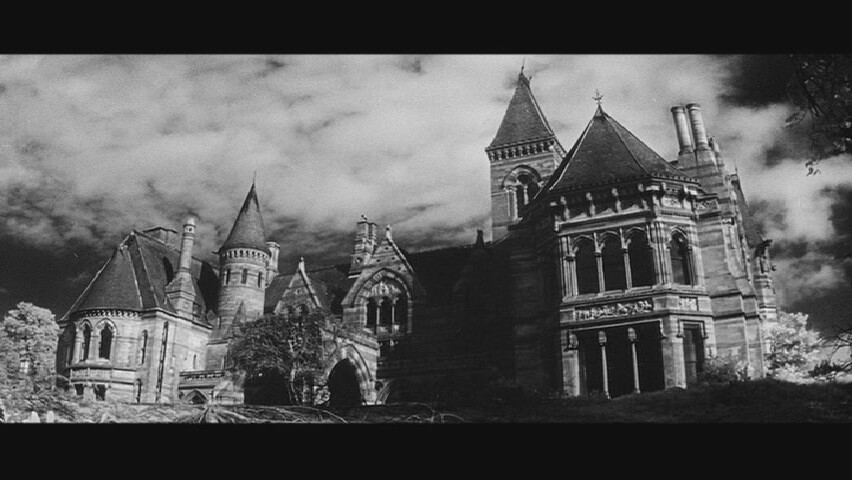
Scaring the audience is not something that comes easily, and an enormous amount of skill has gone into it.  Firstly, there's Hill House itself.  Huge, gothic, all at angles, something as simple as a mirror tilted forwards is enough to cause unease.  Wise films the house like a character, treats its spires and archways like eyes, watching the characters as they go about their business.  Watching us, too.  Even the way actors are framed increases the sensation that there's something else there.  At one point, an empty chair sits slightly out of focus in the background.  We listen to the main character, we're meant to look at her, but I couldn't stop looking at that chair.  My imagination, thanks to the direction and sound, was all too happy to put a ghostly something in that chair.  (It's a trick used to great effect thirty-five years later, in Shyamalan's The Sixth Sense.)

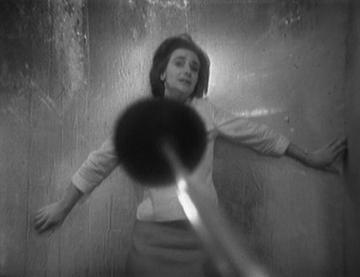
Next, there's the sound.  Obviously there's the famous scene where something pounds on the walls, but I'd argue the entire soundtrack is just as frightening.  Whether it's a creature sniffing around the corners of a door, a dead woman's laugh echoing around the corridors, or just an eerie gust, a constant atmosphere of What-The-Hell-Was-That? hangs over the film.  The music, by contrast, is an all-out assault on the nerves: dramatic, loud, it occasionally tips the story from sinister unease to absolute horror.

Finally, we have the cast.  Eleanor (Julie Harris) is a few apples short of a bunch even before her visit to Hill House, thanks to years looking after her invalid (now dead) mother.  Desperate for attention, Nell may or may not be in the house's thrall, exacerbating things by at one point (maybe) writing a ghostly message to herself in chalk.  (Fellow investigator Theo suspects her all along, saying pointedly "You know none of us did it".)  Nell is also a narrator of sorts, which isn't so much a storytelling device as another method for scaring the audience; her eerie inner voice is, in effect, haunting her, and edging her closer to madness.  We know from the history of Hill House that Nell will fit right in there.

Also present are Doctor Markway (Richard Johnson), whose experiment this is; Theo (Claire Bloom), a clairvoyant whose fluctuating affections for Nell are not helping her mental state; and Luke (Russ Tamblyn), a youngster who stands to inherit Hill House.  The house affects all of them, eroding Markway's enthusiasm, Theo's cool exterior and Luke's carefree attitude until the only one who isn't petrified, oddly enough, is Nell.  The transformation of Luke in particular a smirking cynic is cleverly done to convince any still unfazed stragglers in the audience of how frightening all of this is.

There are a few big jump-out-of-your-seat scares, but it's the building dread and chilly sense of panic that makes The Haunting a classic.  The story, particularly Markway's opening narration of the horrible history of Hill House, is strange and gripping.  The way the film leaves you afraid of empty rooms and probably unable to sleep, is unforgettable.  The fact that Robert Wise did all this with sound effects and furniture puts most modern horror movies to shame.  It's easily one of my favourite films ever, as frightening as Rear Window is tense and exciting.

The Haunting may not work on everybody, as inevitably some people will look at all the empty rooms and just see empty rooms.  But it seems precisely calculated to give me sleepless nights and, as not a lot of films can do that, I'm eternally grateful.  Just not very well rested.

Tuesday, 30 October 2012

I, Pepperpot

Doctor Who
Dalek
Series One, Episode Six


Doctor Who and the Daleks.  They're synonymous.  Show someone with no idea about Doctor Who a picture of a Dalek, there's a good chance they'll know it's not a novelty spice-grinder.  So it was a safe bet that when the show came back, the angry pepperpots would turn up as well, ready to terrify and fascinate a new generation of kiddywinks.  (Though this nearly didn't happen due to copyright issues.  You've got to wonder what else the Daleks had planned besides coming back to Doctor Who.  Village fetes?)  It falls to Robert Shearman, adapting his dark Daleky audiodrama Jubilee, to do the honours.


Some Daleks still work as after-dinner speakers,
usually with limited success.
We waste no time getting to the introductions.  The TARDIS is summoned by a distress call to the last Dalek in existence, loitering in a billionaire's dungeon and refusing to talk.  The Doctor strolls in hoping to help a distressed alien, but all he has to do is say his name.  Familiar lights flash.  "Doc-tor?  THE... DOC-TOR?"  Uh.  Oh.

I can only imagine what this must be like for someone who didn't grow up afraid of these things, but this scene is one big chill down my spine.  The direction nothing but a blue light visible, until those first words – makes it an instant classic.  And Christopher Eccleston knocks it up a notch: the Doctor's sheer terror, followed by venomous hatred, tells us all we need to know about Daleks in seconds.  We also find out who the Time War was against, what the Doctor's involvement was, and why he's been so sullen and guilty since he came back.  "I watched it happen.  I made it happen!"  It's all there.  What a scene.

But squint, listen, and you'll notice something odd going on here.  Nicholas Briggs (undisputed king of Dalek voices) has more to do here than just shout the E word:  "I... AM... ALONE."  Down goes the eyestalk, the music going sad along with it.  Wait, wait, no, stop, stop I say!  The Daleks have been back thirty seconds and they're already acting sympathetic?  A sympathetic Dalek?  Couldn't it just sit there and be scary as hell for a little while?  I know the episodes are only 45 minutes nowadays, but are we really in that much of a hurry to de-fang the show's most famous, most popular, most scary creation?

It's not enough to ruin the scene completely, and I'll poke anyone in the nose who says that it is.  But it highlights something annoying that festers at the heart of this episode: is the Dalek scary, or isn't it?  You can have scary Daleks (and you should), and you can have not-scary Daleks (you probably shouldn't), but it seems crazy to attempt both in their first episode back.

Still, at least it is both.  When Rose meets Tim Nice-But-Dalek and offers her sympathies (because she's never met one so how should she know?), Briggs plucks at our heartstrings like a drunk puppeteer, but once she gives him a sympathetic pat full of useful DNA, it turns out he's fibbing!  I love this.  Depressing as it is to hear all that "I'M GLAD I MET A HUMAN WHO WASN'T AFRAID OF ME" stuff, and oh boy is it depressing, it's totally in character for a Dalek to lie, cheat and manipulate to get what it wants.  That'll teach Rose for not listening when someone says "Whatever you do, don't touch the Dalek."  It doesn't quite redeem the sad-Dalek stuff, because they've barely even started on that yet, but at least it's a second great Dalek moment.  Hoorah for that.


ONCE SEEN, CANNOT BE UNSEEN.
Pretty soon the inevitable occurs, and the Dalek starts doing what it does best.  (What it does best rhymes with "Frecksterminate.")  Downloading the entire internet might not be its biggest asset; it now "knows everything", so presumably all about kittens, movie trivia and adult entertainment.  But it's soon back to its former glory, and yeah, the new bronze design looks terrifyingly gorgeous.  The Doctor's "release me if you want to live" is a nice nod to The Terminator, and a good way to keep the Dalek scary (though perhaps not as scary as Topless Eccleston).  The Dalek's effortless and eye-popping extermination of everyone it sees puts paid to any images of little men sat inside shaking sink plungers and egg-whisks.  This thing means business, and no, getting up those stairs will not be a problem.

Then the episode's subtext drops by to say "Coo-ee!", and the Dalek tells the Doctor "YOU WOULD MAKE A GOOD DALEK."  Now, hold your horses there, Mr Metaltron: the Doctor might identify with it, because they're both the last survivors and both feel somewhat superfluous in the universe.  But that's about as far as the comparison goes.  This stuff's great acting-fodder, mind you: the Doctor's empathy and even, on some level, respect for the Dalek makes a complicated brew of emotions whenever they face off against each other, and Eccleston sells the long history between them every time he's on screen.  But the Doctor needn't lose any sleep over this.  Did he blow up the Daleks?  Yes.  Does he order this Dalek to die, in effect trying to exterminate it?  Yes.  Because as far as he knows, it's going to get out and kill everybody.  Because that's what Daleks do, it's all they do.  The Doctor himself says that a Dalek is motivated by hate and wanting to destroy everything that's different, and the Doctor isn't like that, so that's that, really.

But they won't let it lie.  Pretty soon Rose's DNA gives it a bad case of emotional turmoil, and while the Doctor's itching to reset the Dalek population to zero (the bastard, with his comprehensive knowledge and experience of Daleks!), all the Dalek wants is to feel the sunlight.  Ugh.  Look, it's just too soon to start re-assessing what Daleks are really like.  Having this one pathetically wiggling its tentacles and mewling about feelings would be horrible anyway, but it's their first episode.  It's like The Terminator, if Ahnuld played a friendly robot before playing a scary one, or Darth Vader telling Luke he wants to look on him with his own eyes, except in the first Star Wars movie.  The whole point is that the character has grown and changed, but that takes time.  You can't run before you can walk.


"DO NOT BE ALARMED.
THIS IS MY FRIENDSHIP PLUNGER."
The Doctor Learns and Grows as a result of Rose's telling off – "He's not the one pointing the gun at me!  What the hell are you changing into?" – but that's wrong, too.  Rose doesn't know Daleks.  This particular pepperpot is having an identity crisis, sure, and it won't kill her, but it's still an absolute danger to everyone else.  Or did she fail to notice stepping over a bunch of corpses?  This is typical Rose, assuming she's A) the most important person involved and B) knows more than anyone else, except possibly the Doctor.  Her obvious glee at knowing more about aliens than Adam, The Boy Genius, is tinged with superiority.  At least the Doctor recognises that the humanity she's passed onto the Dalek is poisonous to it – Rose, the Best Person In The Universe, naturally assumes it's "better"

It's an important watershed moment for the Doctor – "I'm the only one left.  I win.  How about that" and Eccleston's on fire, when he's not made to say dreadful Learn And Grow dialogue like "Oh Rose, they're all dead!"  Rose applies what she's learned so far, but she's not in full possession of the facts, and compassionate as she is, 200 people are still dead.  It's supposed to be a strong episode for both of them, but nope, not quite.  And as for their relationship, the Doctor in fact never said he'd protect her (there was a whole thing about him not saying it last week), and the Dalek's got no reason at all to call Rose "the woman you love".  I smell a Russell T Davies rewrite.

The cast, not to mention all those juicy American accents, add a nice action movie flavour to it.  Henry Van Statten makes a delectable intermediate baddie.  But Bruno Langley's not the most nuanced actor, so I'm not exactly thrilled to have Adam come aboard at the end.  Yet more typical Rose self-importance: she invites him without first clearing it with the pilot.  Hey, I'm sure that'll work out and won't be a total disaster...

The premise doesn't work, as after all those exterminated corpses it's a bit rich to ask us to sympathise.  But the important bit is the corpses.  Ignore the violin soundtrack.  On some level, those scariest of monsters are back, they look better than ever, and don't pretend you're not glad to see them.

Monday, 29 October 2012

Night Of The Noticeably Fed

Doctor Who
Aliens Of London and World War Three
Series One, Episodes Four and Five


In his first two episodes, Russell T Davies gave us two distinct types of Doctor Who.  There's the bawdy, silly, just-a-bit-of-fluff monster mash, and the emotional character-developer using sci-fi as a backdrop.  Which do we get in Aliens Of London?  Um...


Above: character development.
To be fair, it's often both.  There are some great ideas, and some moments that really say something about the characters.  There's genuine creativity here as well, handling an alien invasion story with wit.  But make no mistake, we're in flufftown.  Triple-digit IQs need not apply.


If we absolutely have to return to the Powell Estate a few short episodes after leaving it, and I'm not sure we do, at least it's an excuse for some meaty character stuff.  The Doctor means to drop Rose off twelve hours after she left (not something he'd ordinarily bother to do, but apparently she's worth it), but there's been a slight hiccup and it's actually been twelve months.  Whoops!  Rose is listed as missing.  Her mum's been worried sick.  Mickey's been accused of murder.  It is one hell of an opening, both horrifying and (thanks to the bashful way the Doctor breaks the news), shockingly funny.

In a couple of seconds Rose goes from having an exciting TARDIS-themed hobby to dealing with the consequences.  It's not something Doctor Who used to think twice about, so it's absolutely ripe for a going-over.  Come to mention it, yeah, it's a big deal when someone drops their entire life to travel with the Doctor; most of his past companions didn't end up back where they started either, meaning they pretty much vanished without explanation.  Episode Four seems a bit soon to worry about all this, but it's a pleasant surprise to be thinking about it at all.

Having said that, it is a bit of an overreaction, if not on Jackie's part then on Davies'.  Rose left the flat a couple of days ago to have an adventure, and thanks to a quirk of the TARDIS she's paying the price but she hasn't actually done anything wrong.  (Well okay, the way she did it, hanging up on Jackie and disdainfully ditching Mickey, left a lot to be desired.  But that's just her natural, er, charm.)  It's a curious double standard, that we should expand our horizons and see the universe, but not if it means actually leaving the house.  Does Russell have issues about leaving home?  What's so wrong with getting out there and doing stuff?  So Rose went and got a life.  The horror, the horror.


He was acquitted of murder, but he'll always be guilty...
of hilarity!
It's not exactly consistent.  Jackie's initial outrage lasts a couple of scenes, but then she's sat with the neighbours chatting about boyfriends as if everything's fine.  And Mickey, who's had a pretty rough year, is reintroduced by doing a comedy pratfall into a fence.  Slapstick didn't suit him last time, and it's still an awkward fit, especially given what he's been through.  I know life doesn't stop being funny when awful things happen, but couldn't this stuff be taken just a little bit seriously?

Anyway, on with the plot, which arrives so suddenly you wonder if Russell had the first five minutes finished before he even came up with it.  A spaceship crashes in central London, and before you know it everyone, not just Jackie, is worried about aliens.  This helps make a natty point about Jackie et al having no reason to trust the Doctor, but also gives us a lovely insight into why he does what he does: Eccleston's irrepressible thrill at seeing history in the making is a big part of who the Doctor is.

Once the alien invasion hits full swing, things get decidedly fluffy.  Rather than investigate, the Doctor plonks down in front of the TV, giving us some curiously emotive news reporters and that American channel Jackie's TV apparently defaults to every few minutes.  Meanwhile, in Downing Street, the real villains are gathering, and they are farting.

Ah yes, the Slitheen.  There's a lot to like about them: the fact that they're a family, not a species, because not every member of every race acts the same thankyouverymuch Star Trek; the way their plan plays on what you (and the Doctor) expect of an alien invasion, which wittily rewards any sci-fi fans in the audience; and the general creepiness of a bunch of aliens wearing human skins like lycra.  I'm not so keen on their motive for blowing up the Earth, which just like Cassandra's is a boring bunch of dollar-signs.  But it's probably supposed to be a reversal of the usual Today London Tomorrow The World schtick.

They work best when they go against convention.  They even call the Doctor on his own flim-flam when he threatens to sonic some alcohol at them.  "Your device will do what?  You're making it up!"  It's a bit risky making fun of the sonic screwdriver and its limitations, given the rubbish it's capable of doing, but hey, they're right.

Less good, though, all that farting.  I said in my review for Rose that New Who feels awkwardly obligated to poke fun at itself (and that there were "worse bodily functions" ah well), and that all goes a bit far in this one.  From giggling at their own naughtiness to stopping and talking about the fact that they're farting, they seem determined not to be taken seriously, because who could take a bunch of green blobby aliens (or worse, fat people) seriously?  Um... people who watch Doctor Who, perhaps?  Their general disgustingness is played for laughs, but so is their murderous nature.  Even their death is coupled with a comedy swearword.  As for the unzipping effect, so unsettling at first, it's way overdone and eventually, yes, played for laughs.  How many times do they need to get their kits off?  And seriously "literally hair-raising"?


"Yes, Prime Minister, I see what you did there.
Please stop explaining."
Oh well.  They are funny a lot of the time, especially David Verrey as the greasy acting-Prime Minister, and their plan's pretty cool.  If they seem overly stereotypical in spite of all the smart touches, that's probably because Aliens Of London is trying to celebrate the general monsterness of Doctor Who.  It's got the first New Who cliff-hanger, which goes laboriously all out juggling three perilous situations and ending, of course, on a malevolent chuckle.  Just like the old days!  There's also a rather familiar morgue scene with something knocking on the freezer door (shades of the TV Movie, perhaps?), and that time-honoured solution to an alien menace, blowing them the hell up.  Make no mistake, this episode's got its nostalgia on, complete with references to the Doctor's career with UNIT (and more pressingly, the Doctor's name and the TARDIS being red-flagged by the government – no wonder he didn't want them to find the TARDIS, he doesn't want to get drafted!).  It's a lot of fun in that regard.

The second episode is more about hurriedly putting the plot to bed than carrying on the character development, but there's some there.  We have a nice thread about Mickey and Jackie working together because, presumably, they're all they've got; the Doctor gradually overcoming his (random) dislike of Mickey, and eventually offering him a place on the TARDIS; and Jackie wanting to know if Rose can ever be safe if she travels with the Doctor.  It's an understandable thing for a parent to worry about, but her request that Rose "always be safe" couldn't be granted even if Rose lived in a one-horse village and slept in a house made of pillows.  It's probably meant to be hard-hitting that the Doctor leads a dangerous life, but isn't any life potentially dangerous?  I know the Doctor's meant to be murkier than just some wonderful guy who's fun to be with, but Rose hasn't made any Faustian deals here  she's just seeing the world and helping people.  The constant guilt-tripping doesn't compute for a show that's also trying to encourage a life of adventure.

Meanwhile, there's a lot of running through corridors (because apparently No. 10 Downing Street is massive), including some unwise Benny Hill-esque chase sequences, because apparently some of us didn't get the memo about this being comedy.  And how could I forget some of the most hilariously terrible computer hacking ever put on screen?  Mickey can, from his home computer and using one password (which is one word with no numbers, symbols or different cases, none of which asterisk out when he types them), launch a missile at Downing Street.  It's easier than eBay.  There's even a big red button marked FIRE!  In a self-deprecating story about blobby green aliens that fart, it takes some doing to cross the line into unbelievability, and this bit does it with a pole-vault.  (Rose's "ingenious" solution of surviving by hiding in a cupboard isn't much better.  Oh, so the three-inch steel walls won't help, but wait until you see the cloakroom?)


Junior School Under 7s Missile Survival Team.
She got the Bronze.
It ends on a sour note.  Despite the Doctor being warm enough to let Mickey come aboard if he wants (he doesn't), he still forces Rose to choose right now between one life and the other, with no question of co-existing in both.  He becomes in that scene exactly the sinister git Jackie thinks he is, and between him putting the screws on Rose and Rose leaving Jackie miserable once more, I'm left wondering who the hell we're supposed to actually like.  (Oh, and another random thing: why do characters keep saying "Who the hell" and "What the hell"?  Is it supposed to sound gritty?)  It's not exactly out of character for him to get possessive, so fair enough to an extent, but really... this over Rose?  I'm just not seeing it.

Cast-wise, it's a strong one for the Doctor, although his possessiveness doesn't make much sense right next to his offering Mickey an olive branch.  Mickey grows, despite some lingering slapstick tendencies.  The Slitheen are all having tons of fun; it's not their fault the comedy's so broad.  And Penelope Wilton is a constant highlight as bright spark Harriet Jones.  Maybe it's her vague resemblance to Elisabeth Sladen, but she strikes me as a better and more useful Doctor Who companion than Rose could ever be.  Shame we can't keep her.

It's unwieldy, and on a constant humour offensive that cannot help but miss half the time.  But when it's funny, it's very funny; when it's thoughtful, it's refreshing.  The good stuff's trapped inside a wacky, often annoying pantomime, but squint and you'll see it.

Sunday, 28 October 2012

Who You Gonna Call?

Doctor Who
The Unquiet Dead
Series One, Episode Three


A man stands sullenly over his grandmother's body.  The cadaver awakes, throttles him.  The mortician returns, and unsurprised, says "Oh no.  We've got another one!"  But he can't hold the dead woman down  she smashes out of her coffin, lurches towards us in the street, her ghostly moan breaking into a scream, until finally that familiar sting, and... dum de-dum, dum de-dum, dum de-dum, DUM de-dum!  Without question, this is one of my favourite openings ever, equal parts Doctor Who and Ghostbusters.  I remember just how I felt watching it for the first time in 2005: like it was the '70s, and Doctor Who was at its gothic best again.  Ohh, love it.


"Go get her, Ray!"
The rest of the episode's pretty good, too.  Continuing to explore what Doctor Who can do, i.e. taking us to the past as well as the future, it gives us a rollicking good time in Victorian Cardiff.  (On that score, it's nice to have monsters turn up somewhere other than London.  Although Rose's puzzlement that she should wind up in historical Wales, as opposed to anywhere else, is hilariously put across by Billie Piper.)  You've got to wonder if Russell T Davies kicked himself that he didn't think of doing Christmas + Charles Dickens + Ghosts for the first Christmas Special.  Still, they weren't expecting to ever make one of those.

And did I say Dickens?  Good, because Simon Callow is superb as our first Doctor Who-style historical personage.  It's admittedly pretty obvious fan service, having our heroes meet someone famous (and dead) and tell them how great they are, but well, you would, wouldn't you?  Besides which, Charlie Boy is put to rather good use.  His renowned scepticism is a good foil for an apparent ghost story; his initial disenchantment with life and eventual rediscovery of his imagination are a good reason to include him; and the ultimate revelation that there's nothing the Doctor or Rose can do to prevent his death makes it a poignant trip.  It's not the sort of thing you can keep doing and still expect to have impact – though that didn't stop the Doctor Who gang from having at it over and over again – but this first time, it works.

The episode's grisly sense of humour also works a treat, courtesy of League Of Gentlemen's Mark Gatiss.  Take Sneed, the slippery mortician, who goes from "She's not dead, sir, merely sleeping!" to calling dead people "stiffs" depending on who's listening.  Even the Doctor's only too happy to make crass jokes in amongst the tragedy – a Happy Medium?  Yikes.  This Doctor's sense of humour is his question-mark pullover – and more importantly, to suggest that Rose is the one with the maladjusted morality.  When it's suggested that the gaseous Gelth be allowed to inhabit humanity's corpses, he's got no objection, and snaps at Rose for suggesting otherwise.  "Get used to it, or go home."  Brr.  This Doctor refuses to be an easy fit, or to see the smaller picture; as long as he seems utterly alien but still fundamentally compassionate in the process, I'm all for it.  (And he's not that bad: he's willing to take Gwyneth's place at the end, and gives her a little kiss when he realises he can't save her.)

And Rose is in the wrong.  Not just about the corpses – who, yeah, aren't exactly going to good use – but about the people she meets being "stupid" because they're not from her present.  It's a sobering moment when Sneed's servant Gwyneth says "Things might be different where you're from, but here and now, I know my own mind."  We do think of people from the past like that, and the Doctor's got every reason to think of Rose like that, but he doesn't.  It's a point well worth making, even if it makes Rose continue to sound like a self-important little madam.  (Unfortunately, on that score, I still can't stand her and I'm not sure why I should feel otherwise.)

The plight of the Gelth is an intriguing one, and stirs up seemingly the Doctor's last word on changing history:  "Time's in flux, changing every second.  Your cosy little world could be rewritten like that.  Nothing is safe, remember that.  Nothing."  I suspect that'll come back to bite Doctor Who in the soft parts sooner rather than later.  It turns out he's planning to take them somewhere else after they put on the corpse costumes, but it's still an exciting excuse for, well, anything to happen in a story set in the past.  Otherwise you'd just sit there saying, well, there weren't any flying saucers in King Arthur's time, so why pretend?


Those darn foreigners, taking our jobs and our women!
Funnily enough, the excuse isn't needed, as the Gelth turn out to be after more than a mode of transport, meaning the Doctor (with Gwyneth as noble-sacrifice proxy) can intercede.  All that's pretty obvious given their Night Of The Living Dead antics, but oh well.  It's a disappointing outcome, making it black-and-white simple like that.  How much more complex and interesting would it be if the Gelth weren't just your bog standard invade-everything monster army?  Besides which, they're dying, and they're made of gas; is now really the time to get all megalomaniacal?  Seal the deal, Gelth, seal the deal...  (Then again, they've been zombifying and murdering since before the episode started, and the Doctor et al just selectively forget that bit, so perhaps they have good reason to think they'll get away with it.  What is with that, by the way?  We all saw the murdery stuff, right?  Not exactly a cultural misunderstanding, is it?  So why assume that just because they say "Pity the Gelth" they're all sweetness and light?)

Eccleston and Piper are both on brilliant form, and the (small) guest cast are more than a match.  Eve Myles is particularly good as the servant girl with a mysterious gift; her fate is nicely handled, being at the same time a noble sacrifice, no particular sacrifice anyway (as she's already dead) and a nicely spooky enigma.  Also good, the effects: the swirly blue Gelth look all purdy, the zombies look terrifying, and that's a nice mix.  The TARDIS gets to dematerialise in the snow, which looks absolutely beautiful.  The CGI flames in that blown-up building look a bit arse, but hey, nobody's perfect.

The Unquiet Dead is a neat, creepy, morally eyebrow-raising episode for the most part.  It doesn't follow through on all the good stuff, and some of it doesn't add up, but it's close enough to what I loved about Robert Holmes-era Who to make me all tingly.  If I could pop back in time and meet Holmes, I've got a pretty good idea what I'd say to him.

Saturday, 27 October 2012

...And I Feel Fine

Doctor Who
The End Of The World

Series One, Episode Two


*Such as Reign Of Terror, the "monster" of which
is a raging alcoholic named Drinky Jim, see above.
Doctor Who falls into two major categories: monsters come to us, or we go to them.  (There used to be brilliant and entirely monster-free episodes as well*, but that was back when the Beatles were touring.)  After a busy first episode with monsters-come-to-us as its starting point, Episode Two goes completely the other way.  The Doctor takes Rose to Platform One, a spaceship at the end of the world, there to meet aliens, robots and other stuff that completely freaks her out, all while the planet roasts.  It’s audacious, and does a lot more for the premise of the show and the characters than last week’s.

We learn loads about the Doctor.  He’s the last of his kind, the weight of which Christopher Eccleston sells without saying a word; he’s keen to avoid his past, which makes us (and Rose) keen to hear more; and he’s much more at home among aliens and interplanetary weirdness than he is in the Powell Estate, London.  Eccleston’s brash take on the Doctor finds more footing here, as his compassion and otherworldiness are given room to expand.  Overall, he’s a refreshingly weird guy who is most definitely not from round here.

For example, now he's successfully got her into the TARDIS, showing Rose the death of her home-planet seems a funny way to say Welcome Aboard.  (It certainly tops blowing up her day-job for unbelievably blunt you-must-be-my-friend tactics.)  Perhaps he's trying to help her understand his own sense of loss, and grow closer to her in the process.  Or perhaps he thinks she'll appreciate being there for the Earth when no one else can be.  Or maybe he's just super callous.  Maybe all of that.  Who knows?  The Doctor’s one of the longest-running characters in fiction, and it’s great that he can still surprise us, so kudos to Russell T Davies and Eccleston for that.


"Yeah, I know it's your home planet.
Did I mention, I'm also a mental bastard?"
We also learn a lot about Rose.  The consequences of running off with the Doctor start to settle in – an area Old Doctor Who didn’t make much time for – as she realises she knows nothing about him.  She’s thrown in the deep end here, and her culture shock (coupled with a brilliant use of Soft Cell’s Tainted Love) mirrors the audience’s own.  She begins to see space and time as the Doctor does, as enormous horizons rather than just your home and your own lifespan; she also gains a fierce new appreciation for Earth and the human race, especially when their only representative is a venomous “bitchy trampoline” called Cassandra.

Rose’s experience (and ours) is like stepping into Douglas Adams’s Total Perspective Vortex, which shows you your (tiny) position in the (vast) universe.  After all, the death of the Earth, the ultimate, point-of-no-return roasting of all that we know, is the subplot.  The meat and potatoes story here is a whodunit with dinky robots holding Platform One to ransom.  It’s admittedly not much plot – turns out Cassandra’s behind it and is boringly in it for the money, meanwhile the Doctor must keep Platform One from being destroyed – but it’s a character-based episode, so the important stuff is the reaction to it.

It’s the smaller moments that resonate most.  Rose’s phonecall home – perhaps a bit premature, well okay very premature, but then she is watching her now long-dead mum’s home-world set ablaze – is a neat way to bond her to the Doctor, who’s clearly not all alien aloofness and can be sweet sometimes.  (You also get that from his little Tainted Love dance.)  Then there’s Jabe’s curiosity and sympathy for the Doctor’s tragic past; that poor alien plumber giving us a quick insight into her life before it ends; and the Doctor taking Rose home for chips, only then (after what she's been through) telling her a little of who he is.  The juxtaposition of big stuff happening and little moments is one of the show’s strengths.

The general presentation's great too.  The CGI and the aliens look amazing – oh, for prosthetics like that in the old days! – and the supporting cast give the smaller scenes a real weight.  Beccy Armory lights up the screen as the alien plumber Rose meets; Yasmin Bannerman’s Jabe flirts effortlessly and convincingly with the Doctor, and shows us how quickly he can enamour himself to someone of any species; and Zoe Wanamaker has tons of fun as Cassandra, no small feat for a character that’s essentially a bit of blue-screen on wheels.  She’s memorable, a bit of a diva, but is enough to stir a grave reaction from the Doctor.  Her death, which he orchestrates, is one of his most chilling moments, and another bit of Doctorly development to chew on.  Do not mess with this guy.


"I'm so sorry.  I think the Face Of
Boe put his fag out next to her."
There are still a few dollops of dumbness, because although this is a much better episode than Rose, it’s still the same writer.  Why do the rooms on Platform One have individual sun-filters come to think of it, why have sun-filters at all?  Isn't that asking for trouble?  All that stuff with the giant fans, and the Doctor’s ability to magically step through them, feels like overly orchestrated jeopardy just for the sake of it.  He’s capable of amazing stuff, but this is sci-fi, not fantasy; magic powers belong in the latter.  (Unless Russell’s going to argue that being a Time Lord means having a fabulous sense of timing.  In which case the Doctor's probably a great cook.)  Also, if he’s able to just hop through them if he concentrates, then poor old Jabe, who catches fire trying to slow them down, dies for nothing.  Do you think the Doctor mentions that bit to her colleagues at the end?

Then there's the awkward problem: despite a supporting cast that's superlative in places, it's still a bit hard to care about what's going on here.  With the Earth's death as a backdrop, a murder mystery of the future "great and the good" (or "the rich", as the Doctor reminds us) seems like decidedly small potatoes.  Despite learning acres of good stuff about Rose and the Doctor, some of it ain't that good, like Rose's bizarrely vicious outburst at Cassandra before she shows any signs of actual villainy.  ("You're just skin, Cassandra!"  And you're pretty much just a mouth in a hoodie, love.)  Not one of her more flattering aspects.

It's not one my all-time favourites or anything, but it advances the characters in meaningful ways.  For that, and for doing it in a certain amount of style, I'll forgive a lot of things.  And fortunately the things holding The End Of The World back are skin-deep.  It surpasses expectations in some ways; in others, good or bad, it meets them.