Monday, 22 April 2013

I Just Crawled To Say I Love You

Doctor Who
Hide
Series Seven, Episode Nine


Oh dear.  Neil Cross again.

Okay, it's wrong to judge a book by its cover (although strictly speaking, that's what book covers are for), so it's probably wrong to think Hide will be rubbish just because I've seen The Rings Of Akhaten.  (Twice.)  Still, I won't deny I was concerned about getting, shall we say, a repeat performance.

Surprise!  It's not rubbish.  In fact, I'm not sure what it is.  This might be one of the most bizarrely all-over-the-place episodes of Doctor Who ever.


"Well what do you suggest I call it?
Night Of The Romantic Bogeymen?"
To start with, it's a scary movie, with four people trapped in a haunted house.  There are numerous nods to The Haunting, which is nice as that's a film I love.  We have a woman overly invested in a ghost, a cold spot, writing on the wall, one room being the "heart" of the house, a mysterious banging on the doors, even a "Whose hand was I holding?" scene.  The trouble with all those references, though, is there's not a smudge of originality between them, and none of it bothers to go for the jugular like it should, because the tone's several miles away from unsettling.

The moment the Doctor and Clara turn up, from a winceful Ghostbusters reference to that plinky-plonk comedy music Murray Gold must be able to do in his sleep by now, the tension largely disappears.  When we get to the hand-holding bit, a moment of oh-dear-god-aaaaaargh! in Robert Wise's movie, it's played like a pantomime.  Couldn't we tone down the zany, just a little bit?  It is actually okay to frighten your audience without pouring on a gallon of Matt Smith Kookiness to make it all better.  (It's even more okay to give Matt Smith more to do than just smug kookiness.)

We veer back towards scary later on, after it transpires the ghost isn't the problem: it's just a stranded time-traveller running away from something else.  Okay.  To be honest, this being Doctor Who I suspected it would turn out to be some sort of victim trapped in something wibbly-wobbly, because there's always a sci-fi explanation for everything, be it ghosts, werewolves, vampires.  Call me old fashioned, but I find this has the same effect as revealing the Wizard of Oz to be a useless old fart with a smoke machine.  If everything is either aliens or timey-wimey, then everything becomes ordinary after a while.

Anyway, the monster is nothing short of brilliant.  Bizarre to look at, never seen either fully or directly, and the jittery way it moves brings to mind old-timey stop motion.  It is terrifying, and yes, more like it, please.  So it's a shame this all turns out to be a gigglesome misunderstanding, and the monster is harmless – to use the Doctor's words, "This isn't a ghost story, it's a love story."  Oh, goodie.  Your mileage may vary on this: if you're a hopeless romantic, the way Hide concludes may leave a sappy grin on your face.  Being a cantankerous fanboy curmudgeon, I was left thinking, "How the hell is this going to frighten anyone the second time round?"

Oh well.  Like it or not, it's a love story.  Actually, it's three: the ghost-hunting Professor and his psychic assistant are in love, or so a lot of clumsy dialogue and starey "glances" tell us (in fifty foot neon lettering); the psychic assistant and the ghost/time traveller are actually distant relatives, and their psychic bond is a familial one; and the scary monster is actually a lovesick scary monster, longing to get back to its lady counterpart.  (Scaring the crap out of everyone it meets is apparently unintentional.)


"Phew, caught up with you at last!
So, do you want to like, go to a movie or something?"
You spend most of Hide putting up with the first of these, which exists seemingly because Alec is a man and Emma is a woman and they're in the same house.  (With respect to Dougray Scott and Jessica Rayne, they're both playing it so straight with Neil Cross's yakkety-yak dialogue that it's like two hatstands being told they're betrothed.)  When the ending comes along and lets rip the other two love stories, it's too much.  How did the Doctor magically figure out Emma and Hila are related?  And was there no less random way of the Doctor figuring out the monster's intentions than having him suddenly stop in his tracks and experience a flashback?  It's like Neil Cross leaned into frame and shouted, "You forgot the last bit!"

Come to think of it, the Doctor is less than dazzling in this one, like when he has the wit to ask "The Witch Of The Well?  So where's the well?" after we've seen it written down right in front of him.  And when he clocks what's really been banging on those doors, it's a good minute or two after it already became thuddingly apparent to the viewer.  Keep up, Doc!  Elsewhere, he's tediously omniscient and smug about everyone and everything, producing names and dates so readily that he must have peeked at this week's script.  He's inconsistent and, strangely for Matt Smith, really quite irritating.  (Speaking of which: it's the 50th Anniversary year, with references aplenty, and no one told Matt how to pronounce "Metebelis 3"?)

Clara has plenty to do, for once.  Apart from some thankless bonding with Emma (because they're both girls and them's the rules), there's the remarkable scene where the Doctor inadvertantly shows her all of Earth's history, birth-to-death.  Well, not that remarkable – it's Rose seeing the Earth get roasted, essentially – but it stops the episode in its tracks and raised my eyebrows.  Matt Smith gets to put across the full alienness of the Doctor (asked if it's okay that humanity just perished, he answers: "Yes"), Clara gets to react to it.  It's necessary stuff (yet more of it, the price of constantly changing the cast), but it's the Best Thing Here.

We also get more of Clara's uneasy relationship with the TARDIS, which really doesn't like her.  It even says so, using a voice interface thingie.  (I'm not sure I like that bit, as it renders the Doctor's chat with the TARDIS in The Doctor's Wife a lot less special, but it only seems to be here because the script hit a brick wall.)  Of all the Clara Who hints, this is the one I'm most interested in, and I hope there's more to come.  As for finding out more about her, despite the secret purpose of this episode being a way to find out more about her, we still don't.  Thanks for that, again.

So, what of Neil Cross's writing, post-Rings Of Akhaten?  There are a couple of real gems here, although television being a collaborative effort we don't necessarily know whodunit.  I'd like to know who to thank for "Collapsing universe, you and me dead, no time complete sentences, abandon planet!", what with "Ignorance is Carlisle" sounding so much like Steven Moffat.  Elsewhere, though, some of that Ringsy loquaciousness is a problem.  The characters talk too zarking much.  When Alec starts psychoanalysing the Doctor the moment he's out of the room, you want to reach into the screen and smack him.  He's not even the psychic one!


Okay, this is cool, but seriously now:
you need keys.
It's not rocket science.
As for the plotting, well, if you're going to set up that the TARDIS can't rescue the Doctor without draining its batteries, a problem so dreadful you have to invent a voice interface to tell Clara about it, don't promptly do it anyway with no consequences.  (Twice.)  Similarly, when Emma uses her psychic link to make all this possible (I think), it's stated that she can't keep it up without serious harm to herself.  A quick pep talk from Alec, however, and she just decides to make the effort.  Well, is it dangerous, or isn't it?  (Now what episode does that remind you of?)  As for the Doctor literally hitching a ride on the TARDIS, and Clara being able to fly it just by asking it nicely... no thanks.  And might I add, grrr.

Hide is many things, predominantly somewhat of a mess.  There's far more going on here than there was in Rings, or Cold War for that matter, and for sheer variety it's quite a memorable episode.  The monster's certainly excellent, and some people are going to want to hug the ending to little gooey pieces.  There are good bits dotted throughout.  I don't know, though.  I like scary things to remain predominantly scary.

Maybe I'll feel better disposed to it some other day.  For now, I'd rather rewatch The Haunting.

Nice Warrior

Doctor Who
Cold War
Series Seven, Episode Eight


You pretty much know what to expect from this one.  There's a monster loose on a nuclear submarine.  So, that's slithering in corridors, crew picked off one by one, and a desperate scramble to stop the bombs from flying.  It's a monster movie, and it's competently done, but that's about the nicest thing you can say about it.  It's written by Mark Gatiss, and you pretty much know what to expect from him, too.

Gatiss wanted to bring back the Ice Warriors.  Fair enough: the list of recurring monsters in Doctor Who's history dwindled dramatically after we got Daleks and Cybermen, and the Ice Warriors haven't had a story all to themselves since the '60s.  He goes about this quite sensibly, giving us just one (like in Dalek) and having it run amok in a confined space (like in Dalek).  The costume's the same as ever, only more badass.  (See Dalek.)  The thing is strangely beautiful to look at, and yet completely intimidating, especially in close quarters.  (Dalek!)  It's covered in chains at one point, and...  Okay, it's safe to say Mark Gatiss saw Dalek.  But that approach worked before, so it ought to work again.


"Exssssterminate."
At least, to an extent.  Whose bright idea was it to throw away what little we know about Ice Warriors and say hey, the armour's just a robotic suit, and really there's a slithery wee alien inside?  Sure, this works for the Daleks, but isn't that precisely why you shouldn't do it all over again?  It's like when the Daleks randomly started converting people into Daleks, immediately (one would hope) prompting a strongly-worded letter from the Cybermen's legal department.  It's been done!  It really is a shame, as the one thing you might conceivably wonder about an Ice Warrior what it looks like without the helmet has already been revealed, in their first New Series adventure.  On top of which, it looks like complete rubbish.

Anyway, this crew of Soviets are running nuclear drills.  (They're also drilling for oil, which seems like a completely random job for a nuclear sub, but maybe that's just me.  Perhaps the Soviet motto is something like: "If it involves drilling of any kind, keep us Soviets in mind!")  They have in their possession a Thing From Another World-style ice block, and in a spectacular example of assigning the wrong man for the job just to advance the plot, an over-zealous crewman is asked to watch over it, and then decides to de-frost it with a blowtorch.  Oh, idiot crewman, we hardly knew ye.

Once the Doctor and Clara arrive, skipping spiritedly through the who-are-you-and-how-did-you-get-heres, it's a question of finding out what the Ice Warrior wants and trying to stop it blowing everything up.  In other words, Dalek, with tracts of Alien and (to use a dusty old Who reference, which I'm sure Gatiss would appreciate as he dredges up the TARDIS's wacky HADS system from 1969), it's a bit like Horror Of Fang Rock.  That's a Tom Baker story where a bunch of people are trapped in a lighthouse with a monster.  It's like this one, except scary.

There's very little wrong with all this.  Well, it's worked before, hasn't it?  The trouble is, there's little to mark it out from anything else.  Mark Gatiss's perfunctory dialogue doesn't help: you've seen and heard it all before.  ("He's finding out your strengths... and your weaknesses."  Darn.  Who else had "and your favourite colour"?)

Take Clara, who's still going through the companiony motions.  TARDIS translates foreign languages?  Tick.  History can be changed?  Tick.  Travelling with the Doctor means dead bodies by the truckload?  Tick.  Yes, it's necessary, but we've been there, so very done that.  Jenna Louise-Coleman attacks it with her usual cute-as-a-buttonness, particularly in the less-than-convincing "this is all getting a bit real" scene, but it still adds nothing to my understanding of what Clara is like as a person, or what really marks her out from Amy, Donna, Martha, Rose and the rest.

On top of which, she feels like a third wheel.  The bit where she takes it upon herself to speak to Grand Marshal Skaldak (le Ice Warrior) requires a torturous bit of chin-wag between the Doctor and the sub's Captain an obvious, desperate bid to find something for her to do.  Why not just have the Doctor talk to him instead?  Matt Smith, incidentally, is in a mostly comedic mood this week.  This is fun to watch, but he's capable of a lot more.  He really isn't challenged often enough these days.


In Clara's defence, how cute is that salute?
The monster goes downhill as soon as the, er, genie's out of the bottle.  Creative camerawork is used to keep it out of sight, but is this done to heighten the tension, or to disguise its rubbishness?  With its silly rubber arms and not-particularly-memorable CGI head, I'm leaning towards the latter.  At least it kills a few people  actually kills them, dead, in modern Doctor Who! but even that feels like small potatoes in the shadow of nuclear war, not to mention the tonally bizarre ending.

Okay, so Skaldak is about to launch the nuke when the Doctor tries to convince him that mankind is young and innocent, and deserves a second chance.  (We saw that before in The Christmas Invasion.)  Then Clara uses her companiony pixie dust to remind Skaldak of his daughter, and how much he misses her, and how proud she'll be if he turns the other cheek.  (I think I saw that in my nightmares.)  Then a spaceship full of Ice Warriors beams up the Grand Marshal and, after much impotent wishing and hoping from the Doctor, graciously disarms the nukes as well.  (Smith And Jones hops to mind.)  The Warriors go on their way as our heroes smile, crack jokes, and nod heartily to their new alien friends.

Uh, guys?  Didn't Skaldak murder at least six people?  Are we really saying he's an all right sort of guy just because he couldn't be bothered to obliterate the Earth?  By Cold War's end, you just don't know if you're supposed to be afraid of the Ice Warriors.  That's an understandable message in a war story, but it's a seriously damp ending, and it robs them of future menace.  (Something similar, only much better, happened in The Curse Of Peladon.  In that one, however, they left all the murdering and monstering to the stories where they really were the bad guys, because y'know, it sort of muddies the issue.)

So what's to like?  The Ice Warrior looks awesome, if only on the outside.  Nick Briggs does a decent voice, even if it is a bit like a Juddoon crossed with Stock Grizzled Monster Noise.  (With added lisp.)  All the Alien-y corridor scenes are tense, if familiar, and easily let down by the sight of those silly rubber claws.  (Oh no!  Not rubber claws!) 

Perhaps the greatest asset is the cast.  Liam Cunningham brings the required level-headedness to the sub's Captain.  Tobias Menzies does what he can with The Slippery Lieutenant Destined To Get Killed.  But never mind all that: David Warner's in it!  It's great just having him here, which is just as well, as his character has almost nothing to do.  (He's supposedly a professor, but other than knowing how long Skaldak's been in the ice he could easily be the janitor.)  Warner has a warmth and exuberance that makes every scene more fun to watch, and makes me wish he still had a shot at playing the Doctor.  In his scenes with Clara, when he's not yammering on about Ultravox, he could be a more rough and tumble Patrick Troughton.  It's a waste of talent, undoubtedly, but it's a marginally better episode because of him.

Cold War's based on such a familiar, tried-and-tested framework that it can't entirely miss, in a meat-and-potatoes sort of way.  For some people, no doubt, this kind of bog standardness is exactly the point of Doctor Who.  There'll certainly be more like it.  For me, that vital spark isn't there – quite possibly because Mark Gatiss is – so it's not one I'll revisit.  Oh well: it's still better than last week's.

Sunday, 21 April 2013

Bored Of The Rings

Doctor Who
The Rings Of Akhaten
Series Seven, Episode Seven


The writing staff for Doctor Who seems to be getting smaller these days, with the same few names being drawn over and over, presumably from a fez.  It's cause for celebration when a new one pops up, and knowing nothing about Neil Cross before The Rings Of Akhaten, I was optimistic.  Finally, some fresh blood!

Well, you can put away the party hats.  Rings Of Akhaten sucks.  Not only is it yet another boring, wishy-washy, will-that-do? sort of episode, but it heralds the arrival of yet another Doctor Who scriptwriter who evidently doesn't bring very much to the table.

The opus gets off to a questionable start, showing us the meet-cute that brought Clara's parents together.  Her dad was hit in the face by a leaf and, naturally, stumbles in front of a car, only to be rescued by his soon-to-be missus.  It's a bit like Father's Day, without any of the emotional power or ring of truth.  (Do people really say "Oh my stars"?  Has anyone ever reacted that much to a leaf in the face?)  This is followed by a so-naff-Richard-Curtis-wouldn't-touch-it speech about the universal importance of that leaf, and then a montage of Clara's childhood which tells us such vital information as, Clara had parents, and a childhood, and then she grew up.  Her mum dies at some point, which would be much sadder if we knew anything about her besides her apparent fondness for total morons, and tendency towards exclaming things clumsily.


A new, less-than-impressive Doctor Who monster is born.
The Doctor is present for all of this, because he's trying to learn more about Clara, apparently in the creepiest way possible.  He's not doing any better than we are, incidentally: he now knows Clara was born.  Wow.  Thanks for that.  (And seriously, enough with the Doctor meeting people at random points in their lives.  It's getting so other writers are doing Steven Moffat's ideas to death.)

Hopping back to the present, Clara wants to go somewhere "awesome", so the Doctor selects Akhaten: a multi-alien society that's a great excuse for the props and costume departments (and Murray Gold) to go crazy.  What follows is a bit like The End Of The World, if the companion's reaction to alien life was a lot less interesting, and no one was in any immediate danger.  Clara deals with everything quite well: she's quite enthusiastic, quite friendly, quite... dull, actually.  When does she get good?

Anyway, she comes to the aid of a little girl, Merry, who must sing to a god in order to keep it from waking up.  This god feeds on stories (as in, psychically-infused objects that have personal meaning, though your memories alone will do; see also, "nonsense", "piffle", and "total bollocks").  If it wakes up it will presumably do so on a larger scale, or... something?  It's never really clear.

Merry's song goes awry, or so I'm guessing, and she's sucked into the god's temple with what looks like a ravenous mummy.  Ooh, human sacrifice, it's about to get good!  Except the mummy is there just to wake up the real god a huge carnivorous star and serves no other purpose.  Same goes for the Vigil, three incredibly scary-voiced thingummies that stalk around trying to ensure Merry goes through with the ritual.  Good grief, they are brilliant!  But weren't there a couple of hooded guys doing that job earlier?  Well, that was a waste of a good monster.  (Incidentally, they can be defeated by sonic screwdriver abuse.  Sigh.)

The only danger facing the girl is that her "soul" will be eaten, but since that consists of "stories", and since the monster eats those all the time even when it's asleep, with no detrimental effect on anyone, just what the blethering poppycock is actually at stake?  (Besides Clara, whom Merry inexplicably offers to the mummy in place of herself.  At least, that's what I think was going on in one scene.  WTF?  Why doesn't Clara react to that?)

It's around here you notice that over half the episode has elapsed, and yes, this really is it.  All that's going on is standing in a room talking about some sort of doom possibly happening.  (Oh no, the mummy's going to get out of its glass cage!  Okay, it hasn't, but I'm sure it will!  Eventually!  Golly, that glass sure is thick!)  Some of the dialogue works: the Doctor's speech to Merry about how life started in the universe, for example, actually sounds like some thought went into it, and it makes a nice, spiritual-yet-scientific statement about the beauty of life.  Good speech!  A few earlier comments raise a smile as well, like Clara not being able to think of anywhere to go in the TARDIS, and the Doctor saying (after he finally drops a companion off precisely where and when they wanted him to), "Hole in one!"  But most of it's just talking, lurching into speechifying, interspersed with sonic-screwdriver-squeezing.  It's an episode in which tumbleweeds would have made a welcome distraction.


"You know what would liven things up?
Stalking through your childhood."
When the Doctor finally confronts the god/star/giant internet smiley (what were they thinking?), having finally run out of ways to point the sonic screwdriver at stuff, he offers it his memories in the hope of overfeeding it to death.  There's a real moment where you think "Oh no!  He's giving up his identity to save these people!  That's horrible!  What a huge effect that will have on the series!", etc., etc.  But after the god soaks up all that Doctory goodness, guess who's still got all his memories and is completely fine?

Blurgh.  So Matt Smith acts himself to tears against a green screen, lumbering through one of the most overwritten (and frankly, unoriginal) speeches ever to clog up his inbox, and for what?  The whole situation deals in such vague, abstract notions that it just doesn't matter.  Not.  One.  Bit.  It's never explained why the monster's such a threat.  It's never explained why the Doctor's memories (which it "eats" but still somehow leaves in tact) are not enough to destroy it.  And when Clara produces the all-important-leaf, which is apparently charged with the "infinite" energy of all the days her mother might have lived, just because she says so... well, I haven't got a sodding clue how that works, either.  (Nor do I know how she retrieved the leaf at all, since the TARDIS was deliberately refusing her entry earlier.  Hey, great scene, and a lovely tease for whatever's going on with Clara – but hello, editor?)

What's this episode supposed to achieve?  I'm guessing some clarification on what Clara is all about.  Sadly, it offers no help, beyond a garden variety tragic past.  She says "I'm not a bargain basement stand-in for somebody else", but just saying that doesn't magically make it true.  Close your eyes and picture any other Doctor Who companion here, and what's the difference?  As for the Doctor's relationship with Clara, besides creepily stalking his way through her entire childhood, he regards her with as much interest as he'd normally reserve for a mysterious petri dish.  This isn't a friendship, it's a project.  Is that different?  I don't think so (see Amy), but it sure isn't fun to watch.

There's little else to say about an episode that attempts to sing its audience to sleep, other than: it succeeds.

The Interwebs Of Fear

Doctor Who
The Bells Of Saint John
Series Seven, Episode Six


Doctor Who's back!  And we're getting more than just five episodes and a Christmas Special!  Fortunately, I'm not remotely bitter about the sharp decrease in Doctor Who reaching our screens these days.  Nope, not me.

Anyway, kicking off this momentous (as in oh-well-at-least-there's-slightly-more-of-it-this-year) anniversary year is The Bells Of Saint John, which despite being mid-way through a series feels like one of Russell T Davies' series-openers.  It's frothy, likeable enough, not much going on upstairs.

The plot revolves around Wi-Fi, downloads and typing.  It's all very modern, with Sherlock-style graphics and lines like "Did you just hack me?" in between social media namechecks, but it's perhaps a teensy bit over-excited about the internet, apparently hoping for gasps of horror at the mere mention of Wi-Fi, and whoops of glee at a climax that amounts to the bad guys hitting "Undo".

Hey, it's great when Doctor Who can take something everyday and turn it sinister, but it doesn't always work.  For me, no doubt for others, Wi-Fi and the internet are handy, functional but-not-actually-interesting parts of daily life.  The same goes for laptops, typing, downloads and Facebook.  Sometimes, just because you recognise a thing doesn't mean it'll make good drama, and no amount of Murray Gold horn-blaring and on-screen graphics can make typing exciting to watch.


"Hey, the loading bar's gone down!"
Dun-dun-dun-DA-DUN-DUN-DUN!
There are monsters: mobile Wi-Fi providers called Spoonheads, so named because of their concave revolving skulls.  (Duh!)  They're a mish-mash of stuff we've seen before (robot doppelganger from Wedding Of River Song, spinning heads from The Beast Below, talking spoon-bots from Silence In The Library, weird speech-patterns from Library again), but then that's a problem with the story as a whole  I've heard it before.

An alien gobbling people's minds via a snazzy human envoy is two parts Idiot's Lantern, one Partners In Crime.  (And let's just say Silence In The Library again for good measure.)  Popping between timezones (here the modern day and the 13th Century) is just standard Steven-Moffat-showing-off-for-no-reason.  We've seen London landmarks too many times to count, and when it turns out we're dealing with the same baddie as in the previous episode, well, doesn't that just take the biscuit?  (And now you mention it, Jammie Dodgers and fezzes make yet another appearance.  Must we charactarise Matt Smith's fabulous Doctor by numbers?)  For an episode all about modern innovation, it's a bit light on new stuff.

In between all the hipster references and loading bars, there's very little human angle to what's going on, which no doubt explains the clumsy info-dump at the start.  A random extra tells us that people are clicking a dodgy Wi-Fi provider and their minds are being downloaded.  (We later discover it's all being added to the Great Intelligence, which makes sense until you realise it's increasing some people's intelligence in order to make them compatible.  Huh?)  Something's wrong with your script when you have to invent someone to deliver the information directly to camera.  But if he didn't, would any of this really seem to matter?

No one gets hurt or seems remotely concerned about this stuff – even when they're possessed by the evil Miss Kislet, in a not-too-shabby twist on the bad-guy monologue, they don't know about it afterwards.  There are deaths, but they're all off-screen and we don't feel any of them.  It's all just a bit easy; persuading the nasty people to stop what they're doing, for example, takes little more than a tap of an iPad.  Thrilling ain't the word.  (That goes double for when the action slows down so badly, the Doctor has time to get changed.)


"Release them!" "No!" *presses button* "Okay!"
Dun-dun-dun-DA-DUN-DUN-DUN!
Okay, let's talk about the good stuff.  One scene, where Wi-Fi is used to divert a plane towards our heroes, is terrifying.  Suddenly you think, are they really going to do planes-as-weapons?  The shock of seeing something like that on TV is worth a hundred Weeping Angels.  The Doctor's method of intercepting it with the TARDIS, meanwhile, is an absolute hoot.

And big surprise, Matt Smith is very good, although with his new Willy Wonka costume and flying motorbike we're certainly leaning more towards whimsy than gravitas.  Hey ho: there's a great gag about bicycles, and the Doctor's "young people" mime is hilarious.  Smith still gets the occasional really good inflection in there, such as a brilliantly delivered "Sorry, what?" when Clara offers to solve a problem he can't, and the inevitable showdown with villainness Celia Imrie.  She's good too, but there's nothing for her to do besides wander round an office looking at people's computer screens.  (Oh well.  Her fate, at the hands of The Great Bored Looking Richard E. Grant, is chillingly memorable.)

At the end of the day, The Bells Of Saint John is really here to introduce the new companion.  So never mind all that whiz-bang techie stuff: it's Meet Clara Oswald, Take #3.  Not the same Clara Oswald we met last time, or the one before (or is it?  No, stop now!  Don't you ever learn?), but in all important aspects it's the same girl.  Setting aside tedious questions of what's going on here, what do we know about her?

She's feisty, flirty, sarcastic.  (So quite a bit like Every Moffat Female, then.)  She doesn't fancy the Doctor!  (Although she makes enough references to that sort of thing to suggest it's on her mind.)  She's really bad with computers, until some plot happens, and then she's really good with computers.  (That's kind of the Random Word Generator approach to character development, but oh well.)  She also, erm, wants to travel?  Which puts her in the same boat as roughly 98% of the Doctor's companions.  What else?


Clara Who.
From the makers of River Who.
Uh. Oh.
Jenna Louise-Coleman's very pretty, and she delivers all the dialogue with the right amount of flirt and confidence, but there isn't really anything there besides a standard Moffat Mystery and some sexy windowdressing.  And all timey-wimey aside, this is the third time we've met her, and it's an episode about her.  Shouldn't we come away from this with more than a vague sketch of who she is?  Russell T Davies used to cram gobs of this stuff into a couple of minutes.  Rushed, yes, but at least he made the effort, and we knew who we were dealing with.

Like Amy, another companion we never really got to know despite reams of plotty muchness, the Doctor scoops Clara up because he can sense this mystery around her.  So we've had that already.  With Amy, however, there also came a sense of obligation from affecting her life in terrible ways; a kinship from meeting her right after he regenerated; and she had an equally understandable fascination with him in both cases.  That bit helps.  It's certainly "different" having a companion who can take or leave the Doctor, which seems to be Clara's "thing" if there is one, but why take him, then?

There are whiffs of more going on here, particularly the Doctor's urge to protect her.  The bit where he parks outside her house and refuses to budge is an obvious highlight, and hopefully a sign of genuine friendship to come.  But so far, he's doing all this because he wants to find out what happens next.  On that score, I've simply been disappointed too often to share his curiosity.  All that nonsense with River, and Amy, and Rory's mysterious many-deaths-for-no-reason?  Sorry, but fool me once...

Thursday, 31 January 2013

Telly Addicts

Doctor Who
The Idiot's Lantern
Series Two, Episode Seven


Mark Gatiss is no stranger to nostalgia.  The Unquiet Dead, an episode I enjoyed, had a sense of horror and excitement distinctly like Doctor Who's golden years.  In The Idiot's Lantern, Gatiss once again uses nostalgia to get his creep on, reminding us uncomfortably of a time when TV programmes had titles like Watch With Mother.  Thanks for that.


Actually, never mind; I can't come up with
anything creepier than Watch With Mother.
Alas, a general sense of creepiness isn't enough to fill an episode, and unfortunately, The Idiot's Lantern hasn't got much else going for it.


Okay, so it's set in the 1950s, one of those historical eras that's close enough to vaguely recall, far enough away to be exotic.  Much like the '80s in Father's Day, it has plenty of novelty even if it's fairly easy to recreate.  The Idiot's Lantern certainly takes the easy route, opting for a street that generally looks like the '50s and setting most of the action indoors where everything's cramped and a bit brown.  (As for the extremely tilted camera angles unique to this episode, one must assume they're something to do with the '50s as well.)  It's set during the Queen's coronation, and all the bunting and street parties tie things pretty well to the present – it was 2006, and Great Britain had just secured the Olympics.  It's a neat parallel.  But, pretty soon nostalgia turns to criticism, as the '50s is presented as a repressed, backward time that is wrong and must be fixed, hence the Doctor encouraging a man to do the housework and ultimately, a woman to leave her overbearing husband.

This is all rather wince-inducing.  It's just too easy to say the patriarchal Connolly family is wrong because it's not very 2006 (and more importantly, not to Rose's liking), and it's ludicrous to fix it by chucking the dad out on his ear.  That might work now, but it wouldn't work then, as the Doctor of all people should understand.  In any case, this is promptly followed by Rose encouraging young Tommy to forgive his monstrous dad after all.  Huh?  By alternately condemning and then instantly forgiving all this, the episode's stance on the '50s is an empty one, little better than Rose thinking Gwyneth was an idiot for living in 1869 and not 2005.

But all that's just the subplot.  In the main, Maureen Lipman is The Wire, an alien masquerading as the continuity announcer from hell.  It scarcely takes any effort to make 1950s telly look creepy remember Andy Pandy, whose existential weirdness is only outcreeped by his permanent rictus leer? but she's marvellously sinister all the same.

When the Wire is prim and proper and just a little bit unsettling, it goes a long way.  It's just a shame they won't let her stay that way.  As things progress and The Wire gets hungrier, she starts bellowing "HUNGRY!", "FEED ME!" and, for those in the cheap seats, "FEED ME-EEEEEEE!"  It's not only disappointingly obvious for a monster to behave like, er, a monster, but it also makes it much harder to forget how obviously this was based on Little Shop Of Horrors.  (By all means pinch ideas from other stories so long as you're going to take them somewhere interesting, but don't then remind everyone what they could be watching instead.)

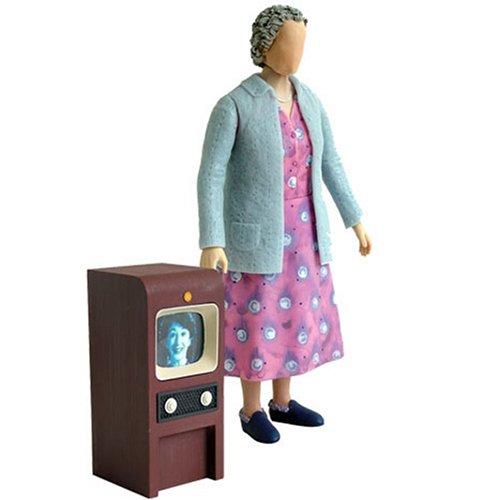
So, The Wire feeds on viewers' brain energy, and is so greedy that she consumes their faces as well.  (Although they get them back at the end, somehow.)  This is done presumably because it's less harrowing than showing lots of normal-looking people in a catatonic state; also because the Mill want to show off their CGI faceless effect; and more importantly, because you can sell more toys this way.  (Because who wouldn't want the Granny Connolly With No Face action figure?)  Unfortunately, as well as making absolutely no sense, this leaves the production team in a quandary.  Are the faceless people scary, or not?  The no-face thing is scary to look at, but they're presented as victims.  However, in a scene highly reminiscent of Rose first meeting the killer shop dummies, complete with mystifying plasticky sound-effects, they're a generic zombie menace as well.  It's never really clear what they're going for.


Bet you thought I was kidding.
The story doesn't seem to know what to do with them, either.  The police are whisking the faceless ones off to a warehouse, keeping them out of the way during the coronation.  The eyes of the world are on Britain, so orders are to sweep any weirdness under the rug until afterwards.  As evil conspiracies go, it's all a bit half-arsed: all the police are doing is locking them up, besides which, they aren't to blame for their wacky orders, and they turn into guilty wrecks the moment they're taken to task over it.  They only know about the faceless people in the first place because Mr Connolly is ratting them out one by one – because somehow he knows which houses contain them, and for some reason he really hates people who don't have faces.  The whole thing's held together with silly string.

On the other hand, at least it allows for some serious Doctoring.  The moment Rose is de-faced, the Doctor snaps: "Now, Detective Inspector Bishop, there is no power on this Earth that can stop me!"  As turning points go, it's cringily overwritten, and it suggests he doesn't really care about what's going on unless it impacts Rose... but okay.  Where's it going?  Simple: stand back, everyone, the Doctor's going to shout a bit!

Maybe it's just me, but it seems like the louder he gets, the less impressive he is.  This is an episode full of the Doctor yammering on and acting wacky, with a silly haircut and lots of pop culture references.  (The Doctor loves watching TV and listens to Kylie, because we don't want to frighten anyone by reminding them he's from another planet.)  When the big change comes over him, awesome as it's clearly meant to be, all he really does is whack up the volume, put on his pouty face and brandish the sonic screwdriver some more.  People listen to him as much or as little as they already did; as for his battle of wits with The Wire, all he needs to do to scare her off is produce the screwdriver.  Yawntastic.

The Doctor is at his best here when he's quiet and subtle, either regarding the misogynist Mr Connolly with silent boredom, or deftly talking the police interrogater into being the interrogated.  As this stuff clearly shows, throwing your Doctorly weight around ought to be about being the most influential person in the room – not, necessarily, the loudest.  And it's got sod all to do with the screwdriver.

Rose has her moments, though despite her Magical Powers Of Observation she still can't deduce that someone's trying to warn her away from danger.  And hey, Tennant's not bad when he's not trying quite so hard: those quiet moments really do resonate.  I don't like the idea that his only investment in all this is Rose, but if it's cause for him to emote well, which he does nicely before launching on his "No one can stop me now!" monologue, then it can't be all bad.

The plot rumbles along as always, Euros Lyn tilting the camera like mad and Maureen Lipman shouting her head off, but still the whole thing leaves a resounding impression of... meh.  For all those criticisms, the tenuous plot, the hit-and-miss monsters, the ironically black-and-white moralising, it's more underwhelming than terrible.  This is sadly not an ideal position for something all about people being glued to their TV screens.

Monday, 21 January 2013

Spare Pants

Doctor Who
Rise Of The Cybermen and The Age Of Steel
Series Two, Episodes Five and Six


Hmm.  Cybermen.

With the Daleks back on our screens, it was inevitable that Doctor Who would dust off its second-most-famous monsters at some point.  But that's the thing with Cybermen: they're second-best.  And for good reason.

The idea's creepy.  They're mostly-mechanical people who skulk around turning everyone else into one of them.  Creepy, right?  So why do they mostly settle for blowing stuff up and killing people, just like every other sci-fi villain?  The whole they-used-to-be-people thing never really makes a difference.  No wonder Star Trek saw an opening and invented the Borg, who are essentially the same thing, only actually creepy.


In their defence, they can bust a move.
Fortunately, the tedious tin-men have an ace in the hole.  Their origin story is an absolute belter, and it's never been done on screen.  It's the subject of a dazzling audio drama, Spare Parts, and why not just straight-up adapt that?  The tale of a people forced to mechanise themselves or die, it's some of the most poignant and compelling Doctor Who you're ever likely to find, and it's just what the Cybermen needed.  Had it been a television script thirty years ago, rather than an audio drama made after the series finished, it'd be one of the major highlights of Doctor Who.

And, well, that's not what we have here.  Spare Parts is credited for inspiration, but what made it to the screen is more like a Doctor Who panto, guest starring the Cybermen.  "It's alive!"  "You're not God!"  "Noooooo!"  So much for poignant and compelling; this is more the stuff of really cheesy B-movies.

Okay, down to business.  How do the Cybermen go about Rising?  Well, an insane megalomaniac (sigh) has come up with a way to improve mankind, whether they like it or not.  Using his popular Earpod technology (geddit?), he remote-controls people straight into factories to be processed as Cybermen.  Meanwhile, the homeless are led into lorries, using the unlikely promise of hot food and a bath, so they too can be carted off to factory-land.  Well, that was easy.

Where's all the good stuff?  The tragedy, for a start.  If they're not choosing to become like this, it stops being about heartbreaking inevitability – which was what made it terrifying, and therefore good in the first place and just becomes another bog-standard nutter forcing his way on the masses.  You've seen that before.

I'm not saying this had to be exactly the same as Spare Parts, but if you're going to fundamentally cut the bit that inspired you to begin with, wouldn't a few fresh ideas make better substitutes than whatever's in the Sci-Fi Cliché Bargain Bin?  Standing in for the good stuff is some lame satire about depending too much on technology.  As for the business of herding hobos with a dodgy bit of "Step right up, sir!", it's considerably less chilling than Chitty Chitty Bang Bang.  Absolutely none of this is helped by Roger Lloyd-Pack being hysterically over the top in every single scene as the megalomaniac, but then what else is he supposed to do with a wheelchair-bound Dr Evil who says things like "And how can you do that from beyond the grave?"

Some of the most poignant and compelling... ah, never mind.
So the origin story is liberated of its terror and its heart, and the mad scientist's a write-off.  What about the actual Cybermen?  Well, they look pretty cool, although the stomping-in-unison teeters terrifyingly close to Thriller.  The voices, courtesy of Nick Briggs, aim for robotic monotone but just come off unintelligable.  Maybe that's just as well, as they're mostly saying moronic stuff like "We are Human.2" and "Delete!"  (And not content with their embarrassing "Exterminate" rip-off, they're soon crowing about "Maximum deletion" as well.  What, as in the difference between Deleting a file and emptying the Recycle Bin?)

Obviously it's sad that they used to be people, but as they're frogmarched to their doom, and as we're dealing with a parallel universe anyway (specifically a quite nasty parallel version of Jackie Tyler), the point never hits home.  Nor is it explored in any depth.  There appears to be no actual use for a human brain inside a Cyberman, as they're almost entirely mechanical anyway.  If you remove all the emotions and humanity, well it's tragic in a blunt fashion, but what's the actual point of having a brain, then?  Why not a robot?  (There's a completely brainless Cyberman at one point, and that one works well enough.)

Any ramifications of all this are thrown away as quick as possible.  The Doctor, faced with cyborgs who used to be people, chooses to explode them rather than let them expand what humanity they have left.  Well, we can't go dealing with any actual issues, can we?  That girl, who's getting married tomorrow but for the slight inconvenience of being a Cyberman?  Not that she has an especially bright future ahead, but it might have been worth a shot, or at least an informed decision about whether she can continue to exist.  Nope: she's better off dead.  Just like New Earth, this raises horrific questions and then steamrolls over them, trading emotion for a comedic montage of exploding heads, adding a cursory "I'm sorry" from the Doctor to make it all better.  How utterly useless.

Perhaps in a generous attempt to leave the good version of this story in tact, Rise is set in a parallel universe  it concerns a whole different bunch of Cybermen.  Fair enough.  Parallel universes are a sci-fi staple, and you don't often see them in Doctor Who.  (The last one was in 1970.)  So what's this one like?  Sigh again: same universe, plus earpods, zeppelins and a totally unexplained military curfew.  Goodness, what breathtaking imagination.  Like so much else here, I honestly wonder why they bothered.

Still, it does throw up a few possibilities, and some of them work.  Mickey gets to meet his nan, who died in our universe, and his brief moments with her have real impact.  It's nice to see Mickey eke out a life away from Rose, and his eventual departure makes sense.  He's The Best Thing In This, hands down.  It's just a shame he hangs around with Jake, a shiny-faced Cyber-fighter who looks and sounds like he's in a soap opera, and his own horribly ridiculous doppelganger, Ricky.  (The extent of Noel Clarke's transformation is a frown and a silly voice.  What were they thinking?)

Worse than Ricky, oh so much worse, is the decision to have Rose meet her still-alive parallel dad.  Let's count the ways this doesn't work, shall we?  It trivialises Father's Day, an episode that explored these emotions in depth.  It makes Rose look like a horrible brat for thinking her lack of existence in this universe is solely to blame for ruining Pete and Jackie's marriage.  It makes the Doctor look like a moron for failing to keep her away from Pete and, as predicted, leaving Mickey to fates unknown.  Rose's eventual failure to kidnap alterna-dad, and the sobbing that ensues, seems less like a tragic outcome and more like Little Miss Greedy not getting her way.  Urgh.  There's just no part of this that works.  Why go there in the first place?


Tennant, here modelling a variety of Halloween "Doctor" masks.
Dum de dum.  What else?  Well the plot's so stupid, full of brains-being-welded-to-things and other genius ideas, it's fruitless to explore it in depth.  (Although I will say that finding out the Cybermen's kill-code, texting it to the Doctor and having him jam the entire phone into the nearest computer orifice is profoundly dumb.)  In all this, the Doctor barely registers.  So brilliant just two episodes ago, David Tennant has become a shouty, ineffectual plonker, and the script affords him little more opportunity to grow than seeing which ridiculous noises and faces he can make.  Yet again there are occasions when the Doctor yells at people to do or not do things, and they just ignore him.  It's getting old already.

Is it written in stone somewhere that the first two-parter in a series has to be really stupid?  Actually, that's not fair: Aliens Of London has some brilliant character development and wit mixed in with the dross.  Rise Of The Cybermen is nothing but a drossfest.  Delete!

Friday, 18 January 2013

Filmflam: Prometheus

Prometheus
Directed by Ridley Scott
2012


Ridley Scott's Alien is, in the best possible way, a textbook horror movie.  It's about seven people trapped in a confined space with a monster.  There's a sinister reason for this predicament which is revealed later, and there's a great deal we don't know about the monster, but the important thing is, they're here, the monster's dangerous, and they may not survive.  It moves at a confident pace, and there isn't an unnecessary moment in it.

Much is left to our imaginations, such as: where the alien eggs came from.   Why the alien ship crashed on LV-426.   What purpose, if any, the aliens were intended to carry out.   Did we need to know any of this to enjoy Alien?   No.   So the long gestation of Ridley Scott's prequel, Prometheus, has left me puzzled.   The aim is to fill those blanks. But how can doing so enhance a movie where the characters neither knew nor cared about the answers to those questions?

In its defence, Scott has tried to distance Prometheus from its crude "How we got to Alien" mission statement, suggesting it will spiral off into its own film series that is about entirely different things.   Time will tell on that.   But it is first, foremost, unavoidably a prequel.   And it does nothing to dispel my feeling that there may never exist a good prequel.

A theologically curious film hoping to evoke 2001: A Space Odyssey in theme, it concerns a group of scientists searching for the meaning of human existence.   Using ancient cave-drawings as a grid reference, they (and a crew of oblivious misfits) trek to an unknown world, hoping to stumble on our Creators.   On board are people who want to investigate at all costs, people who don't want to be there, and people with their own agenda... all of which can be found in Alien.  It's just a lot more complicated and a lot less interesting here.   (Theological curiosity is less gripping than answering a distress call, for starters.)

Scott's strengths have always been in design rather than characterisation, and in Alien he's on record as saying he hired seven really good character-actors and basically left them to it.   For a film where the heroine was arguably less humanitarian than the ship's robot, Alien still felt like it was about real people, bitching and sniping and wanting to go home.   Prometheus does not.   The crew is too numerous for Scott's "leave them to it" approach to work, and the dialogue is too hokey, too full of leaden banter to let them feel real.   Certain characters, like Sean Harris's bizarre mistanthropic geologist and Idris Elba's apathetic captain, feel like half an idea that goes nowhere.

As an ensemble, it's an absolute haystack of accents, clichés and the feeling of scenes and motivations gone missing.   When things are revealed about them, such as a family secret for Charlize Theron's icy executive, they're so redundant as to be downright laughable.   Similarly, letting it fall on Idris Elba to explain the plot, even though his character possesses none of the knowledge he's suddenly splurging for no reason, is sheer laugh-out-loud ineptitude.

The standout is obviously Michael Fassbender as the franchise's latest android, David.   Drawing distinctly from the pantheon of creepy cinematic robots, Fassbender appears to be the only one putting some thought into his character.   Unfortunately, while he may be the brightest spark in a very dull mix, he still must do dreadful things for no clearly established reason.   Strip away the thesping and he's as much a mess as the rest of them.   (Okay, so HAL's betrayal in 2001 didn't make a lot of sense either, but then 2001 wasn't a film designed in the first place to answer questions.   Anyway, all was revealed in the book.)

This film's Ripley, or at least its main character is Noomi Rapace as Dr Shaw.   She's a prominent scientist with a keen religious faith, driven to find answers because she can't conceive and because disease killed her father and blah, blah, blah.   Her husband, Dr Holloway, ought to be Shaw's crucial counterpoint, but the two are equally boring to be around, and he makes even less sense than she does.   (When a scientist finds evidence of alien life immediately on his first attempt to look for it, to then sulk that it's dead after 2000 years is simple churlishness.)

Holloway's eventual descent (for with a much bigger crew comes a much bigger bodycount) is one big plot-hole courtesy of David, and his eventual willingness to die for the greater good is symptomatic of one of the film's major flaws.   Unlike the crew of the Nostromo, these guys just don't try very hard to survive.   If they're utterly terrible at taking care of themselves, and quite offhand about dying to save others, why should we care when they meet their doom?   It was a very human stupidity that drove Harry Dean-Stanton to ill-fatedly look for the ship's cat in Alien; no such logic grounds Rafe Spall's decision to get within spitting distance of an alien snake.   Oh, so you want to make friends with an unknown reptile on a hostile planet, do you?   Good luck with that.

What we have is essentially a group of poorly-defined idiots doing stupid things for no reason.   The film's great mystery remains entirely obscure, and does nothing but add to the pot of unanswered questions, thereby defeating its own purpose.  We learn that the Engineers may have created mankind.   Okay.   We don't know why.   They apparently want to destroy us.  We still don't know why.  None of this explains what a spaceship full of eggs was doing on LV-426, so... what was gained by making this?

In leaving out the answers, Prometheus is not automatically rendered profound.  It is after all a lot easier to ask questions than it is to satisfactorily answer them.   The film's attempt to seem lofty and thoughtful, just by refusing to answer its own ponderings, is betrayed by the minutae of the plot making equally miniscule sense.   (And sorry, but I refuse to believe in the subtextual cleverness of a movie wherein people greet discoveries with "My God!", and desperate missions with "We've only got one shot at this!")  It's surely aiming for the kind of intense debate generated by 2001, but even setting aside its thorough ineptitude, it's far too conscious of the franchise's horror roots to operate on a higher plane.  The ghost of Alien is ever-apparent: the structure is of course very similar, but there are designs, references, character behaviours, even bits of music that remind us, paradoxically, it was Alien that brought us here.

Prometheus is visually accomplished, of course, and the music is pretty and strangely optimistic  a juxtaposition that would have pleased Jerry Goldsmith, who always felt his finished theme for Alien was too obviously sinister.  But attractive production aside, it remains that contradictory thing: a prequel, so it must nod, sequel-like to its predecessors.   There's a semi-facehugger, a faux-chestbuster, even a proto-Alien, because that's what you came here for.   But what is this a ponderous work of science fiction, or The Old Dark House In Space Part 5?   Ridley's attempt to do both will leave the deep thinker irritated, and the horror afficionado counting his diminishing returns.

Tuesday, 11 December 2012

The Time Traveller's Plank

Doctor Who
The Girl In The Fireplace
Series Two, Episode Four


The Girl In The Fireplace is a love story for the Doctor, and there have hardly been any of those.  Why is that?  Well, School Reunion explained quite eloquently that the Doctor lives longer than anyone else, so he doesn't feel he can ever stay attached.  And that's just his close friends: he's never around anyone else long enough for it to go anywhere.  He's still got a heart two, actually but those are the facts and "close friends" is the best he can do, if that.  It's The Curse Of The Time Lords.  He literally said so last week.

Steven Moffat's brilliant way round this is to ignore it and just have him fall in love anyway.  Uh.  It works for a lot of people, and it won a Hugo Award, but... no.  It doesn't work if you take the previous episode into account.  It doesn't work if you want to actually see any evidence of love on-screen.  It doesn't work if you watch these two characters alone in a room, supposedly being in love.  It's a to-the-point shopping list of Doesn't Work.

What does work is the time travel jiggery-pokery where the Doctor pops in and out of a person's life.  (See The Time Traveler's Wife, as Moffat so obviously has.)  After hearing the Doctor/human relationship put into words last week, here it's enacted on the screen, and it's like a point-by-point account of why he can't fall in love with a human.  Fair enough.  Except, d'oh!  It's inexplicably being used to make the opposite point.  The Doctor doesn't build a bond with this woman, he barely meets her at all.  And okay, there is such a thing as love at first sight, but this first sight happens when she's about seven years old.  Ick.


Soon.
The main thing wrong with it is summed up by Rose: "Why her?"  Madame de Pompadour is one of the most accomplished women in history, okay, but none of those accomplishments are on the screen.  We're told she's great, but that's not the same as seeing it for ourselves.  What we do get is a stuffy, wooden, rather unremarkable aristo with a bit of a crush on her imaginary friend.  What, exactly, does the Doctor like about her?  He seems glad to have snogged a famous person, but then what?  There's no wit, no soul, no steel about her; all her womanly strength comes from depending on him.  She's not beguiling, she's not interesting, and (aside from being able to invert a mind-meld, just because), no match for him.  Come off it.  This is the woman who makes his hearts beat faster?  He had more chemistry with Queen Victoria.  He had more chemistry with Charles Dickens.

It doesn't help that Madame de Pompadour is played by Sophia Myles, who makes a bunch of clockwork robots look expressive by comparison.  Here is a woman who actually dated David Tennant, and yet their scenes together fizzle miserably.  Tennant, who played Casanova, and one episode ago communicated boundless love and affection for Sarah Jane with a couple of smiles.  It just ain't happening here.

Of course, the Doctor had years to form a bond with Sarah Jane, and so did we along with him.  There was a weight to School Reunion because of it.  You can't cram that kind of thing into 45 minutes.  You know all that not-seeing we're doing, of all Madame Pom-Pom's accomplishments?  The Doctor's not seeing them either.  Apart from a few scenes where we miss the tail-end, he knows this woman about as well as we do.  Oh, there's the I-think-he's-being-euphemistic-it's-too-subtle-to-be-sure "dancing", and more importantly the mind-meld (because apparently there weren't enough shortcuts in Doctor Who), but if their relationship's based on something that's impossible to interpret as an audience, then how the hell's it supposed to work as televised drama?

Nonetheless, Moffat insists in the clumsiest way possible that this is the real deal.  When the Doctor charges to Madame Pot Pourri's rescue, he's marooning Rose and Mickey on a dangerous spaceship in the future.  They're trapped forever, and he doesn't even mention it, presumably because he loves Madame What'shername so much he's willing to abandon his closest friend.  Even after what he said to her last week, about specifically not doing that.  Russell T Davies reportedly never edited Moffat's scripts, and dear God does that backfire here.  What happened to Rose's obvious annoyance that Mickey was joining the TARDIS crew?  Now they're thick as thieves.  Hello?  Is anybody screening this stuff?  Clearly not, as otherwise they'd have thrown out all that ridiculous "So lonely, lonely then and lonelier now, my lonely Doctor" twaddle.  Was there a scriptwriter's bonus if Steven Moffat used the word "lonely" in bulk?  (Besides which, if the Doctor's so lonely, what's with the conveyerbelt of bezzie mates he's had since 1963?  Yeah, they leave or they die in the end, but doesn't everyone who's ever lived have to deal with that as well?  And okay, the Time Lords are gone, but didn't he spend all of Classic Who avoiding them anyway?  I guess you really don't appreciate a thing until it's gone...)


Lonely, lonely, lonely, lonely,
lonely, lonely, lonely, lonely,
MUSHROOM, MUSHROOM.
I sometimes wonder if this even is a love story.  Aside from his foolhardy rescue plan, the Doctor seems utterly blasé on all things Madame Diet Pepsi until the very end, when he receives the Big Letter Of Lonely and looks miserable about it.  He could just as easily be sad because he's lost a new friend a new just-a-friend – who was hoping to see the stars.  Well, couldn't he?  But this does nothing to dislodge the feeling that, no, that's what they're going for, it just isn't working.  (And Wikipedia informs me that Russell T Davies called it "a love story for the Doctor", so that's that, then.  I also now know the episode's working titles included Reinette And The Lonely Angel and Every Tick Of My Heart, and yes, you are supposed to read those without sicking on your lap.)

Okay, okay, enough about the love story.  What of the plot?  Clockwork robots are invading Madame Pompous Orc's history in order to steal her brain.  They want it to use as a computer, because their ship is lacking in parts and it's named after her and they are apparently deeply stupid.  The body-parts-as-spare-parts stuff is intensely creepy, but it's always disappointing meeting a baddie who does what they do because they're an idiot.  (Besides which, Moffat already did it in The Empty Child.)  Rose and Mickey have little to do other than witness the Doctor's tryst and react hardly at all.  Seriously – why isn't Rose crazy-jealous?  But I enjoyed them getting along for once, even if it does totally contradict the last episode.  Billie and Noel are good.  And I liked the horse.

This is one of those episodes that lives or dies by the idea at its heart, and it dies a strange, awkward death because of it.  Does Not Work.  So there.

Friday, 7 December 2012

Most Likely To Succeed

Doctor Who
School Reunion
Series Two, Episode Three


Oh boy, School Reunion.  This one's got "My Favourite" written all over it, in sparkly ink, surrounded by love-hearts. 

To be fair, any episode feauring Ye Olde Doctor Who characters is going to be a fan-favourite before it even gets off the drawing board.  The hard part is making it more than just a nostalgia trip and School Reunion does, skilfully using the past to help ground the show's present.

It gets off to a running start, instantly sparing us the usual "Step out of the TARDIS, run into trouble, flash the psychic paper" rigmorole.  Before the opening credits roll, we've already got an amazing villain Mr Finch, a headteacher with "sinister" ingrained in his walk, the way he smiles, even the way he hums and an amazing setup, with the Doctor as a schoolteacher.  Who wouldn't be hooked?  And then Sarah Jane Smith walks into the room.


"And, cut.  Okay Dave, you can stop now.  David?"
Younger viewers won't have a clue who she is, but that's okay.  It's perfectly obvious this person is important to the Doctor.  Well, I say perfectly obvious, but it's really David Tennant's expression that gets across all that history in an instant.  It's debateable whether this is magnificent acting or just what happens when fanboy meets fan-favourite, but either way, the look on his face is utterly genuine.

Before you know it, we're tackling one of those issues that should come up all the time in a long running show, but never does: what happens when he leaves you behind?  Never mind nostalgia – this is absolutely key character stuff, especially for someone as Doctor-obsessed as Rose.  So what about it?

As audience-members, we gloss over the chasm between the Doctor's life and that of his companions.  It's easy to assume, given that he travels in time and occasionally becomes someone else, that his companions are as timeless as the Doctor himself, all of them still there should he wish to pop back and see them.  But that's an illusion.  They age, he doesn't, and he'd rather not think about that, thankyouverymuch.  The script comes dangerously close to over-egging this, when the Doctor nearly uses the L word but-then-poignantly-doesn't, but apart from that it's perfectly put, brutally addressing a skeleton in the Doctor's closet and frankly, getting him bang to rights.

He doesn't come out of this in the best light, effectively using the Time War as an excuse even though that happened ages after he ditched Sarah.  And apart from a promise, there's nothing to say the same won't happen to Rose.  (If anything, her feelings for the Doctor might drive him away even faster.)  But, fair enough.  Why should all character development be of the fluffy and nice variety?  (In his defence, the Doctor did say goodbye to Sarah all those years ago, and quite poignantly too.  Perhaps she remembers it differently after obsessing for so long.)

All of this has a flipside, something that bothers me generally about New Who.  The Doctor's probably genuine when he says he assumed Sarah got on with her life.  Back in the day, companions actually had lives to get back to, learning from their time in the TARDIS and growing as a result.  Now, though?  Rose's life before You Know Who amounts to nothing much, the thought of leaving him is inconceivable, and if Sarah's anything to go by – good old, headstrong Sarah – the same is ultimately true of everyone he meets.  I'm not sure I buy that.  I certainly don't want to.

Either way, there's more than enough character development to be getting on with.  What about the actual episode – the plot, and all that jazz?  Well, the mysterious school (with creepy teachers and hypnotised students) is a bit more Demon Headmaster than Doctor Who, but given that it's a backdoor pilot for The Sarah Jane Adventures, the lighter tone seems appropriate.  The school's a nicely eerie setting, especially at night.  It's fun watching the Doctor as the leader of a "gang", sans all the smugness that made Boom Town so awkward.  But as for what the Krillitanes are actually up to... ye-eah, about that...

First, the good news.  Anthony Head is so relentlessly brilliant as Mr Finch that even when their plans make little sense, even when he makes little sense, it doesn't really matter.  Why, for instance, if all the other Krillitanes keep turning into bat-creatures does he stay as a human?  Because Anthony Head is more interesting than a CGI bat-creature, that's why.  I'm not going to quibble with a villain who brings out the best in David Tennant.  Finch brilliantly uses the Doctor's own crisis with Sarah to attempt to get him on-side, and their face-off at the swimming pool is an absolute showstopper, especially for the Tenth Doctor.  Gone is the New Earth shouting, AWOL the futile "Listen to me!" cries of Tooth And Claw – the Doctor here is fantastically restrained, and consequently at his best.  All the big-hitting emotional stuff is reserved for the scenes with Sarah, which lends this performance a lot of light and shade.  It's a joy to watch, and remains one of my favourites.


No smiley-face for you, Mr Nasty Krillitane Man!
But, okay, the plot's got some holes.  The Krillitanes evolve, right?  They cherry-pick "the best bits" from species the way human cultures steal words and customs.  But just because they've got big wings like a bat doesn't mean they're going to be susceptible to loud noises as well.  They're not bats.  Even if they were, why would they steal that bit of a bat?

Far more puzzling, though, that mysterious Krillitane oil.  In order to crack the "God code", they need children to type on a lot of computers.  (Just go with it.)  In order to get smart children for typing, they need a lot of food dipped in oil.  (They also use the kids for food.  Because... waste-not-want-not?)  This oil is part of them, from long ago when they looked different, and it handily makes kids smarter... for some reason.  But the Krillitanes have evolved so much that it also makes them explode if they touch it.  Uh huh.

Setting aside how massively dim it is revolving their entire plan around this stuff, and having huge leaky vats of it to hand (a Krillitane dies just lugging one through the kitchen!), why, besides supreme plot convenience, would it do that?  "Their own oil's toxic to them"?  As usual, a cursory one-sentence "explanation" that just states the silly bit as a fact, like how the sonic screwdriver is now easily foiled by "deadlocks".  Er, okay.  (Why would they bother deadlocking things?  Has news of the Doctor's irritating screwdriver traveled far enough that bad guys build in this random fail-safe, just in case?)

Like Father's Day, this is a case of the important stuff winning out over the, er, other stuff.  Yes, it would be better if the Krillitanes' plan made more sense, and if certain puzzling edits had not been made (such as a scene where a Krillitane dive-bombs the Doctor for no reason), which otherwise leave disjointed roadbumps in the pacing.  But what the episode is here to do, it does beautifully, and then some.  It's not just emotional for the Doctor and Sarah: it's important for Rose, and an absolute revelation for Mickey.  K9's got something to do for once.  As for Sarah Jane, the years melt away in an instant, helped nicely by Lis Sladen being completely fantastic.  Why yes, you can have your own series!

And you know how the Doctor's all with the light and shade this week?  Ditto the script.  Despite heavy emotional themes, this is very often one of the funniest episodes around.  Funny's good, as another Doctor once said.

With a knockout Doctor performance, a solid reason to bring back an old friend, a tissue of laughs and chills, and basically the best thing ever to happen to K9, who cares about a few poxy roadbumps?  Throw this one on the Classic pile and gather round it for warmth.