Thursday, 6 February 2014

Road To Nowhere

Doctor Who
Gridlock
Series Three, Episode Three


Ah, Gridlock.  I've got a soft spot for this one, but I'm not sure why.  So much of it seems like the kind of stuff I hate.

It's set on New Earth, a planet so dazzlingly imaginative it has "Earth" in its name.  We've been here before, in an episode set boringly right after another one, and with some of the same characters.  Isn't the universe bigger than this?  Why, when you can go literally anywhere, are we getting repeats?

Because New Earth is where the cat-people live,
and cat-people look awesome?
Even Martha is irritated by this, once she realises the Doctor is taking her to the same places he took Rose.  (Wait, is that why he's still obsessed with Rose?  To explain the repeats?)  Still, the plot's different this time: far removed from shiny hospitals and apple-grass, the action takes us underground, to a never-ending traffic jam surrounded by petrol fumes.  The drivers remain optimistic, somehow oblivious to the fact that there's nowhere to go, no help coming from above, and something sinister picking them off from below.  Oh, and they've been at this for twenty-four years.

How to tell your plot's really stupid: the characters need to be really stupid for it to work.  And regrettably, the people of Gridlock are award-winning, 24-carat stupid.  These people couldn't find Wally in an otherwise empty room.  In all this time, no one has noticed the police don't exist (despite never answering one call, ever), no one has ever heard back from the people in the "fast lane", and no one seems to be getting anywhere at all.  In all that time didn't one person think, "Time to strap on a gas mask, get outside and look"?

Some of this is intentional.  With people believing in fairytales and ignoring horrible realities, it can only be satire, something Russell T Davies traditionally does with as much subtlety as painting the word "SATIRE" on a frying pan and hitting you with it.  "Everyone goes to the Motorway in the end" sounds a lot like "Once you go to Floor 500, you never come back", just as "They say the air smells like apple-grass!" sounds like "They say the walls are made of gold!"  But where The Long Game satirised journalism and TV, Gridlock satirises belief in general.  Depending on your point of view, it's actually quite startling for a piece of family entertainment.

With Martha kidnapped, the Doctor desperately needs to get into the fast lane below.  When a friendly driver won't take him because asking or telling people to do things doesn't seem to work, big surprise he lets rip.  "What if there's no one out there?  What if the traffic jam never stops?  What if there's no help coming, not ever?  What if there's nothing?"  Blimey, is it cold in here?  Sidestepping the massive Statement Of The Obvious, and the way everyone acts like this is news, this might be one of the most bare-facedly atheist moments in Doctor Who.

Well, isn't it?  These people are trapped by the locked doors overhead, but also by their own belief.  Singing to each other keeps them placid, but all it really achieves is staving off the suspicions most of them already have.  They'll just keep driving, live out their lives, and die.  It's still massively stupid, because I don't think any amount of wishful thinking and Old Rugged Cross can make people this complacent for twenty-four years, and it falls apart the moment you think about it.  (The traffic is moving, so where do the cars at the front go?  If you need three people to get in the fast lane, why doesn't everybody carpool?  If you definitely need three, how do those two people manage it in the teaser?  And if there's something horrible underneath, why hasn't the entire bottom row of traffic noticed?)  But it's one of the jobs of a writer to ask questions, and I admire the ones (intentionally) raised here.

"They say some cars just vanish, never to be seen again!"
Er, surely all of them vanish?
So how is that a rumour, and not a fact?
And there are more.  These people might be doomed to drive in circles, but all those rumours about fresh air and apple-grass are, surprisingly, true.  There is a better world up there albeit one that's been de-populated they just can't get through.  That's where the Doctor must step in, along with the Face of Boe, a mythical figure even he doesn't understand, who cares for them out of sheer altruism, and ultimately frees them.  Sound familiar?  On New Earth, there might be a God after all.  Plus, when Martha's carjackers lose faith, becoming convinced just as the Doctor was that no one's going to help, what's left is Martha's faith in the Doctor.  All of a sudden, the apparent atheist becomes something to believe in.  There's very thin ice between this, and equating the Doctor with a God which he certainly ain't.  But I like the idea that faith comes in different forms.

This theological back-and-forth no doubt contributes to my liking Gridlock.  Of course, there has to be a reason for all those doors being closed, and for the endless traffic jam.  And that's where we swing from "Why I like Gridlock" back to "Why do I like Gridlock?"

Mood drugs are an issue on New Earth, and one of them (called Bliss) mutated into a virus, killing the world.  Those above ground did what they could, sealing the masses underground for their own protection.  And things have stayed that way ever since, with almost nobody above and the masses below keepin' on truckin'.  (No one ever asks questions like "Why are the doors closed?" or "When are they going to open the doors?", even though they were open well within living memory, but as we've established, they are morons, because plot.)  The danger has passed but the doors remain closed, because there's not enough power.  And as a lack of electricity doesn't make for a very good antagonist and seriously, is that it?! there are randomly giant crabs under the traffic jam, snapping at cars to their hearts' content.

The mood drugs are an iffy idea to begin with.  (Since when are Forget, Sleep and Honesty moods, and why would someone wear an Honesty patch?)  They, and the tragic reveal about Bliss, all feel tacked on, not to mention wincefully blunt.  And then there's the crabs.  It should be a thrilling fanboy moment seeing the Macra on our screens after 40 years, and it sort of is, but they're inconsistent with their own past (having mysteriously "devolved") and they don't add anything of value.  We've no idea how they got there, and when the doors open to let the New Earthlings out, no one says anything about getting rid of them.  (Not even the people living in slums, who buy and sell mood drugs and have no other impact in the story.)  Are you keeping score?  That's a stupid plot, populated with stupid characters, facing stupid opposition that they've hardly noticed.

Finally, 30-or-so years after The Macra Terror went missing,
Doctor Who fans have crabs again.
Okay then, swinging back the other way, what about the Doctor and Martha?  Gridlock is ostensibly about how well they know each other, and whether they can progress as friends.  And about time!  Asked about his home planet, the Doctor lies and pretends it's still there.  Why not?  But once they're separated (by carjackers needing a third person), he realises he owes her the truth, and has let his showy-offyness place her in danger.  All of which is satisfying, especially if you're bored of the Doctor mistreating her.  It's great watching David Tennant grapple with consequences, and with the Doctor's past, communicating buckets with a well-timed move of the eyes.  Forget having other characters tell him how mysterious he is: that's how you do it!

What follows is creative and fun (if a bit lacking in incident).  Martha is stuck with two (admittedly irritating) carjackers, and fails (hilariously) to be okay with that.  "I'm pregnant.  I only found out last week!"  "Right.  What am I supposed to do, congratulate my kidnappers?"  The Doctor meets a married couple, one of whom is a cat-person, Thomas Kincaid Brannigan.  It's a role tailor-made for Ardal O'Hanlon, who lights up every minute he's on screen.  Then the Doctor travels between cars, which is an obvious (but brilliant) exercise in set re-dressing.

We find the crabs which look great, if nothing else and then Novice Hame whisks him up to the Face of Boe.  I'm glad Anna Hope is in it again; she was one of the things I really liked about New Earth, and she still brings an understated touch to the role.  The Face of Boe is, well, a big old face, but the Doctor's reaction to his dying words in particular, not wanting to hear them is more brilliance for David Tennant.  When we come to the final scene, with Martha refusing to budge until the Doctor stops brushing her off, it's difficult not to be moved.  Despite the presence of Abide With Me, which is about as subtle as Russell's frying pan, it's a genuinely powerful moment for both of them, as characters and actors.  I rather love it.

Ye Gods, what a mixture.  On the one hand, Gridlock features one of Russell T Davies's worst plots.  Just, yikes.  On the other hand, there's (possibly) some religion-quashing, followed by (arguably) a whiff of there-might-be-something-in-it, or (maybe) none of the above.  There's definitely some brilliant Doctor/companion bonding, even if they both spend most of the episode not doing much, and there's a lot of lovely incidental detail along the way, including a whopping big hint for the finale.  ("You Are Not Alone."  Shame he's not talking about Martha.)  Add it all up, and I've still got a soft spot for Gridlock.  But also, a headache.

Tuesday, 4 February 2014

Shakespeare 4 Kidz

Doctor Who
The Shakespeare Code
Series Three, Episode Two


Here we go again.

There's nothing actually wrong with the whole travel-in-time-and-meet-a-famous-person idea, but do we have to do it every single year?  Isn't there more to history than battling classic horror monsters, and telling famous dead people they're really great?

While it makes some sense to do it all again, because this is Martha's inaugural trip and the Doctor wants to show off (and it worked last time), that doesn't make it any less trite.  Instead of Charles Dickens or Queen Victoria, it's William Shakespeare.  Instead of ghosts or werewolves, it's witches.  Standard jokes include the Doctor saying "Don't do that" and the famous person saying "That's good, I'll have that", like on Quantum Leap.  You could assemble episodes like this with a cookie cutter.

"I could do that."
"Yes, David, FOR THE HUNDREDTH TIME, WE KNOW."
Still, The Shakespeare Code has some good ideas of its own.  It's based on an intriguing mystery in Shakespeare's life, Love's Labour's Won, the apparently non-existent play.  (And also the fact that the Globe Theatre is a rather unusual shape.)  Much like Queen Victoria's odd obsession with cutting down the Koh-i-Noor, it's a nifty springboard for a plot.  The villains are suitably creepy because let's face it, mad old women are scary and the idea of a technology based on words is an elegant way to mix superstition, science and theatre, and make it so William Shakespeare can personally wrap it all up.  Also, David Tennant's a little bit fond of Shakespeare.  If you've got a time machine, you'd be mad to keep them apart.

It hangs together well.  I can't find anything especially irritating about the plot, wherein the witch-like Carrionites are using Shakespeare's talents to free their race from incarceration.  There's a sense of campy fun about it, perhaps inevitable from the hoary Hammer-Horror-ness of cackling witches with rubber noses.  The script is witty, particularly if you've never seen an episode of Quantum Leap, or the previous Doctor Who episodes of this sort.  That accounts for at least some of the audience, every year.  The setting is well realised so in other words, everything's brown but I could do without lines like "London never changes", and "Elizabethan England.  Not so different from your time!"  Guys, relax: the audience won't run away just because you set an episode in a different time.

Probably my favourite thing about it is Martha.  Smith And Jones set up what kind of person she was, but it was a showcase for the character, not so much the actor.  Freema Agyeman takes all that and runs with it here.  She's believably smart, asking what makes the TARDIS go and whether it's possible to change the future; she's believably funny, with exchanges like "When you get home, you can tell everyone you've met Shakespeare!"  "And then I can get sectioned!"; and she's believably pissed off with the Doctor.  Which brings me to probably my least favourite thing about it.

Rose is gone, and she's not coming back.  (Or not in a regular capacity.)  Most viewers, surprisingly enough, are okay with this.  Doctor Who thrives on change and moving on after all, it's not as if we spent all of Series Two mourning for Christopher Eccleston.  So what gives?  Why must the Doctor put Martha down when she fails to spot something, and say "Rose would know"?  What was the point of The Runaway Bride, which devoted a significant amount of time to coming to terms with the Doctor's loss, if you're just going to continue dragging it out?  All it does is make the Doctor look like a complete arse, and suggest you should be more interested in what the show gave you last year than what it's given you this year.  Which is frankly a bit of an own-goal.  On top of all that, Rose was obsessed and clingy and the Doctor wasn't all that keen on her anyway.  As for Martha failing to spot things, would Rose know that a sonnet had 14 lines?  Would she heck.  The whole thing serves crestfallen Rose fans and nobody else.

Rose, schmose.  At least Martha knows First Aid.
None of this helps the Doctor, who's incidentally not at his best.  Precisely no one wants to see him acting frostily indifferent towards his companions, but then I doubt people enjoy seeing him do the old don't-do-that-oh-you-did-it-anyway routine, which happens twice here.  There's another boring old mind-meld, still on loan from Star Trek, though we're spared the sonic screwdriver for a change.  And there's some irritating contradictions in his behaviour.  Martha's worried she'll be carted off as a slave, and the Doctor encourages her to just strut about like she owns the place, because "That's what I do."  Yeah, but you're not, y'know, black.  The issue of clothes is never brought up at all, even though Rose got in trouble both times she visited the past, and neither of those trips went this far back.  Martha, it should be noted, is clad rather scantily here.  (Not that I mind.  I'm only human.)

Worse than all that, though: when asked about changing the future, the Doctor says you can, and that it works literally like it does in Back To The Future.  Now, that's probably the greatest movie ever made (oh yes it is!), and I'm happy just hearing its name, but this is yet another contradiction on how things work in Doctor Who.  You can change time in The Unquiet Dead, you can't change time in Father's Day, but now you can again?  Which is it?  Back To The Future is also yet another pop culture credential for the Tenth Doctor.  Speaking of which, he cried at the last Harry Potter book.  Remind me, isn't this guy supposed to be from, like, another planet or something?  (Thank goodness we've got external characters to clumsily point this out to us.  That's two weeks in a row where people glance at the Doctor and tell him he's a bit moody and mysterious.  I don't care if Shakespeare is a genius, that's not how you do it.)

Oh well: David Tennant has lots of fun, particularly fan-servicing Shakespeare.  There's all sorts of dialogue about how "perfect" he is, though it's all a bit unnecessary.  When Charles Dickens got the same treatment, it was to help alleviate his depression, and Simon Callow did a great job of seeming genuinely moved by their feedback.  Shakespeare's such a confident rock star in this that it comes across as desperately crawling for marks on your English essay.  Encouraging Dean Lennox Kelly to act smug and randy at all times, because it's hilariously not what you'd expect, makes him more of a caricature, not less.  Dialogue like "Hey, nonny, nonny!" doesn't remotely help.

As for throwing in smoochy kisses to J. K. Rowling as well, that's a nice way to bring the story home for younger viewers, but good grief, is it really necessary?  Has anyone not heard of William Shakespeare?  Still, since we almost got an episode about Rowling's imagination coming to life (vetoed because even David Tennant thought that was an iffy idea), I should probably be grateful they limited it to an embarrassing shout-out.

This episode works pretty well at a glance.  It makes just enough sense and it's good fun, and Martha is really, properly brilliant.  Let me count the ways!  As for the rest?  Best not to look twice at it.  As the Doctor says to the Bard, "Don't rub it, you'll go bald."

Saturday, 1 February 2014

Over The Moon

Doctor Who
Smith And Jones
Series Three, Episode One


Whoomf!  New year, new companion, new start.  What a difference it makes.

The last two series openers had a certain apologetic fluffiness.  Nothing too weird or taxing, plus lots of campy humour, as if to say: Don't panic!  I know it's Doctor Who, but trust me, it's fun!  By Series Three they presumably don't feel so defensive about it (being a smash hit and everything), so Smith And Jones just gets on with telling a cracking story.  It doesn't need to use humour as a crutch.  It's just good.

On an unrelated note:
Freema Agyemmmmm.
The main objective is to introduce the new companion, and Russell T Davies does this as expediently as ever.  We meet Martha Jones while she's taking calls from her family on her way to work.  It's a bit tedious having to deal with another companion-family, especially after spending two years dealing with the Tylers, but this sequence is still very well done.  With all the different calls, we learn that Martha is the organised one in her family.  They're a modern bunch, so her dad's got a girlfriend and Martha's okay with that.  Now, I could absolutely do without the soap opera of Martha's dad, but it tells us (in seconds) that Martha has more emotional maturity than Rose.  That's very nice work.

There's an intriguing bit where she bumps into the Doctor, who seems to know her already, and then she finds him in the hospital (where she's training to be a doctor herself).  What's he doing there?  One of the benefits of following a new companion is that we find the Doctor in the middle of an adventure.  I love when they do that.  The beginning, where he arrives, notices something amiss and inevitably investigates, is often the boring bit.  No room for that here!  Within minutes, the Doctor is sizing up Martha Jones (who doesn't point out that, on examination, he has two heartbeats), and before you know it, the hospital's on the moon.

Did I mention it's a good start?  It's got intrigue, clever stuff, gobs of character information, a cool plot, and a fabulous guest cast on the sidelines.  Anne Reid is great as the doddery Mrs Finnegan, but my favourite's probably Roy Marsden as Doctor Stoker.  One of those bit parts that jumps to life for just a few minutes, as he grumbles about his clueless students, he adds real colour to the story.

The good ideas don't run out once we're on the moon.  Russell's not done developing Martha, for a start.  She's calm when everyone else is screaming, and immediately asks all the right questions like why haven't they run out of air which catches the Doctor's attention.  But she's not immediately impressed with him, which keeps things interesting.  "What, people call you the Doctor?"  "Yeah."  "Well, I'm not.  As far as I'm concerned you've got to earn that title."  "I'd better make a start, then!"  With the arrival of the Judoon, militaristic aliens who brought the hospital to the moon, the Doctor and Martha are soon running down corridors and whatnot.  But they manage to keep it amusing.  ("And again!")

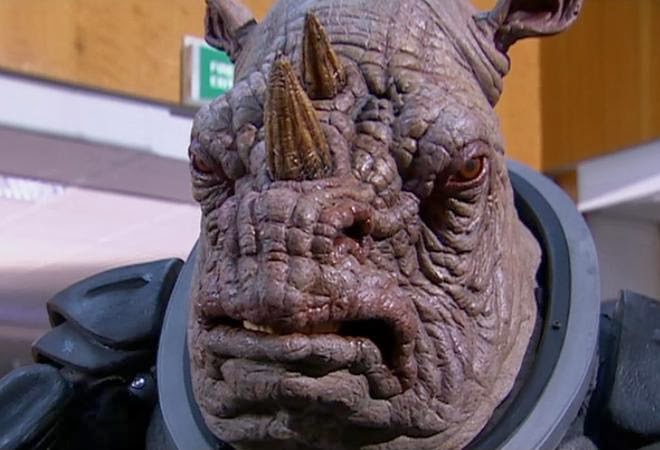
Let's pause to consider the Judoon, and how brilliant they are.  Do I mean the design?  Yes and no.  The prosthetic head is amazing.  But it's a bit boring having them look like rhinos.  Not rhino-like in appearance, not rhino-esque in behaviour, just... rhinos in spacesuits.  Russell's imagination often gets stuck to certain animals (cat nurses in New Earth, a giant spider in The Runaway Bride), and it seems a shame, given the whole of time and space to play with, that we instantly recognise some of the aliens.

And apparently, rhinos have two horns.
Who knew?
Oh well: it's how the Judoon act that really sets them apart.  They're non-partisan.  Not evil, just on a mission, hunting a shape-shifting Plasmavore.  They're grouchy, easily provoked (executing a man for attacking one of them), but basically neutral.  And you almost never see things like that in Doctor Who.  They're reminiscent of the Vogons in Hitchhiker's Guide To The Galaxy, which are not evil, just bureaucratic.  They're a damn good idea, and their language is pretty colourful as well.  "Bo!  Sco!  Fo!  Do!  No!"  Makes a change from "Exterminate", doesn't it?

So, they're not the bad guys.  Surprise!  It's Mrs Finnegan!  Anne Reid clearly enjoys herself as the devious shape-shifting old dear, and she's incredibly creepy as well as funny.  She needs human blood to disguise herself (bye bye, Doctor Stoker), and drinks it out of a little straw that she keeps in her handbag.  This is simple, and horribly effective.  The same goes for her two assistants, burly leather "Slabs" that look like bike messengers.  They don't outstay their welcome.

Annoyingly, Mrs Finnegan takes a turn for the worse before the episode ends.  She does some seriously random psycho-analysis on the Doctor (who at this point she believes to be human, so... huh?), coming out with "You're quite the funny man.  And yet, I think, laughing on purpose, at the darkness."  Where did that come from?  Then there's her barmy plan to use an MRI scanner to "fry the brain-stems" of half the Earth's population, all to get control of a Judoon spaceship and escape.  But why would an MRI scanner be able to do that, and come to think of it, how is there still electricity?  Then, when she's caught red-handed, and we find out why she committed the murder she's charged with: "She deserved it!  With those pink cheeks and those blonde curls and that simpering voice!"  So, for no reason at all, then.  How very dull.

Still, Anne Reid's very good.  It's not her fault.  And the same goes for Martha's family: they serve a real purpose in setting up Martha, and they're quite convincing, but they're still a bit trite and their reprise at the end is a slice of pure, Eastenders-lite garbage.  "This is me, putting my foot down!", said the obviously fictional character.  Russell T Davies does some fantastic work in this episode, and some that's not-so-fantastic.

Really, though, it's mostly very good.  And I've not even mentioned the Doctor.  Half the battle in introducing a companion is how they interact with him, and vice versa.  Good news on that front: it's a pretty great episode for David Tennant as well.

I feel I must comment on David Tennant's hair in this.
So... what happened there, then?
The Doctor has clearly had a bit of time to himself.  He's not grieving for Rose any more – at least, not directly – and, taking Donna's advice, he's in the market for a new friend.  Martha makes an immediate impression, but unlike Rose, she's not desperately in need of a man in her life.  For once, the Doctor has to make an impression as well.  (Hence that nifty "you've got to earn that title" exchange.)  It's not entirely the right one, for example when he kisses her to slow down the Judoon's search.  (A neat idea to confuse their scanners, but he's very lucky they didn't take her for an alien and promptly vaporise her.  Also, she inevitably gets the wrong idea.)  But he's keen to impress her, as per his trip back in time to bump into her outside the hospital.  (Yay, they're being creative with time travel!)  It's a gently different dynamic, and different is good.

Wanting to get things in the open, he lays his cards on the table about Rose before the end, which sends him into a bit of tizz and creates an awkward moment just before they fly off into the sunset.  I'm not 100% happy with that, and it's a shame he has to bring Rose up at all, but that's just the kind of Doctor he is.  He says he prefers to be on his own now, and that's ultimately not just about sulking: if there's no companion, there's no one else to get hurt.  That's an understandable development.

Elsewhere there's some fabulously creative Doctoring, such as sending radiation out of his body via his shoe, and pretending to be a human to trick Mrs Finnegan into getting caught.  (He is a bit too convincing as a human, but then that's just the kind of Doctor he is, too.)   There are some delightful little moments, like his knowing look to Martha when she asks if he's an alien, and his heartbreak over losing the sonic screwdriver.  (Although it won't stay dead, so what was the point?)  Tennant is reinvigorated throughout, and is a pleasure to watch.

Smith And Jones isn't absolutely perfect, but it does what it needs to do plus a whole lot more, and it does it all with sheer confidence.  It's smart, fast and fun without trying too hard, and it shows that Doctor Who clearly still has a lot up its sleeve.  Years later, it still packs a deserving wallop.

Thursday, 30 January 2014

Doctor Of The Bride

Doctor Who
The Runaway Bride
2006 Christmas Special


Another year, another Christmas Special.  It's absolutely brilliant that they were able to make this a yearly thing, but some of the novelty is definitely starting to wear off.

I don't mind them re-using this shot, though.
That's not to say I don't like The Runaway Bride.  Surprise!  I do!  It's just that, where Russell T Davies has to Christmas things up a bit, and he has to, he does it all virtually the same as in The Christmas Invasion.  Once again we're dealing with robot Santas, killer Christmas trees and a spaceship blowing up over London.  There's even artificial snow at the end.  I mean, it's a lovely present, Gran, but you actually got me this last year...

Fortunately, there's more to it than Christmas.  Zip back to the end of Doomsday.  Having seen Rose off to a parallel universe, the Doctor is immediately interrupted by a bride, just popping into the TARDIS, mid-flight, right in front of him.  What?  And that's exactly how it should be.  Either the Doctor moves on, or life moves along for him.  Things don't stay still in Doctor Who.

Done poorly, this is a way of just not dealing with things.  At the end of The Parting Of The Ways, for example, Earth is bombed to oblivion, but we're too distracted by the Doctor's regeneration to stop and deal with it.  Done well, charging in the opposite direction right after tragedy strikes is a way into character development, not out of it.  And The Runaway Bride uses this sudden, shocking turn of events to bring the Doctor to terms with Rose's loss.  He hasn't got time to process it, and he's got a passenger who's not interested in hearing about it.  Nevertheless, it's constantly on his mind.  (And unlike Rose's actual departure, which I found emotionally muddled for all sorts of reasons, it makes perfect sense to me that he's sorry she's gone.  He knows she's miserable, and whether or not he was ready for her to go, he is now on his own.)

Skipping temporarily over his heartbreak, the Doctor tries to get the bride, Donna, to the church on time.  And this is hilarious.  It's great having a character who's not enraptured by everything the Doctor says and does, and Donna has every right to be suspicious of this strange bloke.  "The what?"  "The TARDIS!"  "That's not even a proper word!  You're just saying things!"  It probably goes without saying that Catherine Tate is funny, but Donna is an immediately refreshing and likeable character, partly because she's so pitiably unlikeable.  She's loud, got a short fuse, and her own family don't seem terribly fond of her (let's not get started on the groom) which singles her out and, cleverly, unites her with the Doctor, since they're both lonely.

It's undoubtedly a mark of Catherine Tate's brilliance that Donna sounds so teeth-pullingly irritating when you describe her, but isn't in practice.  (Although some people found her to be exactly that.)  With all her shouting, arguing and occasional slapping, she seems like exactly the worst person to pair the Doctor with in his time of crisis.  So in a weird way, she's just what he needs.

She's good.  They should bring her back and stuff.
Oh, hang on...
Donna's lack of enchantment cuts the Doctor down to size, which is again hilarious, and keeps him from dealing with the Rose situation.  This just keeps it right at the forefront of his mind, and David Tennant does an amazing job with it.  A raging glance when Donna grabs Rose's jacket, a sudden memory when he sees a blonde girl dancing, bittersweet references to Christmas dinner... these are little moments, all the more effective for not bashing us over the head.  I prefer all of this to the Doctor's silent tears at the end of Doomsday, and certainly to all that "I love you" fan-service.  At the very end, when we've just begun to put it out of our minds and Donna asks his friend's name, the way his voice cracks as he says "Her name's Rose" strikes just the right note.  Emotional, but not too much.  It's really well done.

Alas, we can't just have sixty minutes of wedding stress and the Doctor coming to terms with stuff.  There must be a plot.  And this one has its ups and downs.

Donna is dosed with Huon particles.  They attract her to the TARDIS, and a giant spider, the Empress of the Racnoss, hopes to use them to reawaken her species.  (They're buried at the centre of the Earth in an ancient spaceship, which for some reason isn't troubled by the planet's molten core.)  Assisting her are a bunch of robots, which are those killer Santas from last year.  It's fair enough as we don't know where they come from or where they went, but seriously, it's boring.  We've had them.  Think of something else.  (And seriously, they're all still dressed as Santa?  Do they only get work at Christmas?)  The same goes for the Christmas tree, which is notably less novel this time round (exploding baubles?), on top of how tired the thing is.

So what's new?  Well, the Racnoss, which is an amazing piece of prosthetic work, and that's about the nicest thing I can say.  The character's appallingly written: just why is an ancient megalomaniac spider so full of terrible marriage jokes, doctor jokes, and three-men-walk-into-a-bar jokes?  (Okay, maybe not the last one.)  Sarah Parish doesn't exactly have much to work with, but even so, I'm hoping it wasn't her idea to pole vault over the top with every single line.  Possibly the most horrifically exaggerated performance in all of Doctor Who, she comes close to transcending that old expression and actually eating the scenery.

"WOULD YOU LIKE SOME HAM?"
And did we forget about the groom?  Oh, I wish.  In a regrettable twist, it turns out Donna's intended, Lance, is working for the Racnoss.  His motivation is to see the universe "I think you understand that, don't you, Doctor?" but if that's supposed to explain why he's prepared to drug, marry and sacrifice a random woman, well, it doesn't.  (And if it's supposed to provide some kind of commentary about the Doctor's relationship with his companions, god knows what it's actually trying to say.)  Lance just suddenly becomes a venomous bastard, not to mention a complete idiot, because "the evil monster promised me untold riches" is never going to end well.  Not exactly someone you could see clambering to explore the stars, is Lance.

The plot is all rather talky and boring, not to mention unconvincing on Lance's part, and it contains an absolutely abysmal amount of sonic screwdriver abuse.  It's supposedly there to get out of "boring" things like having to unlock a door, but the overuse of the screwdriver is ironically more boring than having to do things the hard way.  How will he get out of this one?  Oh, the screwdriver again, right.  Honestly, if you took it off him, what good is the Doctor?  (NB: The fabulous Who book A History Of The Universe In 100 Objects lists all uses of the sonic screwdriver, and the entry for The Runaway Bride is several inches longer than any other episode.  So there!)

On the plus side, there are some excellent set-pieces.  There's the astounding TARDIS car chase, which might be one of the coolest special effects I've seen in Doctor Who.  (Can you imagine anything like that in the Classic series?)  And there's the moment when the Doctor shows Donna the creation of the Earth.  This is a beautiful way to put Donna's (and the Doctor's) misery in perspective, to potentially cheer her (and himself) up, and to do that necessary culture-shock thing the Ninth Doctor did with Rose in The End Of The World.  But it's also stunning to look at.  Odd that it comes right in the middle of the villain showdown, and just goes to show how gripping that isn't, but I'd still rather be here than there.  As for the attack of the Racnoss spaceship, zapping random holes in London before a tank blows it up, it just feels like another dull echo of The Christmas Invasion.  Only this time, the Doctor doesn't complain.

The Runaway Bride seems a lot worse in hindsight.  It's easy to remember the stale Christmas gimmicks, the terribly hammy Racnoss, the blethering about Huon particles and Catherine Tate shouting a lot.  But look closer: there's a sensitive epilogue to Series Two, a moving performance from David Tennant, and a character who shouts a lot just to hide her lack of a place in the world, all lurking under last year's wrapping paper.  It's worth revisiting.

Tuesday, 28 January 2014

Goodbye, Get Lost, Get Out!

Doctor Who
Army Of Ghosts and Doomsday
Series Two, Episodes Twelve and Thirteen


As an obscure scribbler once observed, parting is such sweet sorrow.  It's also an inexhaustible source of drama, particularly in a show like Doctor Who, which in some ways is a lot of hellos and goodbyes punctuated by monsters.  The Doctor/companion relationship has been more vital than ever since 2005, so the departure of Rose was always going to be a big event.  Particularly if you don't like Rose, and were counting the days.

You may have guessed this already, but I've never quite "got" this character, and I've never understood the idea (in subsequent series) that the Doctor entirely regrets losing her.  Too much says otherwise.  She isn't just going.  It's time for her to go.

How they toy with us.
Evidence for the prosecution: in School Reunion, Rose was forcibly reminded that the Doctor has other friends, and told that he couldn't spend the rest of his life with her.  In The Girl In The Fireplace, the Doctor fell in love with another woman (hmm) and abandoned Rose to be with her.  In The Impossible Planet, the Doctor didn't want to share a mortgage with her.  In Fear Her, when Rose said they would never, ever part ways, the Doctor said "Never say never ever."  And look how Army Of Ghosts starts: in a cute flashback to an alien planet (before another episode set in London, thanks a bunch), the Doctor asks Rose how long she's going to stay with him.  Regardless of her answer (which is predictably, "Forever"), why would you even ask that question if you wanted to be BFFs for life?  The Doctor, like it or not, doesn't see this going on forever.

Never mind characters name-dropping "Torchwood".  This is what Series Two has been building up to.  But you can't spend two whole episodes getting rid of one character.  What's it all about?

Well, after moaning in my previous review that it'd be nice to start an episode part-way through the action, that's exactly what happens.  (Yay!)  The Doctor and Rose pop back to the Powell Estate and find that ghosts are turning up every day, and have been completely accepted by society.  This is thoroughly disconcerting, especially for the Doctor, who doesn't like being out of the loop and quickly "reduces it to science".  (A nice point from Jackie, and while this isn't quite what she means, it is rather boring always making ghosts, werewolves and vampires into aliens from planet Zog.  Still, it's better than slapping them all over TV screens, which is what happens here, including dully and improbably a ghost on Eastenders.)

The Doctor is sure there's something sinister at work, and suggests a lot of stuff about psychic links and people like Jackie "willing the ghosts into existence".  There's some lovely stuff when Jackie talks about her old dad, coupled with a twinkle of music from Father's Day (niiiice!), but then all the psychic link stuff turns out to be complete bollards.  Isn't it a bit unusual for the Doctor to make guesses this wide of the mark?  Why are people so convinced that they are ghosts?  I wonder if there was a previous draft where this actually went somewhere, or if it's simply meant to mislead us before the big reveal.  (Something that's doomed to failure, if you take into account Next Time trailers.)

Next Time: Army Of Ghosts.
Featuring... um.  Ghosts?
The ghosts are coming through a rift thanks to Torchwood, a shady organisation who pilfer alien technology to "protect the British Empire".  (With the increasing visibility of nasties like UKIP and the BNP, this seems less like a loopy conspiracy theory, more like a scary alternate future.)  Tracy-Ann Oberman is nicely overconfident as Yvonne Hartman, the head of Torchwood, and sells the fabulously disconcerting idea that they are A) thrilled to meet the Doctor and B) keeping him prisoner.  The scene where he arrives is wonderful: exiting the TARDIS with his arms in the air ("They can shoot me dead but the moral high-ground is mine!"), he is roundly applauded, and he introduces Jackie as his companion, in order to give Rose some time to sneak around and investigate.  This is deftly handled and very funny.  And ooh, look!  Props from old episodes!

There's more intriguing setup here, such as what Torchwood want with the Doctor, what the ghosts are all about, and what the mysterious sphere they're keeping an eye on has to do with any of it.  And the Doctor is brilliant throughout.  (Apart from singing the Ghostbusters theme.  CRINGE.)  There is, admittedly, yet another scene where he implores someone not to do something, only for them to ignore him I'm surprised that never caught on as a meme but then, joy of joys, Russell T Davies inverts it!  In one of his finest moments, Ten just lets Hartman get on with the ghost shift despite his warnings, pulls up a chair and smiles at her.  And it does the trick.  At last, the Doctor stops trying to get his way by just shouting louder.  It's quite a scene, taking a regular annoyance and making it brilliant.  Kudos.

Anyway, Torchwood are using the ghost energy as a reserve for Britain, to avoid depending on the Middle East.  Ho hum: the specifics are instantly forgotten when – dun-dun-DUN! the ghosts turn out to be Cybermen.  Funnily enough, once the cat's out of the bag the ghosts start doing the Cyberman Stomp.  Why weren't they before?  Do Cybermen tip-toe?  (And here's the real poser: there's an "advanced guard" of Cybermen sneaking around Torchwood Tower, converting people.  Setting aside how they've gone unnoticed, if all the other Cybermen are having to fade into our universe as "ghosts", how the hell did this lot get here?  And why don't the rest of them do the same?)

All the intriguing setup, with the ghosts and Torchwood, doesn't amount to much when the Cybermen get here.  And sadly, they are still terminally unimpressive.  With their choreographed stomping, Diet-Exterminate catchphrase and sorry-I-didn't-catch-that mumbly voices, they just don't do anything for me.  Fortunately, something better is on the way.  Although it does instantly make the Cybermen look even worse.

Fun fact: watching this episode is how Neil, and this blog, got its name.
Dalek Sec: "Kneel.  KNEEEEEEEL!"
One of us instinctively said: "YEEEEEEES?"
Remember that pesky sphere?  Well, it's a "void ship", and having broken through from the void between universes, it has allowed the Cybermen in as well.  (We later learn it, the Cybermen and anyone who travels inter-dimensionally is covered in "void stuff", which is just about the worst oxymoron I've ever heard.)  The void ship is carrying Daleks.  Dun-dun-DUN again!  In all seriousness, great cliff-hanger, and a timely reminder of Doctor Who's only A-List monsters.  We get a slightly embarrassing Yo Mamma So Fat contest between the two – "This is not war, this is pest control!" is delivered with that cute little angry-Dalek wobble – and then the answer to a question eight-year-olds like to ask, Who Would Win If Daleks And Cybermen Had A Fight?  Spoiler alert, the answer is Daleks.  Absolutely 100% all of the time, with no Dalek casualties whatsoever.  It actually gets kind of boring, fast, watching Daleks mowing down Cybermen.  I knew they were rubbish, but did we have to rub it in?

Like Torchwood and the ghosts, all the stuff about Cybermen then pales to insignificance when the Daleks turn up.  Sigh.  These episodes do a good job of escalating the threat, but it comes at the price of throwing away everything that came earlier.  Anyway, the Daleks have a Genesis Ark, which – gasp! – contains a lot of Daleks.  Cue Daleks whizzing around the skies, zapping people and mopping the floor with Cybermen.  It's all very spiffy-looking, but it's still not quite as bad as blowing up every country on Earth, which they did in last year's finale.  This one might have Daleks and Cybermen, but try as it might, the scale is nowhere near The Parting Of The Ways.  And as for this year's actual parting of the ways, well...

It's clear from the start that the Doctor is everything Ev.  Ree.  Thing. to Rose.  Narrating, she says: "For the first 19 years of my life, nothing happened.  Nothing at all.  Not ever.  And then I met a man called the Doctor!"  Cheerful, isn't she?  It's not inconceivable that someone would be completely obsessed with traveling with the Doctor, it would be brilliant after all, but other Doctor Who companions have been interesting people before they met him, and have actually gone on to lead lives.  (Although School Reunion places the second bit in some doubt.)  Not Rose.  Life without the Doctor means patiently eating chips until you die of old age.  No wonder she refers to their parting as "how I died".  (Okay, she's literally talking about a misunderstanding in the papers but, really?  Also, what a let-down, after two episodes and a Next Time trailer going on about how she's going to die!)  All this, combined with the little hints throughout the series that Rose is the only one who feels this way, makes me perfectly comfortable – and unfortunately, not sad – seeing her go.

"No, thanks.  Off you pop!"
The Doctor must seal the two universes, handily hoovering all the Daleks and Cybermen back into the void.  (Cancelling out all previous threats, again.  How many people got killed by Daleks and Cybermen?  Any survivors in Torchwood Tower?  Meh!  Throw the switch!)  Everyone (including Pete Tyler, who is now Rose's dad again, sort of) must pick a universe and stay there.  Rose's glassy-eyed, butterfly-net-crazy insistence on leaving Jackie forever, despite the Doctor telling her to go, is not endearing.  (And it's a bit self-involved.  "He does it alone, mum!"  Well, apart from the Sarah Janes of his past.)  He sneaks a dimensional transporter around her neck, and when Rose returns moments later, the Doctor snarls with irritation.  Do people really look at this stuff and think the Doctor wants to stay with her?  Yes, she's in considerable danger if she stays, but they've faced danger before.  He wouldn't send her packing unless he wanted to.

It's open to interpretation why he does this.  To protect her from danger, like in The Parting Of The Ways, or stop her getting too obsessed with him, or save himself the misery of losing her one day.  Perhaps he's thinking of Jackie, after accidentally stealing Rose for a year, and thinks taking her away forever is a step too far.  Whatever the reason, he still makes the choice, even if it doesn't stick right away.  The moments after Rose's return are hideously awkward, and then she has to make a life-or-death choice, and is ripped away from the Doctor forever anyway.  (Well, until the next trip to a parallel universe – something that's clearly not as impossible as he keeps saying.  Why do they bother using words like "impossible" in Doctor Who?)  This doesn't work all that well, as the Doctor is forced to do nothing to save her, which is a bit awkward.  But then Pete Tyler zips back and rescues her, possibly reminding us that there's only room for one father figure in Rose's life.  (Even if this Pete Tyler is a bit rubbish.)

We then settle in for The Big Goodbye, with Daleks and Cybermen long forgotten, and at this point if you're not a fan of Rose, it's just plain not for you.

"Same old life, last of the Time Lords."
"On your own?"
*nod*
Not pictured: crossed fingers.
She can see the Doctor one last time, as a hologram, somewhere in Norway.  (It's less weird than it sounds.)  Rose convinces her family to drive her there, and they meet on a beach.  Feelings come way out into the open, and a lot of fans cry buckets watching this.  I personally could have done without Rose saying "I love you!"  Did it need vocalising?  Did any of it?  But, if anything, I find the Doctor's reaction even more awkward.

Firstly he tells her that "living a life, day after day" is "the one adventure I can never have."  Maybe underscoring why he and Rose have to part ways?  Except, well, oh no it isn't, you big fibber.  He might not want to settle down and eat chips, but that doesn't mean he can't do it.  Then there's a white lie, nodding when Rose asks if he'll continue traveling on his own.  Yeah, a quick glance at the TARDIS guestbook suggests that's another whopper.  And there's what he actually says to "I love you", which is "Quite right, too."  (Gee, thanks?)  He doesn't get a chance to say the L word back, since the power cuts out, for which I'm grateful.  Even if he did, though, on past form, it wouldn't be entirely honest.

There's so much going on here that I never know what to take away from it.  It bears some hallmarks of a tragic parting of the ways, complete with heroic (if illogical) sacrifice and "I love you".  But there are so many mixed messages underneath you mustn't leave home or you'll hurt your family; you must leave home or your life is meaningless; staying with the Doctor is wonderful; staying with the Doctor will make you "not even human" that Doomsday leaves me cold, even with Murray Gold blaring and oo-ee-ooing like mad.  Some things just don't work.

Still, some things do.  There's some stellar setup and some really neat ideas, even if none of it goes anywhere.  Some people probably really like Cybermen, and we all like Daleks.  It's just a shame that ramming them together makes them both a bit boring.  There's a resoundingly good guest cast (including the scrumptious Freema Agyeman as a doomed Torchwood-er), even though certain cameos – like Mickey and, uh, Jake – don't ultimately add very much.  And hey, some thumping good performances from the leads.  I may not get some of the writing here, but it's hard to fault the actors: Tennant and Piper give it their all.  Like most of Series Two, however, anything built on the Tenth Doctor and Rose is going to be a bit wobbly.  By the end of this, I should be in tears.  Instead, I'm checking my watch.  Fortunately, change is just around the corner.

Friday, 24 January 2014

Here's One We Made Earlier

Doctor Who
Fear Her
Series Two, Episode Eleven


Damn it!  We were that close to getting a Doctor Who episode by Stephen Fry.  When his script (presumably entitled Night Of The Dazzling Special Effects) was deemed too costly and complicated, it was shelved until Series Three.  (Fry never had time for a rewrite, so his episode went unmade.  Boo.)  A replacement was needed, preferably one that wouldn't cost an arm and a leg, so we got Fear Her instead.  Fair enough.  These things happen.

I only mention all this because frankly, it shows.  It doesn't matter that this script wasn't their first choice, and it doesn't matter that it was up against the budget.  What matters is that both of these things are apparent when watching it.


The matte paintings have really gone downhill.
Fear Her takes us to an unremarkable suburb in 2012.  (Back when it was the future.  Bless!)  The Olympic torch is due to pass the end of the street, so everyone's excited.  Also some children have disappeared, so everyone's worried.  The overall mood is pretty weird, especially since the police have apparently given up looking for the missing kids, one of whom goes missing as the episode progresses.  I know people are excited about the Olympics, but there are three missing kids in one street, all gone in one week.  There are Missing posters on a few lamp-posts, but where are the cops?  And the news vans?  Come to think of it, where are the parents?  Shouldn't they be front and centre, and tearing their hair out?  As it is, you could cut the tension with a foam finger.

The Doctor and Rose arrive, tediously clocking the Missing posters the moment they exit the TARDIS.  (It makes me yearn for episodes that begin part-way through.)  The Doctor is intrigued, if a little naive about who's behind it all.  ("What makes you think it's a person?"  You probably don't want to know, Doc.)  Anyway, he's right: the culprit is an alien working through a little girl.  Desperate not to be alone, the Isolus gives Chloe magic powers.  When she draws things she can see (such as children and animals) they are transported into pictures.  When she draws things from scratch (such as scribbles and nightmares), they come into the real world.  It's a bit like Penny Crayon with a split personality, and there's a lot of potential.  It's literally a creative idea.

And it works really well, sometimes.  Take the scribble monster.  Incredibly simple and utterly different.  I like it.  Then there's the drawings: you don't need very much budget for a bunch of doodles, and the sight of one coming to life is both creepy, and simple to animate.  All this is good, especially on a shoestring budget.  But then what?  Only one scribble monster, plus a drawing of Chloe's violent dad that comes to life off-screen.  There are references to drawings that move, but we mostly don't see them.  As for what goes on in the cartoon world, where at one point the Doctor is trapped, forget it.  We just don't go there.


Possibly the best and worst design ever.
There's potential for something genuinely unusual here, and it isn't realised.  What's left is suspiciously like something we've already had.  Do a quick Find-and-Replace, swap "2012" with "1953", "the Olympics" with "the Coronation", "monster that eats children" with "monster that eats faces", "the Doctor disappears" with "Rose disappears", and presto, you've got The Idiot's Lantern, except even less interesting.  Instead of the Wire, which is evil and wants to feed on everyone, we've got the Isolus, which is lonely and just wants to be loved.  Unintentional plagiarism mixed with a complete lack of threat or excitement and you say this episode wasn't their first choice?  Get away!

You might expect the characters to be well developed, given that there's almost nothing else here, but Chloe and her mum are a complete non-starter.  Little girls can be very creepy, a fact utilised by a lot of horror movies, but Chloe just sits there drawing things and talking in the third person.  For "alien menace", read "dodgy Batman impression".  Her mum's a fascinating masterclass in How Not To Be A Parent, as she knows Chloe's responsible for the missing children and does nothing about it, she's asked not to leave Chloe alone and instantly forgets, and she freely admits that when her abusive husband was still alive, "Chloe always got the worst of it".  Best Mum Ever!  As for the supporting cast, the neighbours all sound like extras in a car insurance advert.  No wonder I want to know where the missing kids have been going.  It's got to be more interesting than here.

Amazingly, Fear Her does actually get worse.  Left alone with some colouring pencils and Sky News (Best Mum Ever!), Chloe proceeds to draw everyone in the Olympic Stadium.  This would be shocking if it wasn't so hilariously executed: the tragedy hits home when Huw Edwards notices Newsreader Bob has gone.  "Bob?  Not you too, Bob!"  Later, with the Doctor gone, Rose realises two things are required to make the Isolus leave: heat and love.  Huw, moving on instantly from the 80,000 people who just disappeared, lets us know that the torch is "a beacon of hope, and fortitude and courage, and it's a beacon of love!"  So stop laughing! Rose chucks the pod in the Olympic torch, and that's that.


Let's face it, being in Doctor Who makes him this happy every week.
There's a last ditch attempt to scare the audience, with the unseen Dad Of Doom coming back to life, but the power of love is enough to sort that out as well.  (Oh, goodie.)  But then, disaster!  The torch bearer collapses, prompting Huw to ask "Does this mean the Olympic dream is dead?", but I said stop laughing! the Doctor turns up, grabs the Olympic torch and personally delivers it to the stadium.  Huw, continuing heroically with the worst dialogue in the episode, helpfully tells us "He's carrying the flame and no one wants to stop him!"  And then, "It's more than a flame now, Bob!  It's heat and light, and it's hope, and it's courage, and it's love!"  This is hilarious, mostly because it's the cherry on a cake of sheer saccharine awfulness, and partly because the Opening Ceremony unavoidably looks so much worse than it did in real life.  (If you can't afford monsters, you can't afford the Olympics.  What were they thinking?)  By the end of the episode, I'd sprained a cringe muscle.

Fear Her gets a lot of flak from Doctor Who fans, possibly even more than Love & Monsters.  (Which as we've established, really doesn't deserve it.)  This time, I can understand why: it's boring, unoriginal and cringe-worthy.  But there are plus points, which prevent it from being Worst Episode Ever material, despite its reputation.  Here there are.  Have a pad and pencil ready.

First, there's the scribble monster.  Good idea, well-executed.  Second, there's a (deliberately) hilarious bit where the TARDIS lands the wrong way round it's funny, and long overdue.  But the big plus, for me, is David Tennant.  The Doctor's the best thing here, for once.  He's funny ("I'm being facetious.  There's no call for it"), caring ("Can you help?"  "Yes I can!"), but best of all, slightly odd.  Fear Her's full of strange little Doctor moments, where he sniffs things, makes jokes to himself, starts eating other people's marmalade, or makes a throwaway reference to his family, all of which reminds us (albeit very gently) that the Doctor isn't quite normal.  It's not massively important, but it makes a difference to me, especially where this Doctor – who often blends too much into the background – is concerned.  I'd genuinely watch Fear Her again, just to watch what he's doing.

So there we go.  It's not much, but it's not all bad.  Honest.