Showing posts with label Stephen King. Show all posts

Tuesday, 14 July 2015

The Bookcase Of Fear #9: Redshirts by John Scalzi

Redshirts
By John Scalzi

Here's an example of not judging a book by its cover.  Glance at the artwork or the blurb for John Scalzi's Redshirts and you'll see a sci-fi spoof – and you know what, let's call a spade a spade.  It's a Star Trek spoof.  Very much in the vein of Galaxy Quest, it's clearly aimed at the tropes and conventions of everyone's favourite space exploration show, making a particular bugaboo of those hapless extras who tend to die for idiotic reasons.  And there's nothing wrong with that.  Goodness knows there are plenty of conventions and clichés to choose from, and why not make a book about those unfortunately mortal joes?  There are laughs to be had.

For a while Redshirts goes after the gag, savagely mocking the illogical and unsafe away missions that plague your average episode of Star Trek.  And it's funny, but also kind of limiting.  Spoofs are tough to maintain, just as satire makes it difficult to tell a good story.  The more you remind us of something we are familiar with, and/or point out how silly it is, the further we feel from the characters as people, the harder it is for the story to say anything for itself.  It's just a satire.  Nobody loves Airplane! for its plot.

Fortunately, John Scalzi – who I'd never heard of pre-Redshirts – has numerous tricks up his sleeve.  The joke evolves.  It's not just about how silly it is that people die in certain ways and at certain times, but how other characters deal with it, whether they even notice it, and just why it keeps happening.  Before long, Redshirts is working on a whole other level of meta self-awareness, and rather than loiter cheerily in Star Trek's allegorical shadow, it highlights the comparison.  And... that's about as far as I can go describing the plot before I get into spoilers.  Incidentally, thank you, the people who designed the cover and wrote the blurb, leaving Redshirts looking like Star Trek Spoof 101.  I was not expecting it to go where it went, so I was pleasantly shocked when it did.

There is a downside to this.  Some people may dismiss Redshirts as a spoof.  If they do, they'll miss a complex and funny story which celebrates (and mourns) the life of small and unsung characters, and ponders what we can learn from them.  It has dizzying things to say about creativity, writing and life – all of which is supported by an extensive knowledge of sci-fi silliness that will make Star Trek fans chortle, but that's still just the hook.  It was the book's heart and mind games that made a lasting impression on me.

Do I have any complaints?  Well, it's quite short, but then that might be another way of saying "it's voraciously readable".  I've spent longer, and had less fun with thinner books.  Oh, but here's an annoying niggle: those redshirts in Star Trek tended to be the security guys.  That's why they always went on away missions and why they always barrelled into danger.  They were literally protecting the main characters.  It's not universally true of every episode, and they were still written as blundering suicidal oafs, but it's still a basic piece of internal Trek logic that people love to ignore or forget.  (See also, Captain Kirk's grossly exaggerated libido, which thankfully does not appear in any shape or form here.)  It's a shame to devote all that energy to the minutiae of sci-fi and still miss that detail.

Nonetheless, Redshirts is hugely enjoyable and rewarding.  A creative, thoughtful and while-he's-at-it hilarious piece of work.  You should read it!


Mr Mercedes
By Stephen King

A retired cop with drink and dark thoughts for company.  A one-time killer he never caught, determined to drive him to suicide, and maybe to resume old habits as well.  Both men are hunting the other.

I'm sure Stephen King would agree his book has something in common with... too many hunt-the-killer thrillers to mention, actually.  Mr Mercedes is such a textbook example of "cat-and-mouse" that the cop and killer even share the same initials.  I'm forcibly reminded of a line from Adaptation: "You explore the notion that cop and criminal are really two aspects of the same person.  See every cop movie ever made for other examples of this."  And we know King reads and watches other examples, because his heroic ex-cop likes to list them and point out the inaccuracies – always within the shadow of Dirty Harry, or what have you.

Still, the race to catch "the Mercedes Killer" is an exciting one, despite (or maybe because of) King's craving for giving us information ahead of time.  Even writing it in present tense (possibly to add flavour to what is, for King, a new genre after all) does not alleviate the random spurts of future info that have plagued his novels since Carrie.  Perhaps it's a Hitchcockian device, showing us the bomb under the carriage.  It certainly adds tension, but sometimes we're talking about a lead time of a couple of pages, and sometimes it simply removes the tension.  Sometimes I want to say: Stephen, just let me get there.  The present tense doesn't add a great deal; I stopped noticing it after a while.  Chopping between Bill (cop) and Brady (killer) gives the thing an atmosphere.  It is as unpleasant as you would expect to inhabit the killer's mind.

I'm not sure the catch-him-even-though-he-won't-do-it-again aspect was really utilised (as per the blurb: he'll do it again), but perhaps that wouldn't have been as exciting a story.  And while it's limiting to think of King as a horror author, this brand of fiction (although compelling) is a little limiting too, since there's arguably less call for imagination in the characters.  Certainly these ones.  You could whip up Bill Hodges from any cop movie ever, and Brady's psychosis is altogether garden variety.  (Take one young mega-misanthrope, add Oedipal frosting.)  A scene where he's haunted by his younger brother comes reassuringly close to horror territory, but it's not one of many.

Elsewhere, King's frequent pre-occupation with sex rears its head – sigh – but his concerning fascination with racial stereotypes is the novel's loudest bum note.  Jerome, a brilliant and articulate young [black] man, insists on adopting an old-timey persona called "Tyrone".  He's a racist caricature, no one in the book finds him funny and it doesn't add anything at all to the story.  I have no idea why it's here and I winced every single time.  It's one of those things an author might defend as "more of a reflection on racism", but he's still a white guy writing a black guy that says "massa", so uh, no, it should go.  Of course it should.  It was published in 2013, for god's sake.

I often find myself listing complaints even when I've enjoyed a book.  For good measure, yes, I enjoyed Mr Mercedes, but it's plot-driven and there's really not a lot to say when it works – it's a thriller, it can be quite thrilling.  King's back-and-forth narrative is a fun setup, even if the novel's e-mail correspondence conceit, like Brady's initial taunting promise never to do it again, ultimately falls under the steamroller of Hunt The Killer Thriller, there to reap familiar rewards.


11.22.63
By Stephen King

There's something inevitable about 11.22.63.  (And before we get started, the title sucks.  Say it out loud.  Catchy it ain't.)  The genre-guzzling Stephen King was bound to do a time travel story eventually, and his fascination with Americana leaves the Kennedy assassination looking like 2001's monolith.  It's really no surprise that he's had this in mind for years.  However, the wound was a little too fresh in 1972, and he was busy at the time, so we got it in 2011.

It's a pity he waited, as "Go back and save Kennedy" is an idea I've heard a few times.  Quantum Leap spent three miserable episodes on it, Red Dwarf went there, Doctor Who tipped the wink...  Where time travel is concerned it's simply a hard one to miss.  11.22.63 must do a memorable job, and maybe avoid the pitfalls of time travel fiction along the way.  It does a goodish job of both, for the most part.

The early pace is so fast, it's more like a novella than (oh boy) a 740-page King brick.  Shortly after you've met him, schoolteacher Jake Epping discovers a time portal in the back of a diner.  The owner is dying, and he has a plan to impart.  You already know what that is, so why mince words?  This kind of succinctness is missed during the book's chunky midsection.  It's rarely dull, but there is a lot of it.

And it's mostly exciting.  Jake averts a few other disasters before that big day in Dallas, turning 11.22.63 into a sort of epic Groundhog Day.  (Which is okay, I adore that movie.)  Plus he falls in love – how could he stay here and not? – which is where the book plants roots and puts on weight.  He must juggle two lives, teaching and living in a small town and carrying out you-know-what in Dallas.  Both feel like novels in themselves, and that's after a few hundred pages in Derry, the It place.  (Yes, it's exciting to remember that story, and there's yet another novel's worth of good stuff to be had there, but the further you get from this bit the more out of place it seems.  He really squeezed in an It sequel?  Oh well, I guess in 1958 it was too good to pass up.)  The characters are not his richest or best, but it's difficult to invest all that time and not care about them.  You'll get to know Lee Harvey Oswald pretty well.

There are plenty of heart-in-your-throat moments, but Jake marks time between them, either compiling research on Oswald or worrying away at Sadie's (his girlfriend's) past.  The latter indulges the author's love for the era; the former is where his deep research is most obvious.  (Authors suffer in research, and misery loves company.)  That's a fat stack of waiting, although there's plenty of colour too.  Momentum builds and pays off, and you will race through the last hundred pages, at least until the ending comes along.

I won't spoil it, but in a story like this the ending is always going to be a make-or-breaker.  (There's that inevitability again.)  In my case, we're talking break-like-a-TV-out-of-a-high-window.  Okay, semi-spoiler: it's a bad ending, an almost apologetic, bubble-bursting, effort-wasting Twilight Zone switcheroo that has really, really been done before.  It casts a shadow over everything that came before, all 700 research-filled do-it-all-again pages of it, and I wish it didn't.  The only reason I can think of is that it's "inevitable" – a time travel story just has to go there, right?

But y'know what?  There's no such thing as time travel.  All the "rules" are arbitrary, made up, they vary from writer to writer, or they should.  I'd be more surprised and certainly more satisfied if we avoided, say, a lesson on the Butterfly Effect.  Because we've heard it.  Jake is a savvy narrator, he strikes off all sorts of outcomes just as they occur to you – so why ultimately go for one that's just as obvious, and while we're at it, super lame?  Just what's so wrong with having your cake and eating it?  If you've seen the movie Frequency, or obviously Back To The Future, you'll know how good it can be.  We expect that time will take its grim toll, because that's how life is and how so many stories end.  We come to you, Mr Writer, for the unexpected.

It's just too bad.  With a strict editor and a serious talking-to about what it all means and where it's going, this could have been The Great JFK Time Travel Novel.  Instead it's an exhilarating wait for a terrible punchline; a regrettable choice that, thanks to our humdrum linear world, nobody can go back and fix.


Doctor Who
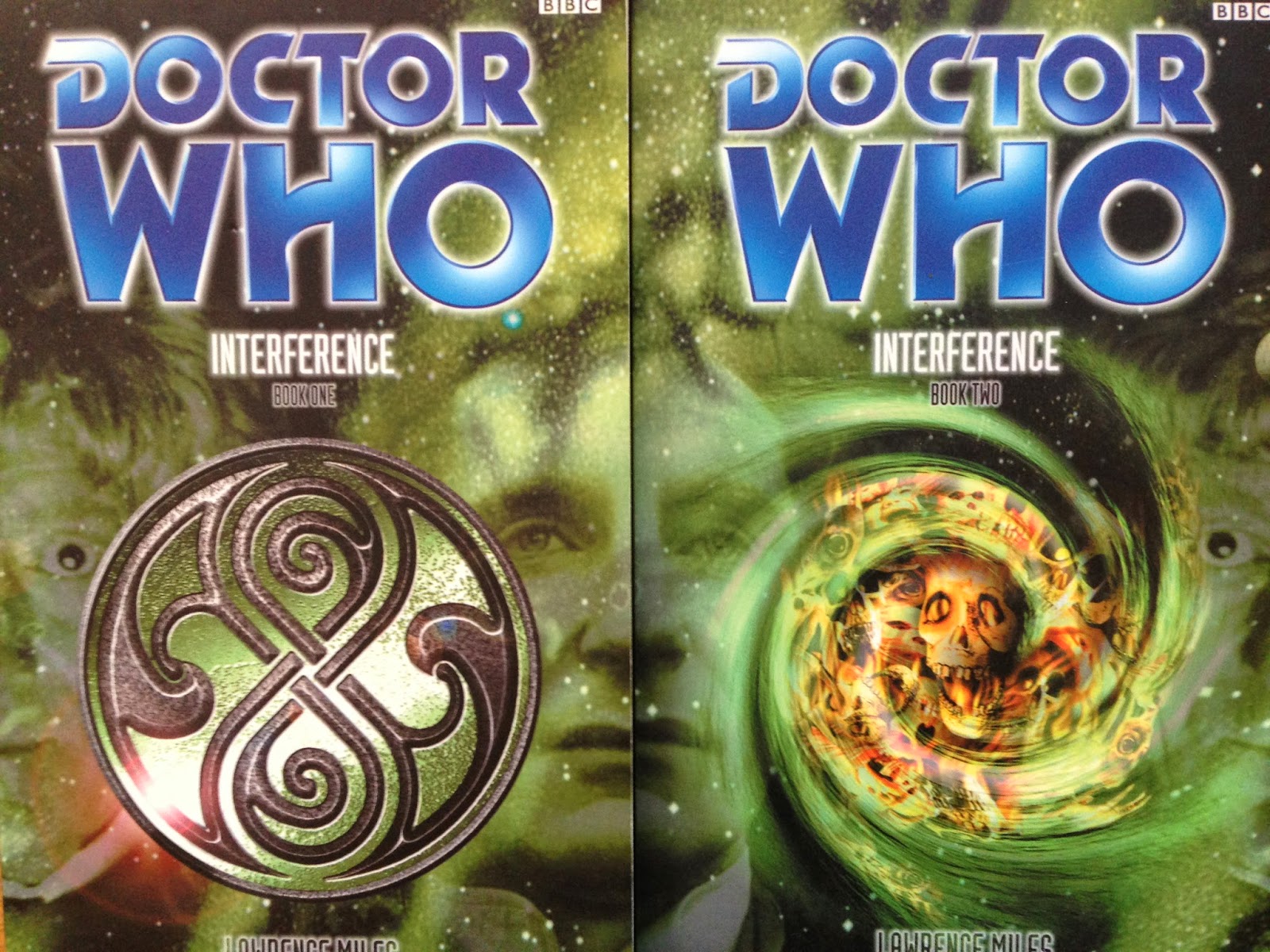
Interference
Book Two: Hour Of The Geek
By Lawrence Miles

There isn’t much I can say about Interference: Book Two that I didn’t already say about Interference: Book One, since it is merely the next 300 pages of the same book, but here goes.

Lawrence Miles continues to confuse “ideas” with “story”.  Banging on endlessly about his evil Faction Paradox (or are they!) and his vaguely technology-satirising aliens, the Remote, and what both of them stand for and what they want out of life, is not a substitute for narrative.  The sheer misery of following their exploits is not something that needed to span two books.  It might not be so bad if the ideas themselves were more interesting, but they just didn’t grab me the way they obviously do the author.  Right now, I don’t ever want to hear the words “remote”, “media” or “signals” again.  600 pages of it.  Good god.

But it’s not all about faction this and signal that: there are characters in here too.  Sarah Jane continues to entertain the most, along with her Ogron pal, but the modern Doctor-and-companion bunch (the, er, main characters) fare less well.  The Doctor’s out of prison at least, but what took him so long?  Sam finally says goodbye, and maybe it’s because I haven’t read all the books with her in, but it didn’t make much of an impression.  Fitz gets up to some depressing nonsense on the sidelines – Fitz who? – and the guest cast are a pine forest, including the no-you-must-be-joking next companion.  Meet Compassion: a person so stunningly unscintillating, Miles might as well pass a bomb to the other writers in this series.  Good luck, folks.

Events finally return to the Third Doctor, and they do pick up a bit, as Miles clearly has a soft spot for that incarnation.  (Conversely, the younger Sarah Jane is reduced to frowning in the background.)  There are some very neat ideas here – although that’s not always a good thing, see above – and Doctor Who history gets memorably changed.  Spoiler alert: Jon Pertwee has an entirely new death scene.  Not a bad idea in theory (and it somehow doesn’t affect the rest of the TV series), but it’s only there to set up events for the Eighth Doctor which – and I can hardly believe this – haven’t happened yet.  Tune in next week?  You must be joking.

Interference is a big gamble, and it doesn’t pay off.  Simply put, despite a few bright spots, this is one boring book for the price of two.

Sunday, 6 July 2014

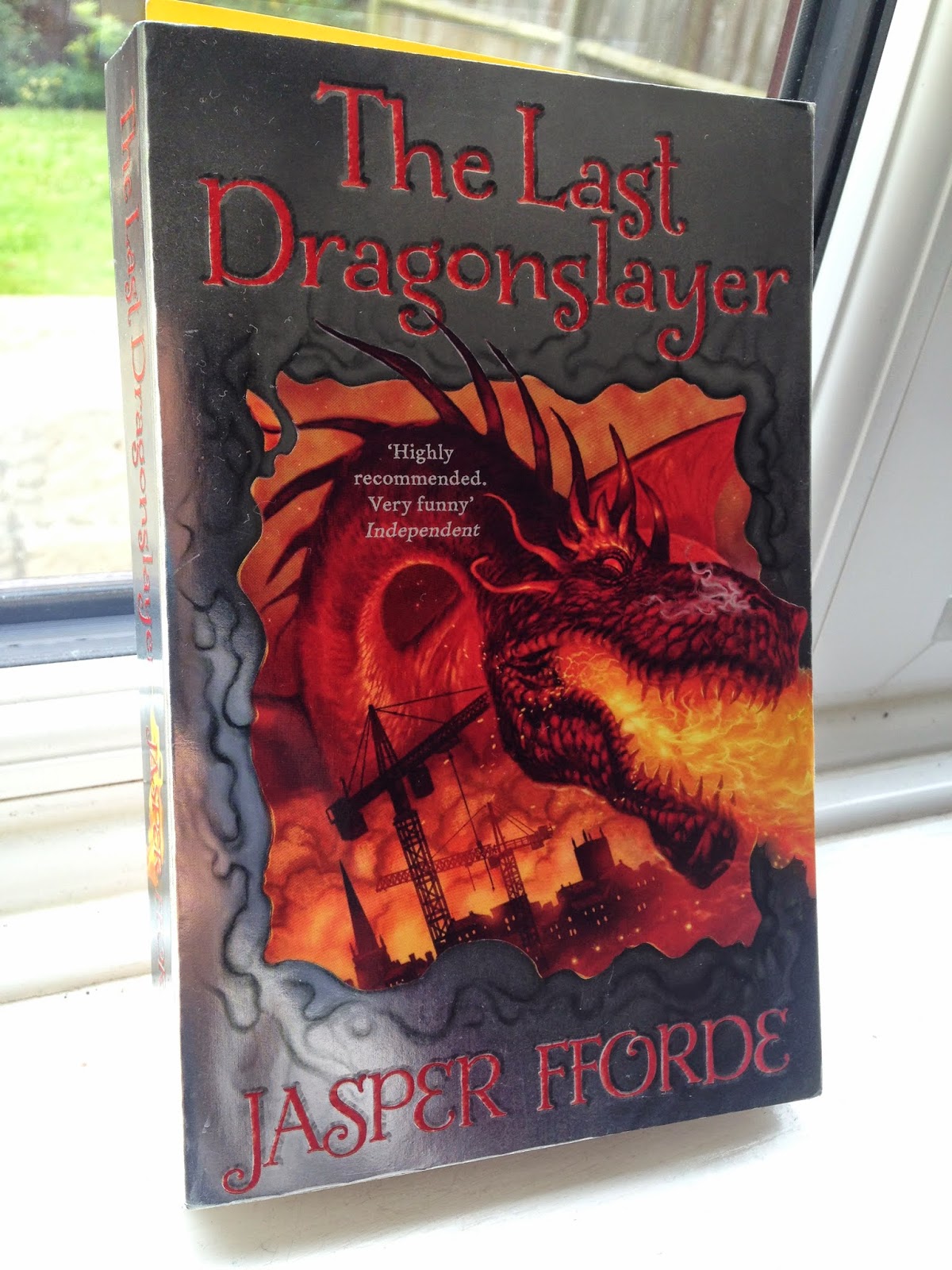
The Bookcase Of Fear #8: The Last Dragonslayer by Jasper Fforde

Quick note to my scant number of readers.  (Ah, lost, are you?  The loo's over there...)  Having finally sorted out my laptop's DVD player, I'll shortly be returning to some DVD reviews.  By which I mean, largely, Doctor Who reviews.  Just thought I should mention it.

Right then!  Have at you, bookcase!


The Last Dragonslayer
By Jasper Fforde


Knowing very little about Jasper Fforde, my first reaction to The Last Dragonslayer (other than “Thanks for the birthday present, Robert”) was being slightly underwhelmed.  A novel about dragons, magic and wizards?  All of that’s been done.  Well, I needn’t have worried.  The Last Dragonslayer takes admittedly very familiar elements and puts them to work in a sharp, charming plot.  Against the odds, it actually feels very original.

It’s set in a parallel world, roughly contemporary, but with magic and dragons as a part of daily life.  I enjoyed the lived-in, clapped-out-ness of magic and the way people deal with it: they use magic to do their plumbing, and have to fill out endless forms to make sure it’s all accounted for, because magic is limited.  I’m sometimes put off by parallel world stories, as I feel at a conscious distance from the worlds they create, but this one very quickly, very skilfully set out its world and made it feel familiar.  I was reminded of Harry Potter, specifically the way those books never really reconciled how magical and non-magical people could co-exist.  I think this one does it better.

It’s the story of Jennifer Strange, a nearly-sixteen-year-old orphan who finds herself running a magical odd-jobs company and looking after its assortment of wizards and witches, all of whom have varying talents and sensitive egos.  Jennifer is a wonderful creation, believably young yet wearisomely mature.  The plot revolves around a prophecy.  (I know, they’re overdone as well, but this one is well handled and isn’t dragged out for half a dozen books.)  The prophecy concerns the last dragon known to exist and Jennifer’s part in its death.  And really, I don’t want to go into it too much – the plot is very tidy and it keeps moving and you should discover it all for yourself.  The book’s short; I don’t want to spoil it.

Fforde’s book is funny without hitting you over the head about it, thoughtful without feeling like a soapbox, and has an endearingly fresh perspective on its fantasy tropes.  I enjoyed it, am glad there are more books in the series, and encourage you to investigate.  Race you!


The Green Mile
By Stephen King


Another Stephen King book bites the dust.  Written as a serial in 1996, The Green Mile is the memoir of Paul Edgecomb – once the head guard at Cold Mountain Penitentiary, E Wing, home of the electric chair.  (And a grim, lime-coloured floor.)  It concerns John Coffey, a mysterious black man convicted of murdering two young girls, and it’s as grim as a Death Row story ought to be, but with some magic and humour mixed in as well.

Being six volumes rather than one, the book has an episodic and repetitive nature, sprinkling recaps throughout just in case you’re joining mid-way.  (In an omnibus, however, this is no longer a problem.)  On the plus side, the repetition (unintentionally?) chimes with the advanced age of the narrator.  King’s usual habit of casually dipping into the future also genuinely seems like something you’d find in a memoir.  However, the framing device – Paul writing his recollections in a rest home, as he avoids a transparently evil orderly – doesn’t add much to the story.  I was generally keen to get back to the events of 1932.

As for the main cut-and-thrust of the book, it’s compelling and has plenty of momentum.  The chapters are short; you can almost feel Stephen King hammering them out to meet his deadlines.  He mentions in the Foreword and Afterword that he enjoyed the challenge, and the change of pace.  It felt like a quick read.

If there’s a major criticism, it’s a lack of depth.  I saw the (excellent) Frank Darabont movie before reading this, and there’s really not a great deal more to be found on the page, besides a more downbeat conclusion.  The characters are all suitably good or evil, and while some are a bit of both, a few border on archetypal.  John Coffey, besides his obvious and deliberate Jesus Christ initials, seems like a textbook example of Spike Lee’s patented “magic negro” character.  Paul’s rest home nemesis, meanwhile, comes from a noticeably dry well marked “evil orderlies”.

It’s an equally sweet and grisly yarn, but it didn’t leave much of an impression.  The green mile (between the cells and the electric chair) might be long, but the shadow of King’s earlier work, Rita Hayworth And Shawshank Redemption, seems a little longer.


The Vampire’s Holiday
By Willis Hall


Willis Hall wrote a lot of children’s books about Henry Hollins, a boy seemingly forever on holiday with his parents.  They’ve encountered all sorts of oddities, including a dinosaur and an inflatable shop, but there’s a series within the series about Count Alucard – Dracula’s harmless, vegetarian descendant.  (Not to be confused with Count Duckula, who springs suddenly to mind.)

The Vampire’s Holiday is the second book in the series, and it’s a lot like the first.  Alucard must contend with the prejudices and fears of a small town, before ultimately fleeing.  Henry rallies to help him – he’s the only person with the common sense to give him a chance – while the townspeople, in particular the mayor, use the vampire business to their own ends.  One of the things I loved about The Last Vampire (and Hall’s other books) is the way every character has a point of view, even the animals.  They all have their own individual (and usually light-hearted) dramas going on, and that makes the story a lot more colourful.

Unfortunately there’s very little plot.  Alucard winds up in England (after his coffin is thrown overboard, although he seemed to be heading in that direction anyway), and he never says exactly why he went there.  I’m assuming it’s a holiday, re the title, but Henry asks him why at one point and he never gets around to answering.  He spends the rest of the book trying to get away, while the people of Scarcombe variously panic, overreact and take advantage of the situation.  (Well, wasn’t it obvious that was going to happen?)  In the middle of all this is Alucard, who’s terribly nice but scarcely interacts with anyone, and Henry, who despite being the hero of Hall’s books has no particular personality.  I can only assume younger readers were encouraged to project themselves onto him, because he’s the least interesting character in every scene, including the ones with his parents.

Still, it’s a funny, friendly story, with a lovely attitude to pre-judging others; there’s some great stuff from the point of view of some captive wolves.  The locals are all suitably amusing, if rather familiar; Hall can’t resist working in a bit of political satire with the mayor.  It’s a nice read, but after two books it’s a shame Henry didn’t try to change a few minds, rather than simply helping Alucard to run away until his next instalment.  Also, the story ignores the end of the last book, where Alucard had some intention of living with Henry.  His only friend in the world, you’d think that would remain his Plan A.


Doctor Who
Interference
Book One: Shock Tactic
By Lawrence Miles


This is pretty ambitious for a Doctor Who novel.  It’s spread over two books, features two Doctors (Paul McGann and Jon Pertwee), and wraps up the complicated story of Sam Jones, a companion invented just for the BBC books range.  I’ve only read Book One so far.  How’s it going?

Put it this way: if I didn’t already own Book Two, I wouldn’t be buying it.  Heck, if that were the case, I wouldn’t have finished reading Book One.

So far (and since this is a full-priced book, it’s fair to pause and reflect), Interference is a mess, decorated with smug window-dressing.  This bit’s in italics!  This bit’s in script!  The chapter titles have funny sub-headings!  Ho, ho.  The prose is often thoughtful, but it’s an absolute headache keeping up with the various plot strands – and being only Book One of Two, surprise!  None of them go anywhere.

Let’s see: there’s an international arms conference in London, where aliens are selling black goo called “Cold” which can teleport and/or harm you depending on the plot.  (NB: This isn't the "real" Cold.)  The aliens are “the Remote”, which means they make decisions based on television signals.  (I don’t know if I’ve understood that correctly.)  Sam investigates this, while the Doctor’s other companion, Fitz, is lost in time somewhere.  He’s trying to get to know the Faction Paradox, a group of evil Time Lord somethings who are behind everything, ever.

One of the Doctor’s previous companions is here to help: it’s Sarah Jane Smith!  (And K9!  Yay!)  Alas, the Doctor is in a Saudi Arabian prison being tortured, talking to himself across time and writing maths equations in blood.  Meanwhile, Sam is spirited away to the Remote home-world (I think?), and Sarah meets a helpful Ogron – those muscle-for-hire aliens from the Classic series.  This is the best bit, by light years.  Then cut randomly to the Third Doctor (and a younger, far less interesting Sarah Jane) trapped in humanity’s final resting place: a Wild West parody called Dust, where there’s a freak-show possibly involving Time Lords.  Meanwhile, the Doctor – the main one, Paul McGann – recounts this entire story later to someone, somewhere, for some reason.  Eventually things grind to a halt because that’s all the pages you’re getting, buster.

As the first part of a story, this is just awful.  The characters are mysterious to the point where they’re barely even there.  The plot is overly busy, but it doesn’t coalesce into an actual story at any point.  I don’t know what “Cold” has to do with anything, or why “the Remote” are worth so much exposition, or what the blithery feck is so interesting about Faction Paradox – no, please, devote another dozen paragraphs to how their cult operates, it’s all gold.  I don’t know where Fitz is, and I don’t know what’s going on with Sam.  (If you haven’t read all the Eighth Doctor books up to this point, worse luck.  And welcome to my world.)  After 309 pages, I don’t care, Book Two or no Book Two, your story should have come together already.  We should know what’s at stake.  By the end of Book One, however, Interference is still total spaghetti.

I loved Miles’s earlier book, Alien Bodies.  A gem of a Doctor Who story, it had bags of imagination and wit.  There’s little in here I even recognise as Doctor Who.  An arms conference?  A Saudi Arabian prison cell?  Even the Doctor, both of him heavily featured on the front and back covers, barely registers.  It’s 309 pages of punishingly dull non-story.  After that, Part Two had better be the best book ever written.  No pressure.

Wednesday, 30 April 2014

The Bookcase Of Fear #6: Stephen King's The Stand

The Stand
By Stephen King


Well, I’m back.

At 1138 pages, The Stand is comfortably the longest book I’ve ever read, nudging aside the second-longest, also by Stephen King.  I emerged from it earlier today, parched and bleary-eyed.  What was the last book I read before this?  What's the date?  What year?

“The Stand” is the aftermath of a man-made plague, and it might as well be broken up into three volumes, ala The Lord Of The Rings.  For 300-odd pages it concerns the plague, not-so-affectionately known as “Captain Trips”.  The horrifying superflu spreads from one panicking security guard to pretty well everyone in America.  (The rest of the world soon joins in, thanks to some slithery men in black not wanting the USA to take the blame.  This sequence barely covers a page – perhaps it was a late addition? – and in any case, we never really leave America.)

King has said it was “fun” tearing down society, and given the pace of the rest of the novel it certainly falls apart fast.  Plenty of satirical nightmares are brought to life as the army struggles (pointlessly) to cover it up.  The death toll is virtually everybody; you won’t forget any of it in a hurry.  The horrifying imagination of this section could be a whole novel.  (Though in all honesty, at 300-ish pages, it is.)

The next section is about the survivors.  Some of them die just the same, only later (Captain Trips getting his second wind); some are killed in various grim mishaps; the rest gather their wits and start going… somewhere.  They have nothing to guide them except dreams, either concerning an old (very old) lady in the East, or a spooky “dark man” in the West.  This section is full of dreamy eeriness, as characters pass through deserted places, avoid simple perils and sidestep the dead.  Reading this, it occurred to me how many post-apocalyptic stories I’ve come across, almost all involving zombies.  It’s refreshing to read one where the dead stay dead, and our heroes’ problems stay closer (relatively speaking) to reality.

King deals, in detail, with the simple matters of staying alive and getting places.  I suspect much of the story came about from wondering how people would cope in a worst case scenario.  It’s a satisfying What If in that way, and I enjoyed the grim reality of Captain Trips, plus the harsh reality of surviving it, more than the book's final third.  More on that in a minute.

Being scattered over the country, it takes a while for our heroes to meet.  As with King’s also-elephantine It, you’ve got plenty of time to get attached to them.  Most of them are compelling: there are heroes that grow and conquer considerable flaws, but also villains who agonise over their choices.  (By the end, very few of either are left standing.)  The cast grows exponentially when both groups set up their own towns, and there are some very long chapters devoted to characters I just didn't care for.  Some of these guys are overgrown archetypes; most of the women are (typically?) defined by their sex, either sex-obsessed or sexually victimised or mothers.  Mother Abigail, the Godly figurehead, seems much more symbol than person, even after we hear her generous life story.  And despite seemingly endless effort to big up the villain, Randall Flagg – an ethereal, supernaturally-gifted spawn of Satan – he never struck me as remotely interesting.

King obviously finds him fascinating: he crops up in later works, particularly The Dark Tower series.  Flagg seemed to me like a mess of all-powerful ideas and weird, kooky details.  He’s boringly persuasive and omnipotent, until the plot (and presumably, God) requires him not to be.  Which leads to a wider point: much like Homer, if it’s all ultimately up to the gods, with characters getting psychic visions as to where it’s all going, they all seem a bit impotent.  Since, in fiction, it’s always up to the gods – i.e. the writer – it seems like cheating to have that in the actual plot.  (That said, King is a big fan of foreshadowing.  For me, Carrie was ruined by spending its entire length telling me how it ended.)  Anyway, I often wondered what Flagg could accomplish that would, all told, be genuinely worse than an apocalyptic superflu.

It all comes down to good vs. evil (personified as bluntly as possible by Abigail and Flagg), and it is eventually quite satisfying.  However, with its Godly messages, religious quests and explosive finale, it seems like a million miles from the realistic, satisfying What If that germinated the story.  While the story certainly evolves as it goes along, I wonder if it lost something.

My copy is the extended 1990 edition, with 400 pages put back in, and it takes a hell of a long time to get anywhere.  (Also my edition – a battered TV-movie tie-in – is replete with typos.  The best one is “minges”.)  The good moments are couched in sheer, gratuitous length, and unlike It – a not-really-relevant comparison, I know – I didn’t feel very much closure at the end.  Our heroes' fate is happy (at least those who made it), but it's totally open to future miseries.  Because hey, it's a cautionary tale: cue an outrageous moral finger-wagging right at the close.  I wish that bit hadn't made the cut.  If your point hasn’t sunk in by page 1130-something, can very much be achieved with an epilogue?

Saturday, 26 April 2014

The Bookcase Of Fear #5

On Writing: A Memoir Of The Craft
By Stephen King


The latest dent in my mountainous Stephen King collection, On Writing is carved into two books: an autobiography and, as the title suggests, a guide to writing.  Both are brief.  (The former, maddeningly so.  I wanted more.)

How-to-write books are a tricky business, since there's no magic formula and no two writers are identical.  The best King can offer is an insight into how it works for him, and it's a frank, helpful account of his writerly foibles.  (Another similar book is Russell T Davies's The Writer's Tale.  Mixing how-he-did-it with why-he-bothers, it's as far from an instruction manual as you can get, and it's a great read.)  I found the autobiography in this more arresting and certainly more fun: his childhood escapades with brother Dave are hilarious, the account of his mother's passing is beautiful, and his infamous collision with a car is included, making for a serendipitously dramatic end.  As for the writing advice, it's simple and true, if not surprising.  He urges you to read lots, write lots, murder your darlings.  The lack of any secret ingredient is sort of his point – the trick is to just get on with it.  I agree with most of what he says, although I think he's a little harsh about "writing courses".  He thinks of them entirely as retreats, and not university courses, the latter of which I've experienced.  They can work well.

Stephen King isn't to everyone's taste.  I consider myself a fan and even I find him haphazardly hit and miss, but I found it a rich, helpful book.  It's fun hearing how a few of his stories came together, and you get some good advice.  Bargain.


How I Escaped My Certain Fate
By Stewart Lee


I know next to nothing about Stewart Lee, whose face I routinely confuse with that of another TV personality, whose name I can't remember.  But I was vaguely aware of Richard Herring (his '90s comedy partner), so I thought I'd give this a try.

I've read a couple of disappointing books by comedians, such as Dara O Brian's Tickling The English and Jack Dee's (unsurprisingly?) muted autobiography, and this is among the better ones.  It's a not-entirely-misanthropic look at being a comedian, including three of Lee's shows as transcripts.  Each of Lee's shows, and really his whole comedic outlook, is skewed away from mainstream acceptance; a lot of his jokes are deliberately, often morally complex.  "Complex" is a good word for the book as a whole, large amounts of which is recounted in footnotes, which can go on for pages at a time.  This makes it a bit too complicated for a light read, although on the plus side, it ensures that you're not skimming any of it.  You've got to take it all in, just to find your place.

Lee is surprisingly upbeat about his life (considering how misanthropic he is about everything else), and what it means to do comedy for a living.  He also deals with the unfortunate reception to Jerry Springer: The Opera, which he co-wrote, and how that ultimately helped him.  Despite a rather self-defeating need to be on the outskirts of popularity, he's simply very funny.  The mix of transcripts, footnotes and autobiography is an arresting one.  The overall book might be interesting more often than funny, but I'm glad I read it.


How Not To Grow Up
By Richard Herring


I read this hoping for a less "heavy" counterpart to Stewart Lee's book.  (The books are unrelated; the "How To" titles are sheer coincidence.)  It was, if anything, heavier going.

Richard Herring is about to turn 40, so he wants to examine what it means to be childish, vs. what it means to be mature.  It's not a terrible idea for a book, but it's also not a very original one.  And this book doesn't make the most of it.

Herring, who I've thoroughly enjoyed seeing live and very briefly met (he's very nice), boils the problem down to the kind of obvious "You're only as young as you feel" platitudes you might find on a fridge magnet.  (And increasingly, on Facebook.)  The majority of his book takes the form of a mid-life crisis, wherein he's both keen to meet the right person, and desperate to have a threesome at some point in his life.  There's a blunt "What it means to grow up" subtext in there, but it's not very interesting if you're not similarly obsessed with this one particular sex act.  On and on he goes about his sex life, lamenting that it's the wrong kind of sex he's having, usually with eager fans or gorgeous married women.  Cue the sound of tiny violins, and friends endlessly rolling their eyes at him, not that he seems to notice.

He does eventually clean up his act, finally meets The One (his partner, not Keanu Reeves in The Matrix), and is very grateful and lyrical about all that.  The trouble is, his "transformation" is mostly a standard set of New Year's Resolutions, and his girlfriend arrives right after a seemingly endless succession of women he's also excessively, uncomfortably keen on.  I'd reached Richard Herring Relationship Saturation Point by the time his amore turned up.  I also felt awkwardly like it was none of my business.

It's not a massively hilarious or insightful book.  It seemed to take several years to get through, and I think I like Richard Herring less for knowing all this stuff about him.  It's not one to revisit.  Or possibly, if you can help it, visit. 


Evil Machines
By Terry Jones


I like a lot of things about Terry Jones.  I like some of his Monty Python sketches (although I haven’t sat through the Complete Box Set yet), I love the movie Labyrinth (which Jones wrote), and I have a fondness for the 1996 Wind In The Willows film, with Jones as Toad.  Less successful in my eyes is Jones, the novelist.  His Starship Titanic (based on an idea by Douglas Adams) made for a rather horrible book, full of unlikeable and flat characters.  Evil Machines, though not horrible and not technically a novel, is not brilliant either.

There is a somewhat winning impishness to these short stories about technology that won’t behave, but it never spills into the anarchic laugh-out-loudness suggested in the blurb.  Multiple mentions of Monty Python, Roald Dahl and “edginess” give a false impression.  These are primarily children’s stories, which is fine, but they’re simple, somewhat clumsy, and very repetitive, mostly concerning objects that perform their tasks too excessively.  The prose is friendly and silly, but rarely witty.  Pythonesque social comment does peek through at times, but it's mostly couched in unimaginative and obvious storytelling.  This generally lacks the imagination of Python (being so limited in theme) and the teeth of Dahl.  It’s all too fluffy.  You can forget about “edge”.

Then, around halfway, the structure changes.  The short stories are suddenly linked into an overarching plot, allowing a novel to creep up on you unexpectedly.  I like this idea very much; however, the protagonist (a work-obsessed businessman) is two-dimensional, as is his family (a grown-up son and daughter he’s never had time for – where have I heard that before?), and the novel plot, concerning a robot that wants machines to rule the world, has scarcely any more ideas going for it than the short stories that precede it.  (One in particular features an evil vacuum cleaner, also a megalomaniac.)  Things lapse too comfortably, and all too often into cliché, especially re the dialogue.  These characters do not have interesting conversations; the situations they're stuck in are all drawn from the same boringly dry well.

I like the idea of machines that won’t behave, and I like the concept of a short story collection that turns the tables halfway.  Sadly, there is a gulf between the ideas in this book and their execution.

Monday, 27 May 2013

The Bookcase Of Fear #1: Stephen King's It

It
By Stephen King


I have too many books, and way too many in particular that I haven't read.  This is a lifelong thing: I've always enjoyed just having books, particularly nice crisp new ones, nearly as much as reading them.  And it needs to stop.  Some day soon, my bookcase will no longer be a terrifying monolith of Why Haven't You Got Around To It Yet.  I'll be able to point to everything on it and say, probably, "Don't bother with that one, it's rubbish."  It's my During The Year Resolution.

It's fitting that I start with Stephen King, as I currently own thirteen of his books, have got rid of two that I couldn't finish (Christine and Cujo), and have read from-cover-to-cover a grand total of... three.  The Shining, which I adored.  One of those books that grabs you with the first sentence; after it ended I felt like it was a disservice to label it "Horror", it being so all-round satisfying.  Then Carrie, which didn't grab me much at any point.  (It spends a lot of time signposting its conclusion, which is fine as a pretend-it's-based-on-real-events gimmick, but ultimately builds hype that isn't met.  You spend 90% of the book marking time.)  And now, because I was up for a challenge, It.  1116 pages of monstery horror.  I've seen the infamous Tim Curry TV adaptation a few times, so I knew my way around.  Still, though.  A thousand pages?

Part of the reason for this – and the way King keeps it from simply feeling long – is that it's really two books.  We have the story of the Losers, a group of kids battling a supernatural horror in their hometown of Derry, in the summer of 1958.  Then the sequel, twenty-seven years later, finds the kids grown up, returning to finish what they started.  King runs the stories next to each other, as the adults slowly recover their fractured, traumatised memories, using the past to help them in the present.  It's an ingenious method of keeping the tension up over such a massive pagecount.  There are also diversions, as the one member of the group to stay in Derry over the years fills us in on the history of the town.  These "Interludes" are yarns in themselves; tales of horror and misfortune that happen, in the end, to include the book's supernatural monster.  Cut out Pennywise the Clown, or the giant bird, or any of Its other chameleonic horrors and this could be a very loose short story collection.  I wonder if It was intended as a sort of everything-but-the-kitchen-sink blow out for King; a cross-section of every idea in his head.

This is literally true of the titular creature, which can look like anything, meaning King must dredge up virtually every monster he can imagine.  It engenders a constant blur of creativity, which keeps things exciting and varied but does, ultimately, lead to some repetition, and a bit of fatigue.  There are seven main characters (Bill, Eddie, Ben, Beverly, Richie, Stan, Mike) each with their own nightmares and individual interpretations of It, and there simply came a point where I thought: must we hear about all of them?  Repetition is surely inevitable in a tome like this, and it crops up elsewhere: the Losers' particular brand of banter goes round in circles, from good-natured laughter to reassuring Bill, the leader, over and over again that they'll really go through with this.  Yeah, I get it, now get down into those damn sewers!

My mind occasionally wandered towards the TV miniseries, and some of the changes it made.  Many were for the better, I feel.  The eventual battle with It – or rather, battles, in '58 and '85 – is largely metaphorical, involving a great spiritual Turtle that supposedly created the universe.  Can't say I missed any of that on-screen; somehow, despite the book's great length, there doesn't seem to be time to explain what the hell that's all about.  (The miniseries' more traditional battle involving slingshots and silver, much more affordable on a 1990 budget, also made a bit more sense.)  Also gone and not missed, an impossibly bizarre moment when, having defeated It for the first time, Beverly suddenly decides to have sex with each of the other Losers in order to re-affirm their... friendship?  Or something?  It's one of the two creepiest moments in the book, and unlike the other – a chapter on Patrick Hockstetter, a terrifying teenage psychopath who's perhaps even more nightmarish than It – it's probably not intended that way.  Capping off the story of poor, abused-by-her-father Bev, "wrong" doesn't begin to cover it.  Particularly, unavoidably, as it's a man writing the story.

Apart from that one bewildering misstep, It does a good job of measuring out its seven heroes, each with their younger and older selves.  The reader invests so much time in each one that, numerous as they are, they feel alive and well-defined.  Besides the satisfying monster plot, there's a genuinely moving story about childhood and maturity, learning from your past, letting go of traumas and conquering them.  Stephen King's soft side peeks through occasionally.  By the book's end, It has been thoroughly defrocked and defanged, so that not only the characters, but also the reader feels thoroughly free of the monster's hold.  Reading the book, soaking up the terrors of the past and facing them, ultimately shedding them, feels like growing up.