Sunday, 6 July 2014

The Bookcase Of Fear #8: The Last Dragonslayer by Jasper Fforde

Quick note to my scant number of readers.  (Ah, lost, are you?  The loo's over there...)  Having finally sorted out my laptop's DVD player, I'll shortly be returning to some DVD reviews.  By which I mean, largely, Doctor Who reviews.  Just thought I should mention it.

Right then!  Have at you, bookcase!
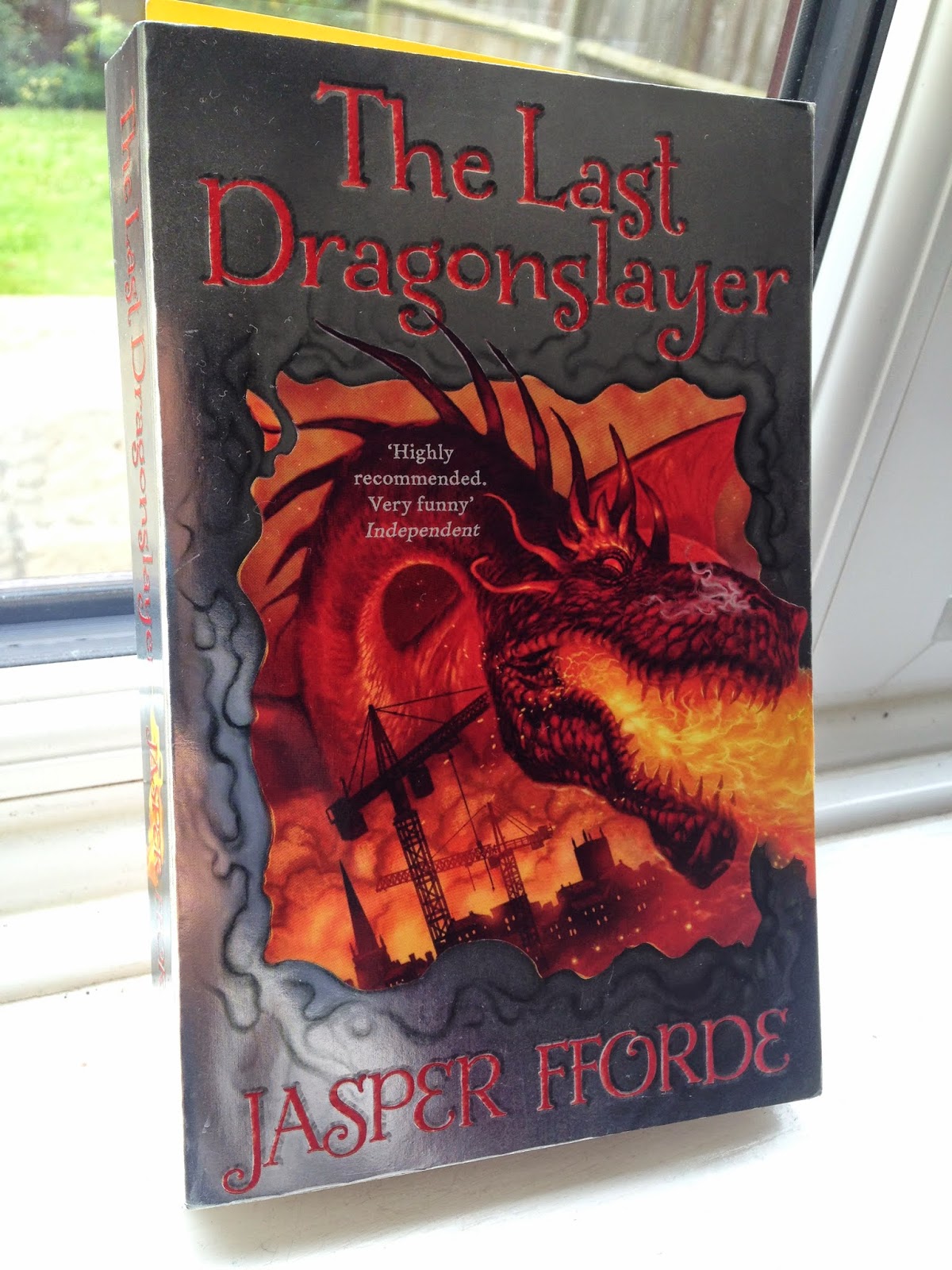


The Last Dragonslayer
By Jasper Fforde


Knowing very little about Jasper Fforde, my first reaction to The Last Dragonslayer (other than “Thanks for the birthday present, Robert”) was being slightly underwhelmed.  A novel about dragons, magic and wizards?  All of that’s been done.  Well, I needn’t have worried.  The Last Dragonslayer takes admittedly very familiar elements and puts them to work in a sharp, charming plot.  Against the odds, it actually feels very original.

It’s set in a parallel world, roughly contemporary, but with magic and dragons as a part of daily life.  I enjoyed the lived-in, clapped-out-ness of magic and the way people deal with it: they use magic to do their plumbing, and have to fill out endless forms to make sure it’s all accounted for, because magic is limited.  I’m sometimes put off by parallel world stories, as I feel at a conscious distance from the worlds they create, but this one very quickly, very skilfully set out its world and made it feel familiar.  I was reminded of Harry Potter, specifically the way those books never really reconciled how magical and non-magical people could co-exist.  I think this one does it better.

It’s the story of Jennifer Strange, a nearly-sixteen-year-old orphan who finds herself running a magical odd-jobs company and looking after its assortment of wizards and witches, all of whom have varying talents and sensitive egos.  Jennifer is a wonderful creation, believably young yet wearisomely mature.  The plot revolves around a prophecy.  (I know, they’re overdone as well, but this one is well handled and isn’t dragged out for half a dozen books.)  The prophecy concerns the last dragon known to exist and Jennifer’s part in its death.  And really, I don’t want to go into it too much – the plot is very tidy and it keeps moving and you should discover it all for yourself.  The book’s short; I don’t want to spoil it.

Fforde’s book is funny without hitting you over the head about it, thoughtful without feeling like a soapbox, and has an endearingly fresh perspective on its fantasy tropes.  I enjoyed it, am glad there are more books in the series, and encourage you to investigate.  Race you!


The Green Mile
By Stephen King


Another Stephen King book bites the dust.  Written as a serial in 1996, The Green Mile is the memoir of Paul Edgecomb – once the head guard at Cold Mountain Penitentiary, E Wing, home of the electric chair.  (And a grim, lime-coloured floor.)  It concerns John Coffey, a mysterious black man convicted of murdering two young girls, and it’s as grim as a Death Row story ought to be, but with some magic and humour mixed in as well.

Being six volumes rather than one, the book has an episodic and repetitive nature, sprinkling recaps throughout just in case you’re joining mid-way.  (In an omnibus, however, this is no longer a problem.)  On the plus side, the repetition (unintentionally?) chimes with the advanced age of the narrator.  King’s usual habit of casually dipping into the future also genuinely seems like something you’d find in a memoir.  However, the framing device – Paul writing his recollections in a rest home, as he avoids a transparently evil orderly – doesn’t add much to the story.  I was generally keen to get back to the events of 1932.

As for the main cut-and-thrust of the book, it’s compelling and has plenty of momentum.  The chapters are short; you can almost feel Stephen King hammering them out to meet his deadlines.  He mentions in the Foreword and Afterword that he enjoyed the challenge, and the change of pace.  It felt like a quick read.

If there’s a major criticism, it’s a lack of depth.  I saw the (excellent) Frank Darabont movie before reading this, and there’s really not a great deal more to be found on the page, besides a more downbeat conclusion.  The characters are all suitably good or evil, and while some are a bit of both, a few border on archetypal.  John Coffey, besides his obvious and deliberate Jesus Christ initials, seems like a textbook example of Spike Lee’s patented “magic negro” character.  Paul’s rest home nemesis, meanwhile, comes from a noticeably dry well marked “evil orderlies”.

It’s an equally sweet and grisly yarn, but it didn’t leave much of an impression.  The green mile (between the cells and the electric chair) might be long, but the shadow of King’s earlier work, Rita Hayworth And Shawshank Redemption, seems a little longer.


The Vampire’s Holiday
By Willis Hall


Willis Hall wrote a lot of children’s books about Henry Hollins, a boy seemingly forever on holiday with his parents.  They’ve encountered all sorts of oddities, including a dinosaur and an inflatable shop, but there’s a series within the series about Count Alucard – Dracula’s harmless, vegetarian descendant.  (Not to be confused with Count Duckula, who springs suddenly to mind.)

The Vampire’s Holiday is the second book in the series, and it’s a lot like the first.  Alucard must contend with the prejudices and fears of a small town, before ultimately fleeing.  Henry rallies to help him – he’s the only person with the common sense to give him a chance – while the townspeople, in particular the mayor, use the vampire business to their own ends.  One of the things I loved about The Last Vampire (and Hall’s other books) is the way every character has a point of view, even the animals.  They all have their own individual (and usually light-hearted) dramas going on, and that makes the story a lot more colourful.

Unfortunately there’s very little plot.  Alucard winds up in England (after his coffin is thrown overboard, although he seemed to be heading in that direction anyway), and he never says exactly why he went there.  I’m assuming it’s a holiday, re the title, but Henry asks him why at one point and he never gets around to answering.  He spends the rest of the book trying to get away, while the people of Scarcombe variously panic, overreact and take advantage of the situation.  (Well, wasn’t it obvious that was going to happen?)  In the middle of all this is Alucard, who’s terribly nice but scarcely interacts with anyone, and Henry, who despite being the hero of Hall’s books has no particular personality.  I can only assume younger readers were encouraged to project themselves onto him, because he’s the least interesting character in every scene, including the ones with his parents.

Still, it’s a funny, friendly story, with a lovely attitude to pre-judging others; there’s some great stuff from the point of view of some captive wolves.  The locals are all suitably amusing, if rather familiar; Hall can’t resist working in a bit of political satire with the mayor.  It’s a nice read, but after two books it’s a shame Henry didn’t try to change a few minds, rather than simply helping Alucard to run away until his next instalment.  Also, the story ignores the end of the last book, where Alucard had some intention of living with Henry.  His only friend in the world, you’d think that would remain his Plan A.


Doctor Who
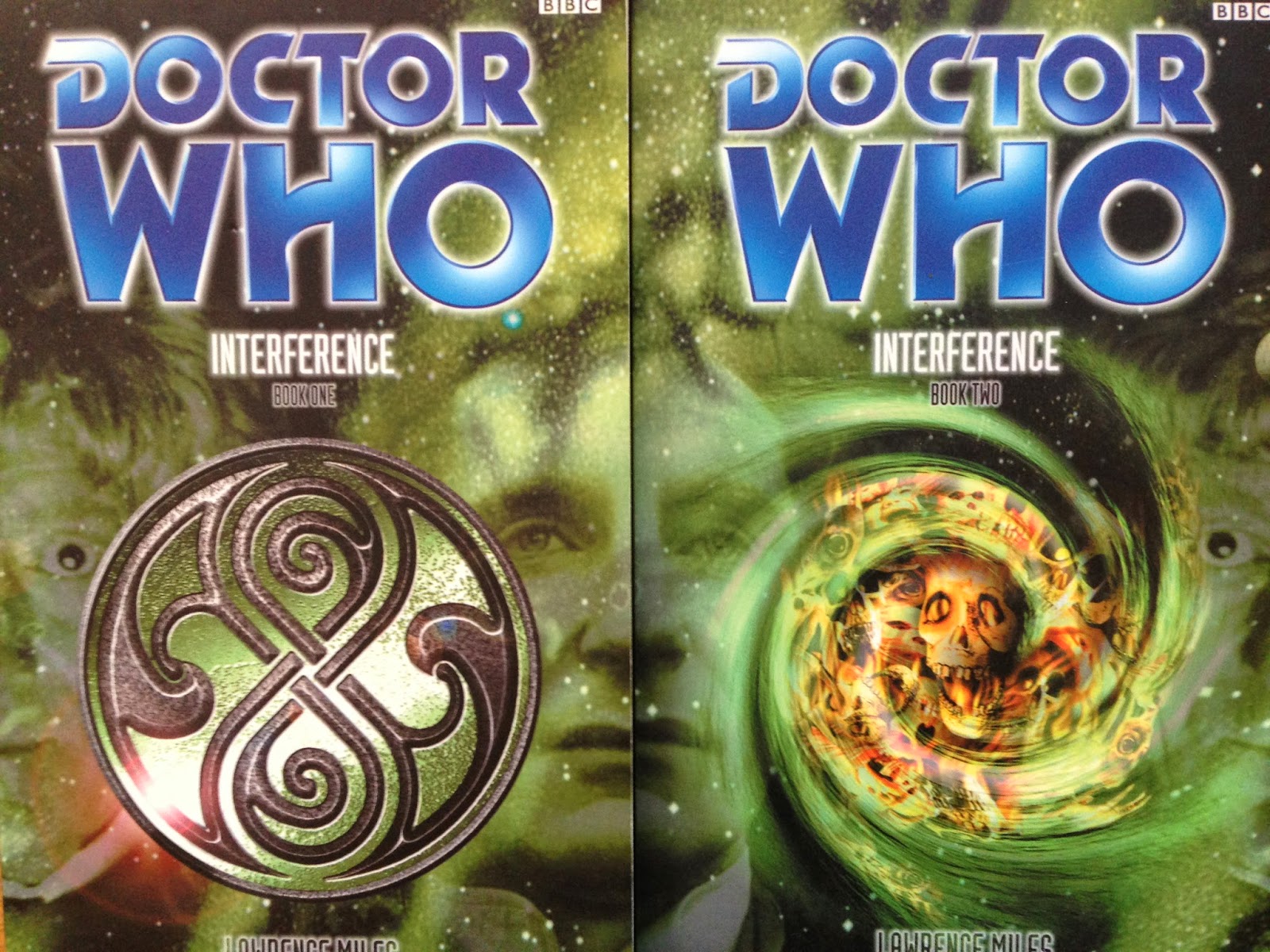
Interference
Book One: Shock Tactic
By Lawrence Miles


This is pretty ambitious for a Doctor Who novel.  It’s spread over two books, features two Doctors (Paul McGann and Jon Pertwee), and wraps up the complicated story of Sam Jones, a companion invented just for the BBC books range.  I’ve only read Book One so far.  How’s it going?

Put it this way: if I didn’t already own Book Two, I wouldn’t be buying it.  Heck, if that were the case, I wouldn’t have finished reading Book One.

So far (and since this is a full-priced book, it’s fair to pause and reflect), Interference is a mess, decorated with smug window-dressing.  This bit’s in italics!  This bit’s in script!  The chapter titles have funny sub-headings!  Ho, ho.  The prose is often thoughtful, but it’s an absolute headache keeping up with the various plot strands – and being only Book One of Two, surprise!  None of them go anywhere.

Let’s see: there’s an international arms conference in London, where aliens are selling black goo called “Cold” which can teleport and/or harm you depending on the plot.  (NB: This isn't the "real" Cold.)  The aliens are “the Remote”, which means they make decisions based on television signals.  (I don’t know if I’ve understood that correctly.)  Sam investigates this, while the Doctor’s other companion, Fitz, is lost in time somewhere.  He’s trying to get to know the Faction Paradox, a group of evil Time Lord somethings who are behind everything, ever.

One of the Doctor’s previous companions is here to help: it’s Sarah Jane Smith!  (And K9!  Yay!)  Alas, the Doctor is in a Saudi Arabian prison being tortured, talking to himself across time and writing maths equations in blood.  Meanwhile, Sam is spirited away to the Remote home-world (I think?), and Sarah meets a helpful Ogron – those muscle-for-hire aliens from the Classic series.  This is the best bit, by light years.  Then cut randomly to the Third Doctor (and a younger, far less interesting Sarah Jane) trapped in humanity’s final resting place: a Wild West parody called Dust, where there’s a freak-show possibly involving Time Lords.  Meanwhile, the Doctor – the main one, Paul McGann – recounts this entire story later to someone, somewhere, for some reason.  Eventually things grind to a halt because that’s all the pages you’re getting, buster.

As the first part of a story, this is just awful.  The characters are mysterious to the point where they’re barely even there.  The plot is overly busy, but it doesn’t coalesce into an actual story at any point.  I don’t know what “Cold” has to do with anything, or why “the Remote” are worth so much exposition, or what the blithery feck is so interesting about Faction Paradox – no, please, devote another dozen paragraphs to how their cult operates, it’s all gold.  I don’t know where Fitz is, and I don’t know what’s going on with Sam.  (If you haven’t read all the Eighth Doctor books up to this point, worse luck.  And welcome to my world.)  After 309 pages, I don’t care, Book Two or no Book Two, your story should have come together already.  We should know what’s at stake.  By the end of Book One, however, Interference is still total spaghetti.

I loved Miles’s earlier book, Alien Bodies.  A gem of a Doctor Who story, it had bags of imagination and wit.  There’s little in here I even recognise as Doctor Who.  An arms conference?  A Saudi Arabian prison cell?  Even the Doctor, both of him heavily featured on the front and back covers, barely registers.  It’s 309 pages of punishingly dull non-story.  After that, Part Two had better be the best book ever written.  No pressure.

Monday, 12 May 2014

The Bookcase Of Fear #7: Douglas Adams's The Salmon Of Doubt

The Salmon Of Doubt
By Douglas Adams


I first read Douglas Adams in 2001.  I found myself in a library, saw a name I vaguely associated with Doctor Who and read a few chapters.  It was The Hitchhiker's Guide To The Galaxy.  I was a Douglas Adams fan when I left the library.

I devoured more of his work soon after, so we're talking the Hitchhiker's radio series (dazzling), the TV series (er, mostly harmless), a comedic dictionary (The Meaning Of Liff), a serious look at endangered species (Last Chance To See), and two novels about Dirk Gently.  A "holistic detective", Dirk believes in the fundamental interconnectedness of all things – which means fairly random things happen and he just goes with it.  (This is not too different a concept from the Infinite Improbability Drive, which powers the plot in Hitchhiker's.)  I've always imagined him as Terry Jones.  Anyway, The Salmon Of Doubt is partly comprised of Douglas's third, unfinished Dirk Gently novel – not completed because, among other things, he died suddenly in 2001.  As it turns out, I picked a sad time to become a fan.

The Dirk Gently text, which is funny and imaginative and tantalisingly vague, fills all of 79 pages.  The plot elements are as disparate as Dirk's adventures ever got: they include a cat that's half-missing, a confused rhinoceros, a mysterious actor and the end of the human race.  You're left with really no idea what it was all about, and its sheer unfinishedness comes as a serendipitously literal way to express what we've lost.  For what it's worth, it's a delightful 79 pages.

The rest of the book (after an introduction by the editor and a foreword by Stephen Fry) is loose material by Douglas, including letters, essays, introductions, interviews and a short story.  I didn't care for some of the technological stuff (Douglas being a self-confessed and unabashed nerd, and me being an ignoramus), but the rest is a very effective cross-section of his ideas.  A few of them bounce from one piece to another, some ending up in The Salmon Of Doubt at the end.  Particular highlights include an argument for the non-existence of God from the point of view of a puddle, and an introduction to Sunset At Blandings, the sadly unfinished posthumous novel by P. G. Wodehouse.  The irony of this is apparent and bittersweet, but it's also notable for its rousing defence of comedy writing.  This is something that no doubt goes through the minds of all "funny" writers, and it's reassuring to see Douglas put it into words.  I love the bit about how Shakespeare couldn't make a joke to save his life.

The Salmon Of Doubt is very funny, a little all-over-the-place, and generally quite interesting.  It's just the right kind of tribute.


The Further Adventures Of Eddie Dickens
Book Three
Final Curtain
By Philip Ardagh


Speaking of authors I'm a fan of, I became a Philip Ardagh fan at university (roughly a million years ago) while I was studying children's literature.  Tasked with finding a decent kids' book, and apparently forgetting words such as "research", I picked one that looked good and hoped for the best.  The book was Awful End, and it's nearly 200 pages of hilarious, raving insanity.  Philip Ardagh lampoons Victorian story conventions, populates it with outlandish and anarchic characters, and often pokes his head through the fourth wall to say hello as well.  It was an eye-opening, I-didn't-know-they-had-it-this-good sort of book.

There were two more books in the Eddie Dickens Trilogy (about a hapless Victorian youngster with a deranged family), and another trilogy, The Further Adventures, came along after that.  This is the last book in that series, and one I've been meaning to get around to for ages.

It takes place at Awful End – that's Eddie's family home, where he must contend with his parents, his Mad Uncle Jack, his Even Madder Aunt Maud (and her stuffed stoat, Malcolm), a platoon of retired army men, various guests, doctors, criminals, and a parade of "wandering theatricals" who want to perform a play about Eddie's life.  The plot is actually a little low-key by Eddie Dickens standards, which is to say that while it does feature duplicitous robbers, elderly midgets and a surprise attack with a cabbage cannon, it doesn't stray very far from the house or its regular characters.

In all honesty, this isn't my favourite of the lot, but it is funny and clever, and while it does mention a lot of events from previous books, it's not necessary to know any of them inside-out.  Ardagh is generous with reminders and explanations, and while it's nice to look back on the series as a whole, it probably makes as much sense if you've never read any of them.


The Time Traveler's Wife
By Audrey Niffenegger


This is a popular one, or so I'm guessing from the number of "How far have you got?"s and "Are you confused yet?"s I received from colleagues while I was reading it.  The Time Traveler's Wife is also the (unofficial) basis for a fair chunk of Doctor Who episodes, so it seems like a good one for me to read.

It's about Henry, who time-travels at random, appearing naked at various times and places (mostly) in his own lifetime.  His life is intertwined with that of Clare, his wife-to-be, who met him when she was six.  He didn't meet her until he was twenty-eight, however; he filled in the blanks later.  Their relationship has simultaneously not happened yet, and happened already, depending who you ask, and when.

Told in first-person from both Clare and Henry's perspectives, The Time Traveler's Wife requires some concentration, but it's really not too difficult to piece it all together.  I enjoyed working it out, and the amount of detail Audrey Niffenegger lavished on her central idea.  Granted, we never really understand why Henry is time travelling – though it's apparently a genetic disorder and some science is used to explain it, it's still a pretty giant conceit and one you just have to go with.  But the everyday details are what's important, such as Henry's constant struggle to stay clothed and fed, matter-of-factly ignoring the law as he goes.  The concept is never taken for granted.

On the other hand, a few things go strangely unexplored.  There's the question of determinism, i.e. whether Henry and Clare ever independently fell in love with each other.  Since they both knew more about the other when they met, their relationship is a circle with no beginning.  (In case you're curious, old-Henry getting to know young-Clare isn't altogether creepy – he refrains from any kind of physical stuff, and it doesn't seem like it's his fault that he's such an influence on her life.  But then, is it?)  There's also the issue of changing history, which Henry generally believes to be impossible, and so doesn't bother trying – except one scene has him almost changing what's written on a piece of artwork, until Clare gets frightened and changes it back.  It's suggested they have avoided something terrible here, but what?

Some of the book is beautiful, particularly the pair's latter years, when comings-and-goings are few and far between.  (And some of it is horrifying: Clare's pregnancy might make Stephen King squirm, and some truly harrowing things happen to Henry towards the end.)  However, ultimately I just didn't like Henry or Clare very much.  While it's satisfying that Henry's character has an arc, being somewhat off-the-rails until he meets Clare, he's still not someone I could invest in, being rather aggressive and pretentious.  Clare is largely defined by Henry, but loves him mostly because the universe told her to; something, for me at least, seems to be missing.  They spend the majority of their time having sex, which ultimately felt a little trashy.  Besides them, there's an unwieldy cast of supporting characters, none of whom really stand out.  Juggling their names was harder than reconciling the timelines.

I enjoyed The Time Traveler's Wife mostly for its mechanics, and it's fair to say it kept me interested.  There are some affecting moments.  Overall, though, I didn't love it.  It's often too dark, and too much of it seems puzzlingly pre-ordained.


Doctor Who
The Infinity Doctors
By Lance Parkin


This has been on my shelf for 16 years, unread, like a lot of Doctor Who books.  (There's a bit of a backlog.)

Starring a non-specific Doctor and very few other familiar characters, The Infinity Doctors was meant to celebrate the show's 35th anniversary.  Besides being released in the same week as the big day, I'm not sure it's successful.

It's unclear where and when this is set, but I'm assuming a parallel universe, where the Doctor never left his home planet to have adventures in the TARDIS (though he has left occasionally, and he still quite likes Earth).  It's quite interesting seeing the Doctor as a figure of authority and respect among the Time Lords, and not (as we know him) a reluctantly-tolerated nuisance.  He's a placid, calm Doctor, similar (in appearance) to Christopher Eccleston.  That's how I imagined him.  Lance Parkin said he looks like Paul McGann, but oh well.

The Doctor is trying to make peace between the Sontarans (angry potato-people) and the Rutans (angry metamorphic squid-things), which goes surprisingly well until something happens to threaten the entire universe.  The Time Lords must stop someone at the end of time from using a rip in space-time to alter everything in the cosmos.  The threat is very big, but also very vague.  Naturally the Doctor is the only one up to the challenge.  This involves a startling amount of science and techno-babble.  If I had to pick an era of Doctor Who this actually celebrates, I'd pick 1981, when the plots were rather dry and complicated.  Back then, even Tom Baker looked confused.

Spoiler alert: the villain is Omega, a renegade Time Lord trapped in a black hole.  You may remember him from a story called The Three Doctors, where virtually the same plot happened.  Omega wants to escape the singularity, but this is impossible as his mind is projecting the world around him.  He needs a replacement, and the Doctor will do.  Meanwhile he wants to use the singularity to wreak havoc on our universe.  So far, that's The Three Doctors.  But instead of three Doctors bickering with one other, we've got one rather nondescript Doctor and a couple of love interests: a Time Lord called Larna, who also acts as a pseudo-companion, and the Doctor's dead wife.  (A surprising amount is revealed about the Doctor's past, but it's all just as vague as Omega's master-plan.)  I kept waiting for the story to go in a radical direction away from The Three Doctors, but apart from some plotty window-dressing, it never did.

Besides redressing a plot that wasn't very interesting the first time, and not putting a brand new Doctor to very good use, The Infinity Doctors has the problem of being set on Gallifrey.  This is a planet so stiflingly uninteresting that the Doctor's decision to leave formed the entire basis of Doctor Who.  Recast as a friendly academic on his home turf, this Doctor rarely lights up the story.  His fellow Time Lords are a less than fascinating bunch, including (presumably) a non-evil version of the Master, who is nice to the point of obsolescence.  I can't quite see any of this as a "celebration" of Doctor Who, unless your favourite bits involved abstract dream sequences, or characters hammering at controls and yelling instructions.

What's good about it?  Well, it's often nicely written, with some prodding at the fourth wall, presumably because it's an anniversary.  The Sontaran/Rutan peace talks are a highlight, particularly as they allow the Doctor to take centre stage.  (Twice, thanks to some time-trickery.)  Some of the Time Lord stuff is quite interesting, particularly the less-glamorous parts of their society, although these feel borrowed from Ankh-Morpork.  The front cover and title are both eye-catching; it's a pity there's no attempt to deliver "infinity" Doctors, with the title merely referring to the existence of parallel universes.  It's probably just as well.  When two Doctors do meet in this, they don't bicker.

Wednesday, 30 April 2014

The Bookcase Of Fear #6: Stephen King's The Stand

The Stand
By Stephen King


Well, I’m back.

At 1138 pages, The Stand is comfortably the longest book I’ve ever read, nudging aside the second-longest, also by Stephen King.  I emerged from it earlier today, parched and bleary-eyed.  What was the last book I read before this?  What's the date?  What year?

“The Stand” is the aftermath of a man-made plague, and it might as well be broken up into three volumes, ala The Lord Of The Rings.  For 300-odd pages it concerns the plague, not-so-affectionately known as “Captain Trips”.  The horrifying superflu spreads from one panicking security guard to pretty well everyone in America.  (The rest of the world soon joins in, thanks to some slithery men in black not wanting the USA to take the blame.  This sequence barely covers a page – perhaps it was a late addition? – and in any case, we never really leave America.)

King has said it was “fun” tearing down society, and given the pace of the rest of the novel it certainly falls apart fast.  Plenty of satirical nightmares are brought to life as the army struggles (pointlessly) to cover it up.  The death toll is virtually everybody; you won’t forget any of it in a hurry.  The horrifying imagination of this section could be a whole novel.  (Though in all honesty, at 300-ish pages, it is.)

The next section is about the survivors.  Some of them die just the same, only later (Captain Trips getting his second wind); some are killed in various grim mishaps; the rest gather their wits and start going… somewhere.  They have nothing to guide them except dreams, either concerning an old (very old) lady in the East, or a spooky “dark man” in the West.  This section is full of dreamy eeriness, as characters pass through deserted places, avoid simple perils and sidestep the dead.  Reading this, it occurred to me how many post-apocalyptic stories I’ve come across, almost all involving zombies.  It’s refreshing to read one where the dead stay dead, and our heroes’ problems stay closer (relatively speaking) to reality.

King deals, in detail, with the simple matters of staying alive and getting places.  I suspect much of the story came about from wondering how people would cope in a worst case scenario.  It’s a satisfying What If in that way, and I enjoyed the grim reality of Captain Trips, plus the harsh reality of surviving it, more than the book's final third.  More on that in a minute.

Being scattered over the country, it takes a while for our heroes to meet.  As with King’s also-elephantine It, you’ve got plenty of time to get attached to them.  Most of them are compelling: there are heroes that grow and conquer considerable flaws, but also villains who agonise over their choices.  (By the end, very few of either are left standing.)  The cast grows exponentially when both groups set up their own towns, and there are some very long chapters devoted to characters I just didn't care for.  Some of these guys are overgrown archetypes; most of the women are (typically?) defined by their sex, either sex-obsessed or sexually victimised or mothers.  Mother Abigail, the Godly figurehead, seems much more symbol than person, even after we hear her generous life story.  And despite seemingly endless effort to big up the villain, Randall Flagg – an ethereal, supernaturally-gifted spawn of Satan – he never struck me as remotely interesting.

King obviously finds him fascinating: he crops up in later works, particularly The Dark Tower series.  Flagg seemed to me like a mess of all-powerful ideas and weird, kooky details.  He’s boringly persuasive and omnipotent, until the plot (and presumably, God) requires him not to be.  Which leads to a wider point: much like Homer, if it’s all ultimately up to the gods, with characters getting psychic visions as to where it’s all going, they all seem a bit impotent.  Since, in fiction, it’s always up to the gods – i.e. the writer – it seems like cheating to have that in the actual plot.  (That said, King is a big fan of foreshadowing.  For me, Carrie was ruined by spending its entire length telling me how it ended.)  Anyway, I often wondered what Flagg could accomplish that would, all told, be genuinely worse than an apocalyptic superflu.

It all comes down to good vs. evil (personified as bluntly as possible by Abigail and Flagg), and it is eventually quite satisfying.  However, with its Godly messages, religious quests and explosive finale, it seems like a million miles from the realistic, satisfying What If that germinated the story.  While the story certainly evolves as it goes along, I wonder if it lost something.

My copy is the extended 1990 edition, with 400 pages put back in, and it takes a hell of a long time to get anywhere.  (Also my edition – a battered TV-movie tie-in – is replete with typos.  The best one is “minges”.)  The good moments are couched in sheer, gratuitous length, and unlike It – a not-really-relevant comparison, I know – I didn’t feel very much closure at the end.  Our heroes' fate is happy (at least those who made it), but it's totally open to future miseries.  Because hey, it's a cautionary tale: cue an outrageous moral finger-wagging right at the close.  I wish that bit hadn't made the cut.  If your point hasn’t sunk in by page 1130-something, can very much be achieved with an epilogue?

Saturday, 26 April 2014

The Bookcase Of Fear #5

On Writing: A Memoir Of The Craft
By Stephen King


The latest dent in my mountainous Stephen King collection, On Writing is carved into two books: an autobiography and, as the title suggests, a guide to writing.  Both are brief.  (The former, maddeningly so.  I wanted more.)

How-to-write books are a tricky business, since there's no magic formula and no two writers are identical.  The best King can offer is an insight into how it works for him, and it's a frank, helpful account of his writerly foibles.  (Another similar book is Russell T Davies's The Writer's Tale.  Mixing how-he-did-it with why-he-bothers, it's as far from an instruction manual as you can get, and it's a great read.)  I found the autobiography in this more arresting and certainly more fun: his childhood escapades with brother Dave are hilarious, the account of his mother's passing is beautiful, and his infamous collision with a car is included, making for a serendipitously dramatic end.  As for the writing advice, it's simple and true, if not surprising.  He urges you to read lots, write lots, murder your darlings.  The lack of any secret ingredient is sort of his point – the trick is to just get on with it.  I agree with most of what he says, although I think he's a little harsh about "writing courses".  He thinks of them entirely as retreats, and not university courses, the latter of which I've experienced.  They can work well.

Stephen King isn't to everyone's taste.  I consider myself a fan and even I find him haphazardly hit and miss, but I found it a rich, helpful book.  It's fun hearing how a few of his stories came together, and you get some good advice.  Bargain.


How I Escaped My Certain Fate
By Stewart Lee


I know next to nothing about Stewart Lee, whose face I routinely confuse with that of another TV personality, whose name I can't remember.  But I was vaguely aware of Richard Herring (his '90s comedy partner), so I thought I'd give this a try.

I've read a couple of disappointing books by comedians, such as Dara O Brian's Tickling The English and Jack Dee's (unsurprisingly?) muted autobiography, and this is among the better ones.  It's a not-entirely-misanthropic look at being a comedian, including three of Lee's shows as transcripts.  Each of Lee's shows, and really his whole comedic outlook, is skewed away from mainstream acceptance; a lot of his jokes are deliberately, often morally complex.  "Complex" is a good word for the book as a whole, large amounts of which is recounted in footnotes, which can go on for pages at a time.  This makes it a bit too complicated for a light read, although on the plus side, it ensures that you're not skimming any of it.  You've got to take it all in, just to find your place.

Lee is surprisingly upbeat about his life (considering how misanthropic he is about everything else), and what it means to do comedy for a living.  He also deals with the unfortunate reception to Jerry Springer: The Opera, which he co-wrote, and how that ultimately helped him.  Despite a rather self-defeating need to be on the outskirts of popularity, he's simply very funny.  The mix of transcripts, footnotes and autobiography is an arresting one.  The overall book might be interesting more often than funny, but I'm glad I read it.


How Not To Grow Up
By Richard Herring


I read this hoping for a less "heavy" counterpart to Stewart Lee's book.  (The books are unrelated; the "How To" titles are sheer coincidence.)  It was, if anything, heavier going.

Richard Herring is about to turn 40, so he wants to examine what it means to be childish, vs. what it means to be mature.  It's not a terrible idea for a book, but it's also not a very original one.  And this book doesn't make the most of it.

Herring, who I've thoroughly enjoyed seeing live and very briefly met (he's very nice), boils the problem down to the kind of obvious "You're only as young as you feel" platitudes you might find on a fridge magnet.  (And increasingly, on Facebook.)  The majority of his book takes the form of a mid-life crisis, wherein he's both keen to meet the right person, and desperate to have a threesome at some point in his life.  There's a blunt "What it means to grow up" subtext in there, but it's not very interesting if you're not similarly obsessed with this one particular sex act.  On and on he goes about his sex life, lamenting that it's the wrong kind of sex he's having, usually with eager fans or gorgeous married women.  Cue the sound of tiny violins, and friends endlessly rolling their eyes at him, not that he seems to notice.

He does eventually clean up his act, finally meets The One (his partner, not Keanu Reeves in The Matrix), and is very grateful and lyrical about all that.  The trouble is, his "transformation" is mostly a standard set of New Year's Resolutions, and his girlfriend arrives right after a seemingly endless succession of women he's also excessively, uncomfortably keen on.  I'd reached Richard Herring Relationship Saturation Point by the time his amore turned up.  I also felt awkwardly like it was none of my business.

It's not a massively hilarious or insightful book.  It seemed to take several years to get through, and I think I like Richard Herring less for knowing all this stuff about him.  It's not one to revisit.  Or possibly, if you can help it, visit. 


Evil Machines
By Terry Jones


I like a lot of things about Terry Jones.  I like some of his Monty Python sketches (although I haven’t sat through the Complete Box Set yet), I love the movie Labyrinth (which Jones wrote), and I have a fondness for the 1996 Wind In The Willows film, with Jones as Toad.  Less successful in my eyes is Jones, the novelist.  His Starship Titanic (based on an idea by Douglas Adams) made for a rather horrible book, full of unlikeable and flat characters.  Evil Machines, though not horrible and not technically a novel, is not brilliant either.

There is a somewhat winning impishness to these short stories about technology that won’t behave, but it never spills into the anarchic laugh-out-loudness suggested in the blurb.  Multiple mentions of Monty Python, Roald Dahl and “edginess” give a false impression.  These are primarily children’s stories, which is fine, but they’re simple, somewhat clumsy, and very repetitive, mostly concerning objects that perform their tasks too excessively.  The prose is friendly and silly, but rarely witty.  Pythonesque social comment does peek through at times, but it's mostly couched in unimaginative and obvious storytelling.  This generally lacks the imagination of Python (being so limited in theme) and the teeth of Dahl.  It’s all too fluffy.  You can forget about “edge”.

Then, around halfway, the structure changes.  The short stories are suddenly linked into an overarching plot, allowing a novel to creep up on you unexpectedly.  I like this idea very much; however, the protagonist (a work-obsessed businessman) is two-dimensional, as is his family (a grown-up son and daughter he’s never had time for – where have I heard that before?), and the novel plot, concerning a robot that wants machines to rule the world, has scarcely any more ideas going for it than the short stories that precede it.  (One in particular features an evil vacuum cleaner, also a megalomaniac.)  Things lapse too comfortably, and all too often into cliché, especially re the dialogue.  These characters do not have interesting conversations; the situations they're stuck in are all drawn from the same boringly dry well.

I like the idea of machines that won’t behave, and I like the concept of a short story collection that turns the tables halfway.  Sadly, there is a gulf between the ideas in this book and their execution.

Saturday, 1 March 2014

The Squee Doctors

Doctor Who
Time Crash
2007 Children In Need Special


It's Pudsey Time!

Doctor Who fans are lucky.  Where other Children In Need Specials are just actors mucking about for a good cause (not that there is anything wrong with that), we get fully-fledged mini-episodes.  The last one was downright seminal: six minutes of pure character-development for a new Doctor.  How awesome is that?  And this one features a past Doctor!  I appreciate it.  Really, I do.  But... well, it's still not very good.

Bit like the Fifth Doctor in general.
Hi-yo!
Now, it's great to see Peter Davison again, and I say that as someone who never really liked the Fifth Doctor.  Coming right after the googly-eyed Time Lord lunacy of Tom Baker, he was generally rather wet and ineffectual; the only Doctor, so far as I am aware, to sit quietly in a prison cell hoping somebody else would come and rescue him.  Nonetheless, Peter Davison had it in him – if he'd played the Doctor the way he played Albert Campion, he'd be in my top three – and he's just got better with age.  He's reassuringly wonderful here.

And like last time, with only seven or eight minutes to play with there isn't time to screw up what little plot we've got.  Two TARDISes collide, they'll explode any minute now, so the Doctors work together to separate them.  Easy peasy.  (Timey squeezey?)

The problem is the tone.  Is this a proper mini-episode, like the last one, or is it actors mucking about for a good cause?  Again, nothing wrong with the latter, but there is if you're trying to go for the former.  There's loads of dodgy fourth-wall jokes crammed in here, like the TARDIS's desktop theme and the Master's beard, but having David Tennant tell Peter Davison that "You were my Doctor" brings the fourth wall crashing down faster than William Hartnell turning to the camera and wishing us all a Merry Christmas.  (It may amuse you to know that this actually happened.)

What does it mean, one Doctor saying "You were my Doctor"?  Nothing: it's just the writer, and possibly the actor as well, voicing his fan preference.  It takes something momentous – a Classic Doctor – and uses it just for a bit of fan-service.  Is that really all they're good for?

Okay, Peter Davison also provides a bit of context for David Tennant's Doctor, which is helpful for younger viewers: they both wear trainers and "brainy specs", they're both young and full of vim, and they both say "Wibbly wobbly, timey wimey" – apparently.  (They also share a habit of asking people to do things and then being ignored, which possibly explains why Five is Ten's favourite.)  Sadly, all this does is reduce both Doctors to a gimmicky little list.  On the one hand it fires a well-deserved shot at Doctor #10 for jabbering like an idiot, but on the other hand it takes the piss out of how Doctor #5 didn't have a sonic screwdriver to get him out of every situation.  (Let's not dwell on why the writers got rid of it, eh?  You wouldn't want viewers to notice that it's an even bigger contrivance in the modern series.)

Time Crash is all for a good cause, obviously, but despite being less than eight minutes long it's still hit and miss.  If Peter Davison was your Doctor, perhaps it works.  But for me, it's neither one thing nor the other, and it takes Doctor Who an awkward step closer to the empty nostalgia and silliness of Dimensions In Time.  And in my book, that's a wibbly wobbly timey crime.

Thursday, 27 February 2014

The Sound Of Raspberries

Doctor Who
Utopia, The Sound Of Drums and Last Of The Time Lords
Series Three, Episodes Eleven, Twelve and Thirteen


Brace yourself.  Russell's getting his finale on again.

You know the drill by now: large scale destruction, a classic Doctor Who monster, a parting of the ways.  Russell T Davies obviously felt pressured to step it up for his third year, so we've got a three-parter set over a year (bouncing from 2007 to the end of the universe), in which probably a billion(ish) people snuff it, and a whole secondary human race gets mutilated as well.  Mission accomplished?  Er, yes and no.  It's big, all right.  But you know what happens to bubbles of a certain size.

"For God's sake, John, fine, you can be in the finale.
Now stop inserting yourself into the title sequence."
"Heh.  Inserting myself."
"THAT'S ENOUGH, JOHN."
The first episode, Utopia, is the best by miles.  It's nearly all setup – which is why it doesn't count as a separate story, so there – and though there's not much substance, there is plenty of excitement.

After Captain Jack (literally) hitches a ride on the TARDIS, our heroes arrive on a barren planet.  The last of humanity are preparing to blast off to "Utopia", with the help of a fustery old professor.  No one really knows what Utopia is, but it's got to be better than here, where they're constantly harassed by the savage, pointy-toothed Futurekind.  Unfortunately their rocket won't fly, and the Professor's work is at a dead end.


This isn't the first time Russell T Davies has used a satirical utopia to spur on his characters (although it's the first time he's given up all pretence and actually called it Utopia), and as usual, they're wrong.  The Futurekind are a pretty big hint about what their future really holds – they serve almost no other purpose – but in the meantime, the Doctor meets Professor Yana (Derek Jacobi), who's adorable, and the two of them get on famously.

It's a lovely, layered performance from Jacobi, containing several hints of what's really going on here.  He wears inexplicably Edwardian clothes.  He's paired with an adoring young friend, Chan-Tho, pretty obviously to draw parallels with the Doctor.  (And to achieve Russell's lifelong dream of having a character end every single sentence with "though".)  He wishes, just once, he could be recognised for his achievements.  And he keeps hearing drums.  Spotted it yet?  If it were any more obvious, he'd have a William Hartnell wig and a police box.  But it's quite exciting waiting for the penny to drop, even on repeat viewings.

Meanwhile, in an abrupt break from tradition, Captain Jack gets some character development.  He's understandably upset that the Doctor abandoned him in The Parting Of The Ways, but the Doctor apparently feels that Jack is "wrong" now that he can't die, and it's sheer Time Lordy instinct to avoid him.  This is an odd fit for someone as friendly as the Doctor, and it ignores the fact that he left before he saw Captain Jack alive and well again.  (He was a bit busy regenerating at the time.)  However, a discussion between the two, where the Doctor asks Jack if he wants to die, takes David Tennant to an unusually dark place.  I like new stuff, and I like this.

We'd better make the most of her.
Oops!  Too late!
There are several lovely moments for Martha, such as a hilarious info-dump about the Doctor's regrown hand (I love her tone of voice when she says "You've got two hands!  I can see them!"), and there's some great business at the end, when she realises what's going on with Yana (hold that thought) and tries to keep from spilling the beans.  Freema Agyeman puts across Martha's mingled shock, horror and excitement beautifully.  Isn't she great?  And she gets to rage (understandably) and sulk (unfortunately) about Rose, whom we still can't stop talking and reminiscing about, apparently.

Yeah, about that.  Knowing this is Martha's last story makes it all the more painful.  Why do we keep dwelling on Rose?  What's it for?  It's obviously deliberate, using Rose over and over again to stop Martha gaining a place in the Doctor's affections, but why?  Does it make the Doctor more interesting?  No, it makes him rude.  Does it make Martha more interesting?  No, it just pushes her out of the TARDIS.  Hey, I'm sure there are Rose fans out there, high-fiving each other and crying every time they hear the R word, but it's a non-starter for anyone not irrationally obsessed with this one character.  No doubt we're meant to cheer when Martha decides to learn from her experiences, leave the TARDIS and live her own life – which is how companions should leave, by the way – but the damage it does to the Doctor, who has spent most of this series behaving like an ungrateful jerk, is a total own goal.

Anyway, we've still got two episodes to cover (!), so back to it.  The Doctor fixes the rocket (because he's clever, i.e. he has a sonic screwdriver, how fascinating) and everything goes great until Martha notices the Professor's got a fob watch.  You guessed it!  He's a Time Lord in disguise!  As we've already ticked off Daleks and Cybermen, it's time to meet the Master.

Suggested in 1971 as (literally!) Moriarty to the Doctor's Sherlock Holmes, he's been portrayed differently through the years.  He was a suave, bearded gent (Roger Delgado), an emaciated monster desperate to survive (Peter Pratt, Geoffrey Beevers), the bearded guy again but with added camp (Anthony Ainley), and an all-camp point-thoroughly-missed American ex-ambulance driver (Eric Roberts).  In which direction does the new one lean?  Well, once Jacobi discovers his inner Master (during the episode's thrilling ten minute climax), it's a mixture of all the good ones.  He's bitter, malevolent, intelligent and scary.  (And okay, a little bit hammy.)  He's everything I want from the Master.  But then, after one of the show's best cliff-hangers, with the TARDIS stolen and the Futurekind about to burst in, the Master regenerates into John Simm.  And this three-parter promptly begins its nose-dive.

Gaze into the mousey little face of terror.
When The Sound Of Drums begins, we whiz back to the present (throwing that brilliant cliff-hanger right out the window, oh well) and see that the Master has installed himself as Prime Minister.  He has lingered through all of Series Three's modern-day episodes, turning Martha's mother against the Doctor, presumably to drive him and Martha apart, because um.  (Wouldn't that prevent them from going to the future / opening the fob watch / getting him a TARDIS?  What was his plan before the TARDIS miraculously turned up?  And how come he can make Masterly plans when he's a human?  John Smith couldn't.)

Anywho, he's got a wife, who may or may not be hypnotised.  (She continues the "Master Is Like Doctor!" routine begun with Yana and Chan-Tho, because some viewers didn't get the memo.)  And he's got the Toclafane: billions of psychotic spheres that are, in fact, those optimistic humans from Utopia.  They conquer the world instantly, murdering ten percent of humanity as a show of strength.  This creates a paradox – future humans killing past humans – but that's okay, because the Master cannibalised the TARDIS into a Paradox Machine.  (So it's red now.)  When the Doctor gets uppity, the Master uses Lazarus technology to age him to the point of uselessness.  Game over.  This Master gets results.  Terrifying, right?

Not exactly.  This Master is naughty, impish and zany.  In many ways, he's comic relief.  (He also works as a satire on politicians, and the power of personality to overcome a complete absence of policy.  This is as subtle as all Doctor Who satire, which is to say: CLANG!)  Obviously intended to parallel David Tennant's more exuberant mannerisms (so, his worst bits), Simm's Master is one of Russell T Davies's dodgiest impulses – juxtaposing horror and comedy, the broader the better – personified.  He camps it up, chews the scenery, and tries very hard to be funny whilst he kills people.  There's an entertaining dimension to this if you're in the right mood, and don't have nerdy opinions on What The Master Should Be Like, but as a terrifying counterpoint to the Doctor... oh dear.  It doesn't work.

The Master is driven by an urge to survive.  (Or has been since Roger Delgado died and they had to re-jig his character.)  Fair enough.  And there's lip service paid to that, at the end when he refuses to blow up the Earth and take himself with it.  But no, that's not what this Master is really about.  (And he chooses death immediately afterwards, so nuts to all that, then.)  He's damaged.  Insane.  He needs help, and despite all those atrocities, the Doctor wants to fix him.  Altogether: awwww!  No, wait, he's a scary villain, not a sympathetic John-Simmy diddums!  Honest!

The Master's plan is, essentially, fire missiles in all directions.
It's been done.  By Futurama.
As a joke.
Infusing anything with over-the-top comedy is like sprinkling raw onion on your dinner: whatever it was before, it's now pretty much onion-themed.  But the Master's pantomime antics, combined with the undercurrent of he-really-just-needs-a-cuddle, completely undoes the menace Derek Jacobi (briefly) brings to the part.  The Doctor's attitude is the cherry on the cake, enabling some of the gloopiest, writes-its-own-fan-fiction-iest bromancing you're ever likely to witness, with dialogue like "Are you asking me out on a date?", just to drag any form of subtext screaming into full view.  Subtle it ain't.

Neither of them comes out of this well.  Nice as it is for the Doctor to take the sympathetic way out, it comes at a high cost.  Millions of lives are lost, the entire Earth suffers for a year, and the Doctor – the guy you're here to see – spends most of the final episode sat in a wheelchair feeling sorry for himself.  Doctor Who?  More like Doctor Why Don't You Get Off Your Arse And Do Something.  Once again, it's up to Martha to put in the leg-work.

I should be thrilled about this, because I love Martha and it's great that she gets to do something important, but brave as she is, this doesn't actually say anything about her.  Martha spends a year travelling the world and telling people about the Doctor, so that when the time comes they'll all think "Doctor" at the same moment.  This (thanks to the Master's network of hypnotic satellites, designed to keep people scared) will somehow transmit their thoughts to the Doctor (who has coincidentally aged and shrunk) and somehow make him briefly invincible and able to fly (and restore him to his proper age and size, as well as rebooting his clothes).  Somehow.

Setting aside how stupid this all is – and dear god, it's the Stupidpocalypse – this isn't empowering for Martha.  She's just following the Doctor's orders, and she's put in her place yet again when the Master (!) harps on about how great Rose was by comparison.  As for the plan, it's (literally) all about bigging up the Doctor – who just sat there and let millions of people die, waiting to enact his I Do Believe In Fairies master-plan, quietly hoping there'd be a reset button at the end of it.  (What if there wasn't?)  Meanwhile, Jack fixes the Paradox Machine by shooting it with bullets, and everything goes back to how it was before the Toclafane killed everybody.  Except it's after they killed the US President, because... you can't win 'em all?  (And oh yeah, those future humans still get mutilated and become the Toclafane, because whoops, forgot that bit.  They're in another dimension now, probably called The La-La-La-Pretend-It-Never-Happened Place.  Presumably with the Futurekind, who you've forgotten about by this point.  Admit it!)

I do believe in plot contrivances mixed with ridiculous religious symbolism,
I do, I do...
The Master is now the only loose end (well, not the only one!), so his wife helpfully steps in and shoots him.  Why not?  It's not as if her character serves any other purpose, and it saves the writer the effort of thinking up a proper comeuppance.  (The Doctor's best idea is to bundle him into the TARDIS and keep an eye on him.  Yeah, that'll work.)  Cue much sobbing and there-should-have-been-another-way-ing from David Tennant, and an epilogue with Martha deciding that enough is finally enough.  I'll miss her; I have no idea why they thought it was a good idea to sabotage this companion from the get-go, but Freema Agyeman did wonders with it all.

So, three episodes, and really a whole series, building towards... what, exactly?  Martha deciding it was time to go?  Well, okay, but there were episodes this year (42 and Blink) where they seemed to put the tension behind them and act like good mates, and the rest of the Doctor's behavior never made sense in the first place.  The horrible Mr Saxon/The Master, then?  Well, okay, but his character is so thoroughly cocked up that by the end, one is not so much in awe of the Doctor's nemesis as feeling sorry for a lonely, unbalanced guy with severe tinnitus.  Call me old fashioned, but I think the Master should slot more into Category A there.  Especially on his first go.

This story's emotions and ideas generally don't work.  (And something's definitely wrong with a story that requires this many flashbacks.)  The tension isn't really there, either: the moment you see millions of humans murdered in the present day, followed by a One Year Later caption, any semi-intelligent viewer will simply wait for the inevitable reset.  It comes as expected.  (Except for the President and the Toclafane, both left WTF-ingly in tatters.)  As for the plot, cut out a cross section and you'll find one word (rhymes with "frollocks") stamped through it like a stick of rock.  How did the Doctor time all this a year in advance, with no idea that he'd be canary-sized by the end of it?  How come the hypno-satellites work in reverse?  How does shooting the Paradox Machine make everything nice again?  How does thinking "Doctor" turn him into a youthefied flying Jesus Jedi?  How... why... what?  Trust me, don't.  It's like looking into the abyss.

Is this the worst of Doctor Who?  Well, the plot's appalling and the characters are a mess, so it's up there.  (Or down there, I should say.)  It's certainly the worst finale so far, botched and misjudged in most important respects.  Still, that first episode is very exciting, and the cast put in tremendous effort throughout.  It's not their fault things like "tone" and "threat" got utterly lost in the mess.  However, it is definitely the mess I take away from this one, as I run screaming in the opposite direction.  Last Of The Time Lords?  If we're lucky.

Thursday, 20 February 2014

Don't

Doctor Who
Blink
Series Three, Episode Ten


Okay.  Who honestly saw this coming?

I'll never forget the Next Time trailer for Blink.  It was, frankly, not inspiring.  Don't blink?  A whole episode of trying not to blink?  It looked like a 45-minute staring contest.  And it was set to be this year's Doctor-lite episode, which for a lot of people went down like a lead balloon with a death wish the last time they tried it.  The omens, they were not good.

"You can't kill a stone."
Oh really?  Fetch a sledgehammer.
Of course that was then and this is now, and Blink is one of the most popular episodes of Doctor Who ever made.  Surprise!  It won Steven Moffat his third Hugo, which is quite a result seeing as he mostly wrote it as a favour after backing out of Daleks In Manhattan.  (Now there's a What If.)  It's safe to say it struck a chord with fans and critics; it certainly did with me.  And it went out on my birthday!

Okay, what's so super about it?  Well, it's a small story that is at once complicated and logical.  Essentially a time paradox, much thought has gone into ensuring it makes sense, if you're prepared to give it a bit of thought.  That feeling, of having your concentration rewarded, is a big part of its appeal.  We also have a fabulous new monster, and again, Steven Moffat has clearly sat down and worked out how best to frighten you with them.  Their success, still felt in Doctor Who years later, was very much earned.  And there's also the matter of the characters, who by virtue of necessity must not be the regulars.  They need to be interesting, and they need to keep us from getting too upset that the Doctor and Martha didn't show up for work.  They do not disappoint.  Blink might be a Clever (with a capital C) episode, but it's a tremendously human story, and we care about the people in it.

Instead of the Doctor, we've got Sally Sparrow.  She's a plucky, interesting woman who can't help investigating a strange old house.  In it, she finds a message addressed to her from the Doctor, circa 1969.  And she immediately meets a very suspicious statue that might be able to move.

This is a cracking, no-time-to-waste opening, immediately setting up the episode's ideas: the Doctor trapped in the past (a handy excuse for a Doctor-lite), the angel statues having something to do with it (creepy as hell), and Sally Sparrow being the only one who can put things right.  Carey Mulligan is up to the task.  She makes Sally a fun presence, believably kooky but still recognisably real, instantly earning years of fan discussion over how nice it would be to have Sally as a full-time companion.  (I wouldn't mind, but let's leave it a while.  Doesn't the Doctor sideline Martha enough without us joining in?  Anyway, the way she tells a character that his sister loves him, and says "That's nice, isn't it?", actually reminds me more of the Doctor than his companions.)

Sally joins Harriet Jones, Nancy, Lynda-with-a-Y and Martha
in the elite Shut Up About Rose club.
Soon, Sally's friend goes missing, and in a direct (but very apt) steal from Back To The Future Part II, she instantly receives a letter from her, dated decades earlier.  She's been sent back in time by the Angels, and there's no way back.  That's what we're up against.  The Doctor, via a series of DVD easter eggs and messages across time, is trying to tell Sally how to stop them.  (He only knows to do this because Sally will, at some point, meet him and tell him everything he did.  By all means think about this, and the inherent implication that free will is an illusion, if you're in the market for a really top-of-the-range headache.)

Let's talk about the Weeping Angels.  They are "assassins".  (Although I think "predators" is more accurate.)  They freeze to stone if they are observed, but can move unimaginably fast when they're not.  One touch means you're sent into the past to live out your life, while they absorb the energy of the days you might have lived.  Apart from the abstracty "days you might have lived" stuff, this is all instantly terrifying and well thought out.  Most of us have been a bit unnerved by statues at one time or another, particularly as kids; who hasn't wondered if they can move when we're not looking?  And the elemental terror of something touching you, or "getting" you, is a staple of nightmares.  It's a barmy idea, but you can still relate to it.  Like the Ood and the Judoon, the Angels are one of the show's best inventions, at once brilliant and simple.

They also allow Steven Moffat to explore one of his favourite themes, time-travel, from a different perspective.  Like The Girl In The Fireplace (only better), Blink shows us lives being lived in, well, the blink of an eye.  Sally's friend Cathy, and a policeman named Billy, both end up in the past, allowing for that neat Back To The Future bit and a genuinely creative and beautiful death-bed scene for Billy (who we only met one scene earlier).  Steven Moffat often shies away from killing his characters, but old age seems to be an acceptable compromise.  Despite only knowing Billy for two scenes, via two actors, we feel the weight of his death.  It's very well done, and helps sell the horror of what the Angels can do.

Admittedly, there are two sides to this.  Yes, the moving-when-you're-not-looking is terrifying, as is the one-touch-and-you're-dead, but listen more closely to the writing.  They're "weeping" (i.e. they can't look at each other), they're "lonely" (see "weeping"), and apparently they're "kind" (because they "let you live to death").  In spite of everything, isn't it all a bit... cute?  The only victims we hear about in this episode die, and that's sad, but both get to lead full and happy lives.  If anything, they owe the Angels their happiness!  It's a little difficult to be terrified of something if it's sending you directly into the path of your one-true-love, and all those cuddly adjectives don't help.  For good measure they're also referred to as "psychopaths", though there's nothing at all to support that.  They're just hungry, and this is how they feed.  By that logic, all predators are psychopaths.

So, the Doctor's plan: get the Angels round the TARDIS,
dematerialise, trap them in their own gaze.  Clever.
But hang on: why leave Sally and Larry behind?
What if one of the Angels isn't trapped?
Why risk their lives?
And while Blink works like a puzzle, and most of the irregularities (like the Doctor telling a man precisely when he's going to die, which is a bit out of character for him) are explained because it's a pre-destination paradox, there are some questions which don't get answered.  Like the Angels' plan.  They want the TARDIS – fair enough.  They have the key, and they've got the Doctor out of the way.  What's stopping them?  The police, apparently, as they've taken the TARDIS (along with all the other victims' cars) to a police car park.  But we see that the Angels can move in a crowded area (somehow), so why don't they just go and get it?  Oh, that's right: they gave the key to Sally, and they subsequently need to get it back.  Why did they do that, then?  (And don't tell me that scene, with an Angel holding the key towards her, is not them giving her the key.  They could easily hide it if they wanted to.)

Did they need her help finding the police station?  If so, they're awfully lucky, since it's a coincidence she went there in the first place.  (If she hadn't overheard some guy saying "Why does nobody ever go to the police?", would they have got the TARDIS back?)  Couldn't they have just followed the police when they nicked the TARDIS?  Or zapped the police back to 1969, or something?  Just how soon did the police whip round to pinch the TARDIS, anyway, and why hadn't the Angels made use of it already?  Really think about it: if they kept the key, they could have followed Sally to the police station (or just gone there on their own, because how many police stations are there?), and the plot – not to mention the human race – would be finito in no time.

Come to think of it, if the Angels can move around cities – and they can, we see them do it – why are they hanging around a smelly old house in the sticks?  In the commentary (how cool am I?), Steven Moffat says it's because they're basically a bit rubbish, and all they've managed to conquer is this one house.  Pull the other one: why can't they set up shop in the city, and feed to their hearts' content?  And what about all those cars?  Why are all those people coming to a house in the middle of nowhere?  It's a shame there's no reason for this in particular, as (due to their self-imposed exile) it's the only reason the Angels have anything to feed on.

It's an episode built on paradoxes, indeed, where you are rewarded for paying attention to the plot... but not this bit.  Or that bit.  But, it's unwise to dwell on the various plot hiccups and stuff-that-isn't-ironed-out-properly.  Blink does add up, in a broad sense, and it's still cleverer than most episodes of Doctor Who.  It'd be sheer churlishness to let its cons get in the way of its pros.  It's got one of the All Time Great baddies, the Doctor and Martha (briefly) acting like good mates (which makes a bloody nice change, doesn't it?), and Carey Mulligan and Finlay Robertson, both effortlessly hilarious and compelling main character stand-ins.  Blink ultimately has a charm and wit that sets it apart from every other episode to date.  Happily, I think this also sets it apart from its plot holes.