The Haunting
Directed by Robert Wise
1963
"Silence lay steadily against the wood and stone of Hill House, and whatever walked there... walked alone."
I like to think I don't scare easily. The language of horror films is just something you can learn and, with time, easily predict. You know the heroine will investigate the strange noise, find it's a cat or a branch, and breathe a sigh of relief. And you roll your eyes, bored, knowing the killer's stood behind her. We've seen it all a thousand times. The only film that really, truly frightens me – and I mean that when The End appears on screen and the video stops, I'm still frightened – is fifty years old and doesn't include any murderers, monsters or blood. The Haunting is a masterpiece of psychological terror, and I've yet to see its equal.
Four psychic researchers go to Hill House, hoping to investigate claims that it's haunted. And oh boy, is it haunted. They (and we) are subjected to torrents of strange noises and hallucinations, as an unseen thing separates and torments them. Robert Wise's expertly-filmed chiller succeeds because it taps into that basic nightmare fear of what's making that noise, what's on the other side of the door. In dreams, we're paralysed by the idea that we might find out. The Haunting holds us at that level of agonised panic for almost its entire runtime, and never shows us anything. Your imagination does a lot of the work, and guess what: it doesn't stop just because the film's over. Go to bed shortly after watching The Haunting and you'll notice more than ever how many strange, unexplained noises your home makes at night. I did not sleep easily last night, and I've seen this film easily ten times.
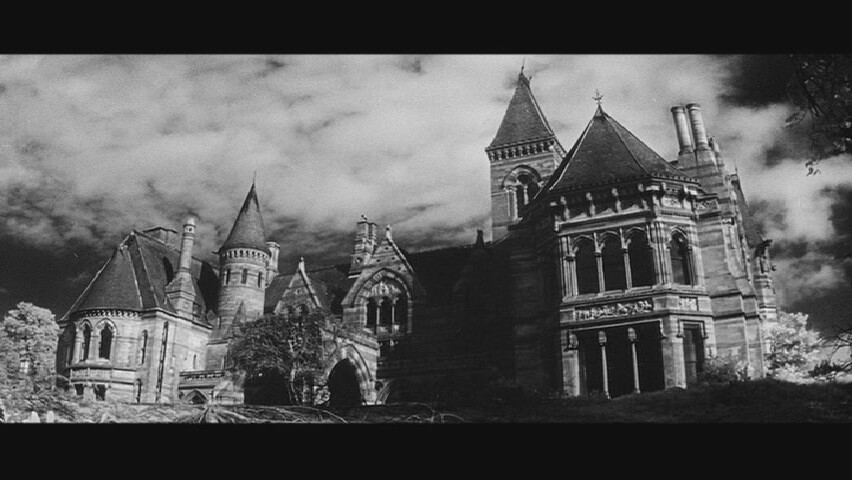
Scaring the audience is not something that comes easily, and an enormous amount of skill has gone into it. Firstly, there's Hill House itself. Huge, gothic, all at angles, something as simple as a mirror tilted forwards is enough to cause unease. Wise films the house like a character, treats its spires and archways like eyes, watching the characters as they go about their business. Watching us, too. Even the way actors are framed increases the sensation that there's something else there. At one point, an empty chair sits slightly out of focus in the background. We listen to the main character, we're meant to look at her, but I couldn't stop looking at that chair. My imagination, thanks to the direction and sound, was all too happy to put a ghostly something in that chair. (It's a trick used to great effect thirty-five years later, in Shyamalan's The Sixth Sense.)
Next, there's the sound. Obviously there's the famous scene where something pounds on the walls, but I'd argue the entire soundtrack is just as frightening. Whether it's a creature sniffing around the corners of a door, a dead woman's laugh echoing around the corridors, or just an eerie gust, a constant atmosphere of What-The-Hell-Was-That? hangs over the film. The music, by contrast, is an all-out assault on the nerves: dramatic, loud, it occasionally tips the story from sinister unease to absolute horror.
Finally, we have the cast. Eleanor (Julie Harris) is a few apples short of a bunch even before her visit to Hill House, thanks to years looking after her invalid (now dead) mother. Desperate for attention, Nell may or may not be in the house's thrall, exacerbating things by at one point (maybe) writing a ghostly message to herself in chalk. (Fellow investigator Theo suspects her all along, saying pointedly "You know none of us did it".) Nell is also a narrator of sorts, which isn't so much a storytelling device as another method for scaring the audience; her eerie inner voice is, in effect, haunting her, and edging her closer to madness. We know from the history of Hill House that Nell will fit right in there.
Also present are Doctor Markway (Richard Johnson), whose experiment this is; Theo (Claire Bloom), a clairvoyant whose fluctuating affections for Nell are not helping her mental state; and Luke (Russ Tamblyn), a youngster who stands to inherit Hill House. The house affects all of them, eroding Markway's enthusiasm, Theo's cool exterior and Luke's carefree attitude until the only one who isn't petrified, oddly enough, is Nell. The transformation of Luke in particular – a smirking cynic – is cleverly done to convince any still unfazed stragglers in the audience of how frightening all of this is.
There are a few big jump-out-of-your-seat scares, but it's the building dread and chilly sense of panic that makes The Haunting a classic. The story, particularly Markway's opening narration of the horrible history of Hill House, is strange and gripping. The way the film leaves you afraid of empty rooms and probably unable to sleep, is unforgettable. The fact that Robert Wise did all this with sound effects and furniture puts most modern horror movies to shame. It's easily one of my favourite films ever, as frightening as Rear Window is tense and exciting.
The Haunting may not work on everybody, as inevitably some people will look at all the empty rooms and just see empty rooms. But it seems precisely calculated to give me sleepless nights and, as not a lot of films can do that, I'm eternally grateful. Just not very well rested.
Showing posts with label Good Stuff. Show all posts
Wednesday, 31 October 2012
The Good Stuff: The Haunting
Tuesday, 23 October 2012
The Good Stuff: Return To Oz
Return To Oz
Directed By Walter Murch
1985
"Weaugh... Teaugh... PEAUGH!"
Directed By Walter Murch
1985
"Weaugh... Teaugh... PEAUGH!"
All is not well in Oz. When Dorothy returns in this sequel (made nearly fifty years later than the revered 1939 original), the Emerald City is in ruins, her friends are missing and everyone else has been turned to stone. There are no songs and dances, and no Munchkins. It’s an audacious approach which did not immediately pay off, marooning Return To Oz at the box office and inviting scorn from critics, who believed it was too dark for children. Were they right?
Well, it’s certainly dark. We begin with Dorothy (Faizura Balk) getting whisked off to a mental hospital, where Aunt Em hopes that some electro-shock therapy will cure her of what appear to be crazed hallucinations – in reality, memories of Oz. It’s a bleak opening, tinged with an even greater worry, as Dorothy receives a key from Oz, suggesting trouble back in theEmerald City . A storm rescues her from losing her memories of Oz, and transports her magically back there. But something awful has happened, and there’s no sign of life – apart from the frightening Wheelers.
Well, it’s certainly dark. We begin with Dorothy (Faizura Balk) getting whisked off to a mental hospital, where Aunt Em hopes that some electro-shock therapy will cure her of what appear to be crazed hallucinations – in reality, memories of Oz. It’s a bleak opening, tinged with an even greater worry, as Dorothy receives a key from Oz, suggesting trouble back in the
So far, upsetting stuff. But fairytales – which L. Frank Baum had always intended The Wizard Of Oz to be – are dark, in places at least. Return To Oz presents us with scary villains, in the Wheelers, the witch Mombi (Jean Marsh), and the Nome King (Nicol Williamson). It shows us mortal peril, in the Deadly Desert (one touch transforms you to sand) and the Nome King’s palace, where one can be transformed into an ornament or tossed into his Fiery Furnace. But these things come with the territory. Without a frightening baddie and a dire situation, what thrill can there be in restoring the order of things? The more terrifying the villain, the more wonderful the escape. Take the moment when our heroes finally escape Mombi, flying to freedom on a creature made of furniture, brought to life with the magic words, Weaugh, Teaugh, Peaugh. It’s a brilliant high, all the more glorious because we’re scared stiff of the bellowing, sometimes headless monster pursuing them. There is darkness, but it only makes the light brighter.
Critics often overlook all the marvellous uplifting moments in Return To Oz, and the cheerful, friendly characters. There’s Jack Pumpkinhead, Mombi’s wobbly prisoner who adopts Dorothy as his surrogate mum; Tik-Tok, a heroic but bulky clockwork soldier charged with protecting Dorothy, who would be invincible if he didn’t need winding up; the Gump, a flying sofa, who’s only been alive as long as we’ve seen him, and would rather just be a head; and Belina, Dorothy’s pet chicken, who suddenly finds herself able to talk, and ends up being instrumental in the defeat of the Nome King. We even see the Scarecrow again, and – in a short scene at the end – the Tin Man and the Cowardly Lion as well. They’re all here. They just needed rescuing first. Is that so bad? Remember that in The Wizard Of Oz, the witch got melted to death, and had an army of terrifying flying monkeys at her disposal, who did things like rip the Scarecrow to pieces. Scary stuff, but not disproportionately so, because good won out.
Anyway, Return To Oz is an amazing film to look at. Jim Henson’s workshop makes utterly lifelike creatures out of Jack and the others, and brilliant stop-motion animation is used to bring the Nomes and their King to life. The performances fuel the illusion: Nicol Willamson is top-billed, and he is terrifying, just as Faizura Balk is perfectly frightened (but determined) as Dorothy. David Shire’s music terrifies as often as it soars, and the story – which melds elements from two Oz books into a single plot – makes for a clever sequel, but also a great standalone film for those few who haven’t seen the original. We learn enough about Oz not to need any previous education, which is how sequels are supposed to work, and so often don’t.
It’s hard for me to be objective about Return To Oz, because it was a big part of my childhood. I must have seen it fifty times growing up. I still believe in every special effect, jump when I see the Wheelers, feel giddy during every heroic escape or happy reunion. I love these characters, and have done my whole life. Is their adventure too dark for children? I can only speak from personal experience, but no. Of course not. It’s a joyous experience, made all the better by the threat of what might happen if good doesn’t win in the end. But hey, it does.
Anyway, Return To Oz is an amazing film to look at. Jim Henson’s workshop makes utterly lifelike creatures out of Jack and the others, and brilliant stop-motion animation is used to bring the Nomes and their King to life. The performances fuel the illusion: Nicol Willamson is top-billed, and he is terrifying, just as Faizura Balk is perfectly frightened (but determined) as Dorothy. David Shire’s music terrifies as often as it soars, and the story – which melds elements from two Oz books into a single plot – makes for a clever sequel, but also a great standalone film for those few who haven’t seen the original. We learn enough about Oz not to need any previous education, which is how sequels are supposed to work, and so often don’t.
It’s hard for me to be objective about Return To Oz, because it was a big part of my childhood. I must have seen it fifty times growing up. I still believe in every special effect, jump when I see the Wheelers, feel giddy during every heroic escape or happy reunion. I love these characters, and have done my whole life. Is their adventure too dark for children? I can only speak from personal experience, but no. Of course not. It’s a joyous experience, made all the better by the threat of what might happen if good doesn’t win in the end. But hey, it does.
Sunday, 21 October 2012
The Good Stuff: Cloudy With A Chance Of Meatballs
Cloudy With A Chance Of Meatballs
Directed by Phil Lord and Christopher Miller
2009
"Steve, my best friend and trusted colleague!"
"Steve!"
"Can I count on your help?"
"[Holds up sardine can he's been trying to open] Can."
"I knew I could."
Directed by Phil Lord and Christopher Miller
2009
"Steve, my best friend and trusted colleague!"
"Steve!"
"Can I count on your help?"
"[Holds up sardine can he's been trying to open] Can."
"I knew I could."
![]() |
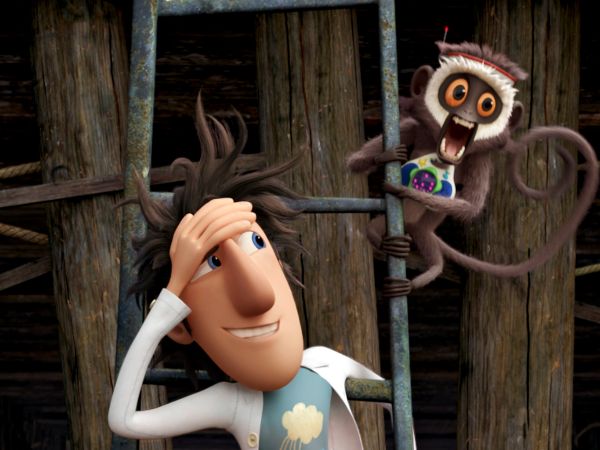
| Steve shares his wisdom. |
Cloudy With A Chance Of Meatballs is no run-of-the-mill kids’ movie. It’s deviously clever, seriously funny, and has so many ideas spewing out of every orifice that its 90 minutes feels a lot longer and more substantial than they should. Even the slightly cumbersome title, lifted from the source book, makes no concession for the sake of simplicity.
Set in the miserable island town of Swallow Falls, which has built an industry entirely around sardines, it’s the story of Flint Lockwood (Bill Hader), a brilliant inventor who is, of course, also a moron. You know how geniuses can have masses of intelligence in one area, but also have no common sense or understanding of the real world? Flint is that, gone mad. His inventions invariably work, but they’re either terrible ideas (ratbirds) or they work too well (spray-on shoes that don’t come off). His latest is a device for turning water into food, and it winds up hovering in the clouds, raining food on Swallow Falls and inadvertently saving the town from a sardine-themed recession. Trouble is, the machine will eventually overload...
Flint is a great character. Brilliant but socially inept, he’s so swept up in his childhood dreams that he hasn’t got a clue how to talk to people, and wanders around his lab making science-fictioney noises to himself. His only friend is Steve (Neil Patrick Harris), a lab monkey wired up to a thought-translator, who offers such useless snippets as “Can”, “Hungry” and invariably, “Steve!” Take a moment to marvel at the genius and stupidity of a man who creates a working thought-translator, and straps it to a monkey.
When an intrepid weather reporter (Anna Faris) lucks out on a trip to Swallow Falls, she grows closer to Flint, and we learn much about her in the process; particularly, how she’s had to hide her brains in order to gain acceptance. In a witty reversal of cliché, Sam (Faris) goes from a stereotypical beauty to a brainiac with glasses. Another witty response to cliché comes in the form of Flint’s father, Tim (James Caan), who couldn’t be more different but wants his son to follow in his dismal footsteps. Yeah, it’s the familiar old father/son dynamic, but Tim’s an utterly sympathetic and believable character, made more relatable by his son’s distinct absence of marbles. The heroic genius is an unstable dimwit; his overbearing father is in fact deeply patient, concerned, and ultimately forgiving. Everywhere I look in this film, there’s a character being written and handled in a fun, refreshing way. It’s also worth mentioning that every character is animated with some beautifully simple detail that accentuates their foibles. The Mayor is tiny; Flint has cockamamie hair; Tim has a huge, unrelenting eyebrow where most people have eyes. It’s expert character design.
A lot of the humour comes from tackling little character clichés, but there’s plenty of thigh-slapping physical stuff too, and visual gags galore. The voice cast (including cult heroes such as Bruce Campbell and Mr T, which from a 12-year old point of view is just about the greatest thing ever to happen in the history of the universe) are consistently excellent, and the story allows for a feast of dazzling sights, such as huge food items attacking the world’s landmarks. (This is followed by a brilliant line about how unusual it is for this freak weather pattern to go after all the world’s landmarks first.)
Cloudy is seriously funny stuff, but it also has rich characters and a story that just keeps turning and gets the most out of its ideas. I’ve heard critics describe it as being aimed squarely at hyperactive 9 year olds and well, they're wrong. This movie works best if you’re a seasoned moviegoer who’s seen disaster movies, science-fiction movies and any film where a guy leans in to kiss a girl after a dramatic revelation. It rewards an understanding of conventions and cliché, but sure, it’ll also make the kids in the audience hoot with laughter. Why shouldn’t it? I’m 27, and I was laughing all the same, whether at a genius piece of wordplay or the look of joy on Steve's face as he offers his latest inane statement. Can! Moustache! Steve!
Saturday, 20 October 2012
The Good Stuff: Ed Wood
Ed Wood
Directed By Tim Burton
1994
Directed By Tim Burton
1994
“Really? Worst movie you ever saw? Well, my next one’ll be better!”
With Ed Wood, Tim Burton has a clear challenge: do you romanticise the Worst Director Of All Time, so that his films don’t look that bad after all, or do what a lot of other biopics do and just tell us how miserable he was? Burton takes a trickier third option, and tells an inspiring, hopeful story about a guy trying to make movies and gain acceptance, while never shying away from the fact that Ed’s movies were really, no-fooling terrible. It’s not a spoof, as there is no need to spoof something as car-crash dreadful as Glen Or Glenda. Nor is it entirely wistful. It’s pitched somewhere between, and its message – that outsiders are never alone, and wanting to do something great can be enough, even if the end result sucks – encapsulates most of the things Tim Burton has ever tried to say as a filmmaker. There’s no doubt in my mind that this is Burton’s best film, and there’s a tremendously sweet irony in the fact that it’s all about a guy who made terrible movies.
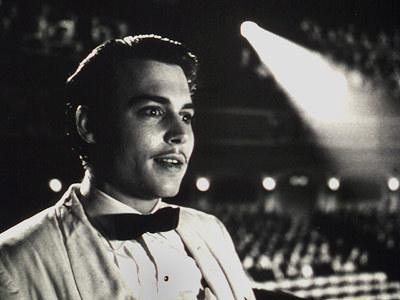
At the centre of it all is Johnny Depp, almost unstoppably optimistic as Ed. He smiles, ignores such petty filmmaking gripes as continuity and clumsy actors, and fawns unashamedly over his idol, Bela Lugosi, whose faded career he gives a last-minute jump start. (Of sorts. His reputation sinks even lower thanks to Wood, but Bela would argue there’s no such thing as bad press, so we’ll go with that.) Their relationship is of course based partly on Tim Burton’s own with Vincent Price, but it’s also a handy metaphor for how Burton views Ed Wood. He’s dimly aware of the man’s many failings, but more concerned with what good he’s capable of. Martin Landau is magnificent as Lugosi, but for me the less-celebrated Depp is the star of the show. It’s a slightly exaggerated, almost cartoony portrayal, making Ed more of an icon than a down-to-Earth normal human being. But then, whoever said Ed was normal?
The entire cast are on top form. Bill Murray is particularly wonderful as Bunny, one of Ed’s cohorts: it’s a performance that’s ingrained into every little movement, making Bunny one of the most real things in the movie. Sarah Jessica Parker has the perhaps problematic role of Ed’s girlfriend, who eventually leaves him. She does a great job of being the voice of reason when necessary – “You make shit! These movies are terrible!” – but also providing Ed with a sympathetic ear. She’s a tough, complex little character.
We get to see Ed’s most talked about movies get made, and his final “masterpiece”, Plan 9, is treated almost with awe – but again, without ignoring the fact that it was stupid, stupid, stupid. And that’s okay. Ed wanted to be remembered, and in a display of typical optimism, Tim Burton tells us that he got his wish. Ed would probably look at his infamous reputation with cockeyed misunderstanding, and see the good in it: all these people wouldn’t profess to hate him with such enthusiasm if they didn’t love him just a little, right? And it’s that ability to see the good in things, even when they are definitely, categorizably bad, that Burton has captured so well.
It's funny and entertaining, certainly, because movies about movies (especially bad ones) are always a hoot. But it’s the hopeful spirit that makes it a moving story as well: Ed’s grinning determination, the kindred weirdos he meets, the faith he inspires in them. There isn't another biopic quite like it, which is fitting for a filmmaker like Ed Wood, who is arguably unsurpassed in his own way. Seriously: Glen Or Glenda absolutely stinks. In that particular case, Burton tells the tale of a longing transvestite much better than Ed himself managed, and that’s somehow no disservice to a man who was lucky to figure out which end of the camera pointed where. The film about his life tells us that we must try, no matter the odds, no matter what everybody thinks, and no matter if they’re right. That’s a hell of a thing to get from watching Plan 9 From Outer Space, and that, one hopes, ought to be Ed’s real legacy.
Subscribe to:
Posts (Atom)