Showing posts with label Neil Gaiman. Show all posts

Sunday, 29 September 2013

The Bookcase Of Fear #3: Neil Gaiman's Neverwhere (Plus A Few Others)

Neverwhere
By Neil Gaiman


Here's an author cloaked in considerable hype.  Geeks love Neil Gaiman: he's inspired two hit movies (one of which I like), and has become a regular big name in Doctor Who, already having at least one fan-favourite under his belt.  (Another episode, not a fan-favourite, may be concealed somewhere darker.)  It's about time I read one of his books.

Neverwhere, if you don't know, concerns a mysterious London underworld called London Below.  It's an invariably unpleasant, but quite imaginative place where seemingly everyone is out to get everyone else.  Our hero, a crushingly ordinary man called Richard Mayhew, finds himself embroiled in it when he helps an injured girl called Door.  She's being pursued by a murderous double-act, Mr Croup and Mr Vandemar, presumably because of her (unsurprising?) knack of opening doors.  Thanks to this small act of kindness, Richard's life in "London Above" is quickly erased: he must go with Door, acquire allies and, if possible, avoid death.  And you can hardly move for death in London Below.

Gaiman's underworld is a work of occasionally impressive imagination.  If anything, there's not enough time to explore it: having now finished the book, I'm still not entirely sure I get it.  It's a sort of medieval society featuring fantastical monsters, pockets of time (and a few people) from long ago, with numerous creative (and/or literal) interpretations of London landmarks.  Earl's Court has an Earl in it.  There's an Angel called Islington.  My favourite was Knightsbridge: by far the book's most intriguing and haunting concept.  But, back up what's all that pockets-of-time malarkey?

The people are not quite as rich as this world.  Richard is dull as a bucket for most of it, eventually going through the traditional you-can-never-go-home-again rite of passage.  His vaguely romantic relationship with the vaguely spunky Door goes spoilers!– nowhere in particular.  Perhaps it's an attempt to avoid cliché, which surely dictates the Man must fall for the Woman; either way, it's a flat ending when he doesn't.  The anti-heroic Marquis de Carabas is obviously a character Gaiman is proud of, and quite right, as he's the brightest spark here.  The villainous Croup and Vandemar, also clearly relished, are comparatively one-note.  They flog that well-spoken-thug caricature you've seen in most of fiction's criminals until it whimpers.

The plot isn't much more than the sum of its parts.  A sort of grimy Wizard Of Oz, our heroes trek through London Below to find assorted baubles and seek help from a magical figure.  When the villain is finally unmasked and his evil scheme laid bare, things quickly reduce to the lowest bad-guy denominator, with ranting and maniacal ambitions and evil-just-for-the-sake-of-it.  (Plus a plot point bizarrely reminiscent of a Doctor Who story from 1987.  Not a good year.)  All of this is a pity, because there's real imagination splashed throughout Neverwhere.  Sometimes, splattered.

I didn't realise Neverwhere began as a television programme.  (I thought it was the other way round.)  This makes sense in hindsight: all those moments where Richard stops to (mentally) recap the action practically scream "Last Week On Neverwhere."  It's understandable, though unfortunate, that the action feels a bit episodic: certain twists, especially a death followed by a return from the grave, might work better with, say, a week of waiting in the middle.

It seems I don't have many nice things to say about Neverwhere.  That wasn't my intention.  It is an absorbing read, with a few bright ideas.  It's just a shame the narrative built to contain them is so perfunctory.


...


I've read other things recently, but didn't get around to reviewing them fully.  Here are a few thoughts on...


Thank You, Jeeves
By P.G. Wodehouse

All right, then, Wodehouse: where exactly have you been all my life?  I was several sentences into Thank You, Jeeves when I realised this was something I was not just going to like, but probably going to love.  Virtually every word of it is funny; the dialogue races along beautifully, of course, but the prose itself (from the perspective of the delightfully idealistic-but-dim Bertie Wooster) is so much fun, I wanted to dive into the book and swim in the words.  Curiously, despite the amazing reputation of Jeeves, it was Wooster who impressed me most.  Perhaps one of the finest Flawed Narrators I've ever come across, his personality bounces off the page.

The plot is that sort of finely-tuned farce (with people getting engaged, identities being mistakes and so on) that Noel Coward and Oscar Wilde were so adept at, except Wodehouse seems more concerned with having fun that appearing clever.  As such, I enjoyed this a lot more.

If the book has a drawback, it's the very dated racial terms.  I thought I'd copped the worst of it just hearing people drop the N-bomb as if it were perfectly normal, but it's later a plot-point that people are frightened out of their wits by black people, casually mistaking them for ghosts or monsters.  I'd be lying if I said these bits didn't make me want to curl up and shiver with embarrassment.  Strike One, Wodehouse.  But everything else was perfect.


Treasure Island
By Robert Louis Stevenson

Just like A Christmas Carol, this one's so colossally famous you can barely separate it from its influence on pop culture.  In other words, it's difficult to read it without imagining the endless adaptations.  (Yes, including the one with the Muppets.)

Still, it's a rollicking adventure with some highlights I've yet to see realised on-screen.  Jim's fight to the death with one of the mutineers, for instance, is darker than what I've seen in the movies.  Meanwhile, certain moments have been enhanced: Flint's murderous crew are more inept and useless in the original tale, Jim's infamous friendship with Long John Silver is mostly a film invention, and the curiously pointless first mate, Mr Arrow, really was put to better use by the Muppets.

It's silly to blame a book for things the films did differently; nitpicking aside, it's an obvious gem.  Read it if you haven't.


The Death-Defying Pepper Roux
By Geraldine McCaughrean

An intoxicating and whimsical fantasy about a boy destined (according to his very strange aunt) to die on his next birthday.  Young Pepper decides he'd really rather not, and hops from one assumed identity to another, touching people's lives in oddly bittersweet ways and visiting a lot of rich French locations.  This conjures the sort of fantasy you'd see in Amelie or Hugo (although it is much better than Hugo).  I did feel a little let down by the resolution, which isn't nearly as fantastical as I'd hoped; however, as the blurb promises, the journey there is certainly rewarding.


I, Partridge: We Need To Talk About Alan
By Alan Partridge

I was a little wary of joke autobiographies since reading Rik Mayall's Bigger Than Hitler, Better Than Christ, which never surpassed its title.  This effort from Alan Partridge (and co.) is far more consistent and a lot funnier.  Particularly skilful is the way Alan "edits" certain events (either in Knowing Me, Knowing You or I'm Alan Partridge) to make himself look better, being somehow oblivious that his fans can readily go and see for themselves, or perhaps genuinely deluded about what happens to him.

I heard the audiobook version of this (read by he, Partridge), and can recommend it enormously.  I'm sure it's hilarious as an actual book, but it'll be difficult to top the self-deluded pomposity of Partridge delivering this tale of heroism, heartbreak and nosebleeds himself, directly to your ears.

Thursday, 30 May 2013

Neil Gaiman's Difficult Second Episode

Doctor Who
Nightmare In Silver
Series Seven, Episode Twelve


Good grief.  How did this happen?

In an otherwise middling series, Nightmare In Silver sounded like a highlight in the making.  It's written by Neil Gaiman, who wrote The Doctor's Wife, an enormously popular episode that gave us a fresh perspective on the TARDIS.  Clearly, he knows his onions.  This one's about the Cybermen, and while they've had a spotty track record (and a run of stories that render them either ridiculous or second fiddle to somebody else), that's all the more incentive to finally get them right.  This one's apparently intended to "make the Cybermen scary again".  It's set in an abandoned theme park in space; done really well, that's most of the "scary" stuff already taken care of.


It could be scary, I... guess...?
All done imagining how good it could have been?  Okay.  For starters, Nightmare In Silver isn't scary.  Not even close.  And it's not a good episode for the Cybermen, who find new ways to be ridiculous, and play second fiddle to somebody else, again.  The characters, the writing and the production design are all horrible.  Kudos on the title, at least; "Nightmare" is exactly the word for it.

Let's begin with the first really obvious misstep.  It probably wasn't Neil Gaiman's idea to include Angie and Artie, the kids Clara looks after, but here they are anyway, so we'll have to make the best of them.  Artie mostly keeps to himself, making fascinating observations like "I think outer space is quite interesting"; his sister is more vocal.  Here are some of Angie's greatest hits, and remember, she and Artie blackmailed Clara just so they could be here:  "Your stupid box can't even get us to the right place!"  "How long do we have to stay here?"  "I hate the future!  It's stupid!  There's not even phone service!"  "I'm bored!"  "Put me down!  I hate you!"  "You always have to turn up and spoil everything!"  "Why can't you just leave me alone?"

I doubt anyone will argue that children this horribly ungrateful exist, but why would we want to watch one travelling through time and space?  Why write Angie, or any character, to be this irritating?  There's an inescapable truth here: irritating characters are irritating.  Why make room for them in your episode?

And even better, all this has a knock-on effect.  Because the Doctor's mind is primarily on the welfare of two little kiddiewinks, and not so much on the fate of the universe, the story's never going to stray into particularly chilling territory.  There won't be any terrifying darker side to the Cybermen – they're just bogeymen threatening the kids.  Consequently, the tone of the episode never escapes toothless, tedious whimsy.  If the intention really was to "make the Cybermen scary again", it seems to have been abandoned at a very early stage.


On-screen description of the above:
"Nothing.  It's just black.  No stars, no nothing."
This is apparently a new, mostly-blue definition of "nothing".
Take humanity's great battle with the Cybermen.  Since the Cybermen can "upgrade" themselves instantly, a final solution was reached: blow up everything that's got a Cyberman on it.  This is obviously meant to be a gobsmacking victory-but-at-what-cost? sort of thing, but the reality is, surrounded by snarky kids, "Spacey Zoomer" rides and "Natty Longshoe's Comical Castle", it's all a teensy bit Looney Tunes.  "We tried other ways.  They only worked sometimes."  Yeah, but if blowing up planets only works sometimes, as must be the case because there are still Cybermen, then what's the point sticking with it?  Even Wile E. Coyote could have figured that out by now, but somehow humanity still seems excessively keen to commit explosion-themed suicide.  What's the betting there will still be a few Cybermen left down the side of the sofa afterwards?

Ah yes, the Cybermen.  I've not been a fan since they came back in 2006, stomping, mumbling and threatening to "Delete" everything in sight.  The fact that they used to be people rarely entered into it, and their potential to be scary and tragic was never tapped.  Cheer up, then: they've been re-designed!  Instead of stomping, they have an irate walk (sort of like a mum marching after her misbehaving kids).  Instead of mumbling, they have a generic Dalek voice which, unsurprisingly, sounds like Nicholas Briggs.  (Doesn't anybody else do voices?)  Instead of saying "Delete!", they say "You will be upgraded", which is quite possibly even less threatening.  (Oh no!  They're going to improve my broadband connection!)

They've developed a few new abilities, mostly of questionable value.  They can zoom around at super-speed, which makes you wonder (apart from who the hell came up with that?) why they don't just do it all the time.  And they can detach body parts, wandering around quite happily without a hand... or a head.  So, is there still a person inside?  You know, the whole point of the Cybermen being that they used to be people?


"Just where d'you think you're going?
You haven't tidied your room!"
Nightmare In Silver doesn't seem interested in what makes the Cybermen tick.  They're mostly represented by the Cyber-Planner, a hive mind that controls them all.  Sound familiar, Star Trek fans?  Neil Gaiman has said he doesn't know anything about the Borg, so it's all a big coinkydink, honest, but there's enough here to suggest otherwise.  As well as all that Borgy "upgrading" stuff, Cyber-conversion now involves tiny robots, rather like Borg nanoprobes.  It's become a gradual process where you sprout little techno-growths and add your intelligence to the whole.  Wha?  Cybermen have no interest in a person's intelligence or wisdom.  They make you the same as they are!  Hey, the Borg quite possibly copied Doctor Who first, but if this is an attempt to steal and steal alike, it's not adding anything of value to what Star Trek came up with.

So what about the Cyber-Planner, a.k.a., Matt Smith?  Half the story consists of the Doctor's mental battle with this evil intelligence, so we get a double performance from Smith.  Is it good?  Well, it's Matt Smith, so it isn't boring.  But the Cyber-Planner isn't written all that differently from the Doctor, so the only thing left for Smith to do is go over the top with it.  This is misjudged from the start: a daft, dopey bad guy who calls himself "Mr Clever", says things like "This is dreamy!" and, as well as being yet another (unintentional?) steal from the Borg, has no link to anything we know about the Cybermen.  Billions of emotionless cyborgs and they all add up to one smug, moustache-twirling plonker?  How does that work? 

The Doctor's mental tussle – represented by a chess match, because that's so original – is acknowledged as pointless; the Cyber-Planner won't honour his word if he loses.  So, er, what's the point devoting most of the episode to it?  Why bother unleashing a lone Cyberman if it turns out, suddenly, there's an army of them underground?  And in the end, when it turns out humanity's Emporer was among them all along and had the option of teleporting them to safety at any time, altogether now: WHY DIDN'T HE DO THAT, THEN?

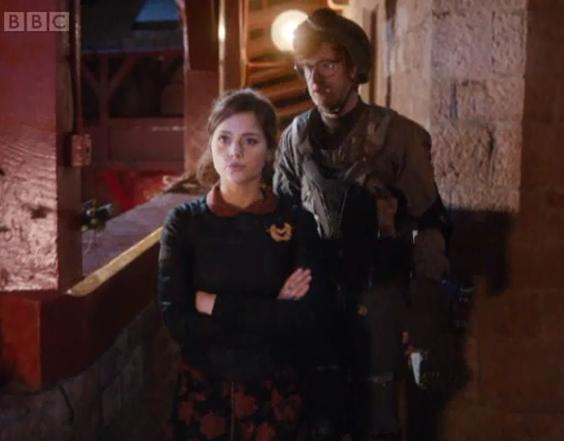
The dramatic stakes just seem to reduce as the episode progresses.  When people die under the command of Clara (whom the Doctor has put in charge of the army, because um), it doesn't register.  But then, that would require Clara to be a three-dimensional person.  I don't know if it's Gaiman's writing, Moffat's outline or Jenna-Louise Coleman's acting, but Clara accepts responsibility, impossible odds and numerous deaths like it's all normal.  "Impossible girl" is about right: no genuine person is this unflappable.  (Still, she ain't perfect.  When the army captain tries to blow up the planet, the only thing stopping her is getting killed by a Cyberman.  Clara looks on, uselessly.  And despite being fully aware that the Doctor is not himself, Clara happily divulges a bunch of stuff the Cyber-Planner wants to know, and gets within arm's reach.  What is the point of a companion who doesn't pay attention?)


"Missy said she saw something, and then she went quiet."
"It's on its way, then."
Someone just died!  SHOW SOME EMOTION!
As well as being a disappointing episode for Clara, who remains exactly the same in every situation, it's not the Doctor's shining hour.  Smith's so busy being wacky as the Doctor and the Planner that there's no drama lurking underneath any of it.  After going on and on about not blowing up the planet, he quite happily suggests they blow it up anyway, making the whole episode oddly pointless.  And then later, he grins leerily at the thought of Clara's short skirt.  Just... yeah.  I wonder who thought that was a good idea.

Reviewing Nightmare In Silver is like shooting fish in a barrel, and it's exhausting.  Gee, what else doesn't work?  Well, none of the soldiers have any personality, so we don't miss them when they die.  Despite the potential creepiness of an abandoned theme park, the sets aren't particularly sinister – oh no, a castle!  especially since they're mostly bathed in garish purple light.  Numerous ideas appear to have got lost in translation, like the frequent references to how the planet will implode, followed at the end by an explosion.  I know Doctor Who is rarely a proponent of hard science, but that's ridiculous. 

There are a few very small dollops of positivity, which tends to be the best you can say about Doctor Who nowadays.  There's Matt Smith, who despite the dodgy villain role and even dodgier characterisation is still, somehow, fun to watch.  There's Jason Watkins as a Cyberman underling, not a particularly dazzling role but well performed.  There's the odd funny line, such as "Don't wander off!  Otherwise the next thing you know, somebody's gonna have to start rescuing somebody..."  And I quite like how the Cybermen look, if nothing else.  But apart from a few frills, this whole episode is a silly, misjudged, wrong-headed mess.

I still can't believe it.  I hoped Neil Gaiman would turn in the year's best episode.  Let's face it, there wasn't much competition.  Against all the odds, somehow, he has delivered the worst.