
Into The Dalek
Series Eight, Episode Two
"Where are we going?" "Into darkness." Yeah, he's not kidding. Into The Dalek is some seriously gloomy Doctor Who.
This is a good thing, of course. We've collectively followed the show for fifty years, and it's important that it finds ways to surprise us. Steven Moffat said we'd begin to wonder how well we know the Doctor, and to my surprise, he's delivering on it. (As is Phil Ford, who once again shares a writing credit.) Peter Capaldi is fascinating to watch, gripping, funny, everything you'd want from the Doctor, but he's not necessarily your friend. When he asks Clara if he's a good man, he requests that her answer be "Honest, cold and considered, without kindness or restraint." Never mind Scottish: that's how he is now. I'm not sure if I like it, which is the point.
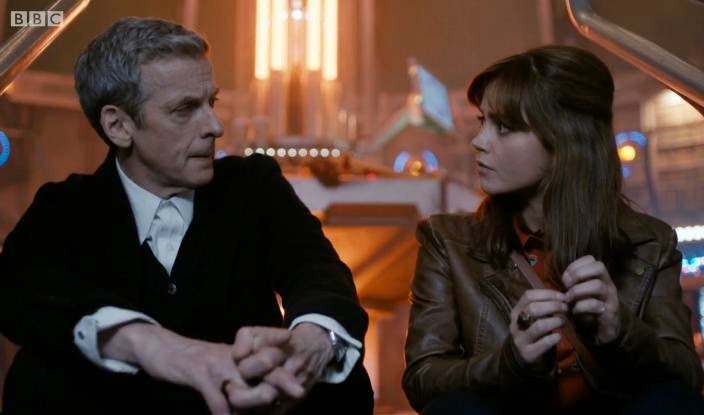 |
| INT. TARDIS: "Clara, tell me. Am I a good man?" "Yes. I've met your previous selves, and they were good men. They're you, so you're empirically good as well." "Oh, right you are, silly me." END TITLES. |
The big talking point is the death of one of the rebels, Ross. Once he triggers a Dalek's antibodies, there's nothing that can be done to stop it. The Doctor shows no remorse – he told him not to do it, he did it anyway, so he's "dead already". But he seemingly offers hope, which turns out to be a way of tracking his remains to a safe location, thus saving the rest of them. No magic solutions, no agonising about it afterwards, he just does what he can to save who he can. Fair enough, but false hope is pretty grim, even for a darker Doctor.
And yet, as unpleasant as he can be, he's still the Doctor. Remember William Hartnell? There was a Doctor with a character arc: a dangerous misanthrope, he kidnapped his companions to stop them telling anyone about the TARDIS. In Episode #3, he tried to kill a caveman to save the bother of carrying him. But he learned from his companions and became the Doctor we know, as much about saving individual lives as the worlds they live on. Capaldi is the start of a new set of regenerations. Perhaps that's why he's a bit of a bastard again.
It's a process and we'll have to see where it goes, but some of it already doesn't add up. His dislike of soldiers is seeded through the episode, just as it was in The Sontaran Stratagem. It didn't convince me back then, either: the Doctor's been around long enough to know you don't need a gun to kill people, and that guns don't make you a soldier. His total disregard for the death of Ross takes the moral high-ground away, but he's still stomping on it when he refuses to take on a new companion, Journey Blue, citing her job description. I can't help feeling they're making an issue out of this just so it can be overcome later.
Which brings us to Danny Pink, the new teacher at Clara's school, who is an ex-soldier. Clara and Danny's scenes provide much needed light in an episode that's all shade. Some fans will automatically cry "Soap opera!", but they're nuts. Danny is immediately likeable, and funny without making a big thing about it. The bit where Clara asks him out is brilliantly-edited and (relax, let it happen) hilarious. Best of all, Clara feels more grounded just for taking an interest in him, which is something her character needed. It's disappointing that the TARDIS is merely "one of her hobbies", but at least that disconnect makes more sense this series. Clara was just an accessory to Matt's Doctor, a pretty girl who wasn't Amy Pond; with Peter, she is a necessary moral counterpoint, and isn't just along for the trip of a lifetime. Obviously she'll need the occasional breather. Danny, who offends the Doctor's sensibilities without having met him, adds an interesting ingredient to the mix.
 |
| A wibbly effect, eerie noises, moving slowly and pretending it's slo-mo... Sniff! It's just like the good old days! (The sad thing is, I mean it.) |
The plot is equally direct, though there are niggles, some bordering on... the word for big niggles, whatever that is. (Biggles?) The Doctor rescues Journey and returns her to the rebel base – this is a future where the Daleks are on the rampage, there isn't time to go into specifics, and that's fine by me. It feels like Classic Who, just having a Dalek war going on somewhere. The rebels are about to kill the Doctor to ensure their base stays a secret, when it's suggested he help their patient instead. A Dalek, damaged and no longer wishing to kill everything in the universe. It just wants to kill Daleks. The Doctor agrees to help it (hold that thought), and rushes to collect Clara.
Plot niggle #1: why do they let him go? They were going to kill him just to keep the base under wraps, and they still don't trust him afterwards, as they keep him under armed guard. Why did they trust him not to summon the Daleks? Scene missing. Hmm. With Clara in tow, the Doctor and three guards are miniaturised and put in the Dalek, because they have miniaturising equipment on board, so why not. Plot niggle #2: actually, why not? Is this really their first resort? Have they tried X-Rays and monkey wrenches? They never really say what's wrong with it, so it's a bit "Huh?" that they immediately opt for the crazy sci-fi solution instead of a mechanic.
Straight onto plot niggle #3 then, which is a biggle: what are they trying to achieve? "A Dalek so damaged it's turned good. Morality as malfunction. How do I resist?" Er, I would think not wanting to do anything that might turn it the other way would be a pretty good deterrent. Sure enough, they discover the reason for the malfunction (a radiation leak), and the Doctor fixes it without pausing to consider the consequences. The Dalek reboots, of course. What were they expecting it to do?
Best just to go with it. The stuff inside the Dalek is creepy, if familiar; movies like Fantastic Voyage and InnerSpace are dutifully referenced, the journey through the eyepiece is weirdly reminiscent of cheap old Who effects (which I love), the rubbish chute is unavoidably a bit Star Wars, and the robot antibodies are on loan from Let's Kill Hitler – but this is an unimaginably better episode than Let's Kill Hitler, so I'm not complaining. What this stuff is really here for is to juxtapose the new Doctor against a Dalek. It's a time-honoured way to set his moral compass, and he's never needed it more. So, how do they get on?
As it happens, I recently saw Victory Of The Daleks (urgh), and one of things it tried to do was pit the Doctor against "good" Daleks and see how he'd cope. Of course, that episode couldn't examine an idea if it was printed in luminous paint on a billboard. This one gives the Doctor genuine hope, which is thrown heart-rendingly out the window when the Dalek reboots. (Capaldi is brilliant here.) It then pushes him to admit he thinks a "good Dalek" is impossible. Clara is horrified, forcing him to give it further thought. He concludes that there is still, and always is, hope. That's a great mix of Doctor/Dalek prejudice and the power of the trusty, ever-optimistic companion. It's Doctor Who to a tee.
 |
| "Welcome to the most dangerous place in the universe." What, inside a Dalek? Is that really worse than, say, stood in front of a Dalek? |
Of course, it doesn't end well. The Doctor is convincing at first, but the Dalek just zeroes in on his hatred for all things pepperpot-shaped. And this is a fair point. He's never made it a secret that he hates their guts, and for all this Dalek's new Jeff Goldblumy ideas about life being indomitable, it's obviously going to gravitate towards the angry bit of the Doctor's psyche. Quite right. I was concerned we'd get a thoroughly friendly Dalek at the end of it, which is where 2005's Dalek went, and that's an episode they've obviously watched again for research. Don't panic: Ford and Moffat manage to change a Dalek without betraying what a Dalek is.
And yeah, on the subject of Daleks, when they finally arrive: ho-lee-crap, they are terrifying. These are the Daleks of old, doing nothing whimsical, no zooming around, no Murray Gold choirs. They just show up and kill everything. There's a sheer hopelessness to the attack scenes, a crushing, saddening doom. And then Rusty The Not Exactly Friendly Dalek trundles in to blast them to kingdom come – which he somehow manages to do without bringing the scariness of Daleks down around him. Their deaths are equally horrifying, and tragic because it's not what the Doctor wanted, and might be the Doctor's fault. Daleks who want to kill us and Daleks who don't; they're equally scary, as they should be.
With the "bad" Daleks dealt with and the Doctor's faith almost in tatters, Rusty can't resist a parting shot. "I am not a good Dalek. You are a good Dalek." The aforementioned Dalek episode from 2005 made the same assessment, and sorry to say, it was balderdash then as well. Does the Doctor destroy heaps of things, sometimes without pity? Yes. Does he also do a bunch of other stuff and act in loads of ways that have nothing to do with Daleks? Again, yes. It's just too simple to label him like that – and it's eye-crossingly bizarre to do it when they so perfectly summed him up as the opposite earlier. The Doctor thinks, he feels, he loves, he regrets, he also happens to kill things. He's still not a ruddy Dalek.
A couple of moments don't ring true, and a couple of plot points don't add up. Is all of that annoying? Yes. Is that enough to make Into The Dalek a bad episode? No, silly! This is a relentless look into the Doctor's soul, and that of the Daleks, and you won't like everything you see, but the Doctor, the Daleks and Clara are more interesting for having looked. It's quite something.


