Tuesday, 30 September 2014

The Doesn't Care-taker

Doctor Who
The Caretaker
Series Eight, Episode Six


Oh dear.  This is a review I don't really want to write.

I was quietly expecting to like this one.  I've a soft spot for episodes by Gareth Roberts, as they tend to get overlooked by fandom – The Unicorn & The Wasp and Closing Time spring to mind.  He can do "funny" exquisitely well, which isn't something to sniff at, but he's also really great at juxtaposing the Doctor against normal people, not to mention smaller, less apocalyptic threats.  Here's another episode of The Doctor Undercover, and this one is set in a school – which has already been done in School Reunion, one of my all time favourites.  That doesn't automatically mean it won't work a second time; it's just a bit less special by default.  That's an annoying place to start.

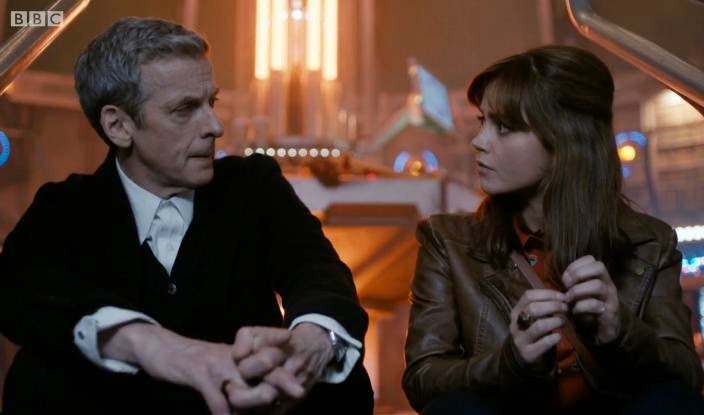
The Caretaker is also concerned with Clara's "normal" life vs. her life in the TARDIS, which they highlight really well in a very funny opening montage.  But we've seen this theme before in The Power Of Three – another episode I'm fond of, so there's a feeling of "Oh, this again" here as well.  However, the main talking point is the Doctor, and his attitude towards Danny, which had been building up before they even met, and is clearly a theme for the series.  That's what the episode is – the Doctor meets the boyfriend.  We'll learn more about both of them in the process.  Is it a success?  Um.

Of course the Doctor thinks she's dating a Matt-Smith-alike,  and of course
he's okay with that.  What do you mean, "unspeakably creepy"?
(Okay, he probably views it as natural for her to fancy Matt Smith,
and has no feelings vice versa.  But I can't help thinking about it.)
You may have noticed that the Doctor, this year, is a bit of a git.  Well, a lot of a git.  He's mostly git.  He's rude, dismissive, difficult to like.  This is, broadly speaking, a good thing – you've got to keep the character interesting after fifty years and a dozen-or-so previous actors, and learning to love him all over again is an important part of that.  It's also important to remind us that he's an alien, and being a bit less likeable is a simple way to achieve that.  I totally get all of that, and I'm under no illusion that the way they're writing Peter Capaldi's Doctor is an accident.

Even so, I'm not enjoying it.  Your mileage may vary.  I don't enjoy the Doctor being rude to people out of reflex.  I don't enjoy him loudly telling people to shut up.  I don't enjoy him refusing to accept that an ex-soldier could have a modicum of intelligence, or that a PE teacher could either.  I think the Doctor is basically a good person and he's interested in other people, although he is different from them.  I think there's alien, and there's arsehole, and we are confusing the two, possibly due to an unfortunate cross-pollination with Malcolm Tucker.

The Caretaker does come up with reasons for the Doctor's rudeness towards Danny in particular – and states them all rather boringly out loud, which isn't a very subtle way to do things, but is how this series rolls.  The main one is fatherly disapproval, which could work, except he was being rude to Danny before he knew this guy was a boyfriend to be disapproving of.  (And to an extent, before they even met.)  The other reason is, you guessed it, the soldier thing.  The Doctor's dislike of soldiers is a massive issue at the moment, and I might as well throw my hands up here: I don't get it.  Yes, the Pertwee Doctor hated the military, partly because they blew up some life-forms behind his back, mostly because he was stuck with them for several years.  Yes, the Hurt Doctor did some soldiery things the subsequent Doctors are ashamed of – but Day Of The Doctor really ought to count as closure there.  Why's it such a bitter, personal problem now?   (Remember, he's aged 1,000 years since the John Hurt reunion.  That's ancient history.)

It's a thorny issue, because of course, the Doctor is a massive hypocrite.  (Which they also point out, because the audience might have cotton wool for brains.)  He's made use of the military any number of times since (and during) the Pertwee Years, and he's befriended a few of them.  He's quite capable of blowing things up by himself, with or without the handy caveat of "There should have been another way" or, as per The Next Doctor, "You made me do it."  The Caretaker examines that as well, positing that he's simply a higher ranking officer than the likes of Danny, and dislikes the lower ones out of snobbery or shame.  That's a new one, and it's not necessarily out of the question.  But it's yet another reason not to like this guy.

Hooray for character development and everything, but I wish this episode went some way to resolving these issues, rather than just highlighting them.  For the first time this series, I felt at arm's length from the Doctor.  He's still funny, because it's written by Gareth Roberts and Steven Moffat, and Peter Capaldi can do put-downs like nobody else.  He's still compelling, because he's Peter Capaldi and he's intensely interesting to watch.  But the whole rude, dismissive thing is getting in the way, for me.  Christopher Eccleston was like that in his first episode – saving humanity out of irritated obligation, not massively fussed about the individuals.  And fair enough, but he learned.  That's what Rose was for.  Is Clara helping this guy, or not?  (They point out that she's his external conscience, because of course they do.)  Why is he calling us "little people", like David Tennant's Doctor during his nervous breakdown?  What happened to the Doctor actually quite liking humans?  It just feels like rude is the new bow tie: it's cool, apparently.

"THAT'S NUMBERWANG."
None of this goes unnoticed by Clara or Danny, and again, it's obviously no accident.  He's not meant to be likeable, we're not supposed to be enthralled by this behaviour.  There's even a cheeky line: "I hate you!"  "That's fine.  That's a perfectly normal reaction."  The fact that it's making me want to punch iPlayer, or switch it off, or run crying back to Matt Smith, is merely an unfortunate side effect.  It's a gamble.  We've yet to see the pay-off, but at this stage, I can understand a less patient fan giving up, at least until they're done with the monotonous I Hate Soldiers thing, or the equally monotonous I Hate Boyfriends thing.  (Oh good, this again.)

First time through, The Caretaker set my teeth on edge.  Second time, its charms became more apparent.  The Doctor is terrible at undercover work, and that can be hilarious.  It's not quite the same as Matt Smith's brand of undercover terribleness – Capaldi is more grumpy old man than charming eccentric, and he manages to embody an alien superciliousness, as well as exactly the cantankerousness you'd expect from a school caretaker nobody wants to talk to.  The way he refers to himself as "a man of mystery" is, hilariously, to die for.

Some of the really funny stuff is Clara, just generally, or failing to cover up her trips in the TARDIS.  ("Nice frock.  Bit wet..."  "Freak shower."  "Is that seaweed?"  "I said freak!")  There's a brilliant moment where the Doctor name-drops Jane Austen, which is a ridiculously annoying habit Clara rightly calls him on, except this time he's just read the bio at the back of Pride And Prejudice.

Of course, The Caretaker isn't just a Funny Episode.  It's a character-developer for Clara and Danny, and it's a low-key, patient episode in order to accommodate that.  I don't mind – Clara's character only improves if you heap some layers on it, and she grew more interesting just by meeting Danny in Episode #2.  They are inevitably rushing things a bit, thanks to the time-jumps between each episode.  A moment where she says she loves Danny feels awkwardly unearned.  Danny spends most of the episode either losing patience with, or being bluntly pissed off with her, which leaves her trying to make excuses for the Doctor and herself, which isn't the best window into their relationship.  Sam Anderson is very good as the very patient Danny, but we don't really see what it is he likes about Clara.  Doctor-issues get in the way of any genuine chemistry.  I appreciate slowing down to examine characters like this; I'm just not sure it worked this time.

As for the monster plot, including the Doctor's puzzling decision to lure it to the school because "This is the only suitably empty place in the area" (WTF?), the Skovox Blitzer must be one of the most irrelevant "threats" in Doctor Who history.  A marauding robot thingummie that shoots people and needs to be got rid of and that's it, it's so underdeveloped it's almost off-screen.  Of course it's really just a starter pistol for the character stuff, but plots should always try to be interesting, and this one struggled to keep my attention even while I was looking at it.  (Although it did make me laugh, as it's inadvertently quite similar to Mitchell & Webb's Numberwang robot, Collosson.)  Still, unless my ears deceive me, that's Sam Anderson doing the voice, which bounces us back to the theme of officers and soldiers, what with the Doctor pretending to be the Skovox's boss in order to shut it down.  That's pretty nifty, although I still hate the soldier theme and want it to die, which does get in the way a teeny bit.

I admire the things this episode tries to do.  Some of them will make more sense in the fullness of time, and they probably make perfect sense now, to people other than me.  Good for them – you, even.  I really, really wanted to like this, and I take no enjoyment in not enjoying The Caretaker, but that's where I'm at: arms folded, frown in place, wondering when it's all going to come together.  Hurry up.

Saturday, 27 September 2014

Crimey Wimey

Doctor Who
Time Heist
Series Eight, Episode Five


Ah, phooey.  Stephen Thompson again.  I tried not to roll my eyes when I found out who wrote this one, because in an ideal world you'd treat every episode as its own special little flower and forget any of the writer's baggage.  But I can't help it, grumpy old sod that I am: I didn't like his previous episodes, so I automatically want to duck and cover when a new one comes along.

Fortunately, Time Heist is pretty good.  It holds together well and there are good bits.  It's co-written by Steven Moffat, however, so I don't know who to thank.  Similarly, any problems will be indiscriminately shared out between the two of them, because I'm fair like that.

"What do you want, more than anything else?  Whatever it is, it's in this bank."
Quite a big assumption there, Doc.  You could easily be here under duress.
Time Heist scores an early point by avoiding one of the show's boring bits, aka the how-do-we-get-involved-in-the-plot bit.  This usually means plonking the TARDIS directly in the path of some trouble, or a famous person, or both.  It's just narrative housework that needs clearing away before the opening titles.  Sod that: we jump right from the Doctor picking up the TARDIS phone to a dark room later on, where he, Clara and two others have just had their memories wiped.  They have agreed to rob a bank, and they've got no choice but to go through with it, right now.  And we're away!  The story begins with a shot of adrenalin.  Big tick there.

I've seen bits of Hustle and The Real Hustle, and far too many awful Ocean's movies, so I know the drill: a bank with flashy security, a few talented individuals needed to break in, vaguely philanthropic reasons for doing so.  It's one of those pre-existing frameworks you can just drop Doctor Who into, it being a super-malleable concept and everything.  The way it's handled is suitably flashy, and it works.

The Doctor's thing is that he's clever.  Psi's thing is that he can interface with technology.  Saibra's thing is that she can look like other people.  Clara's thing is... I'm guessing, moral support?  Their actions are all more or less pre-ordained by a mysterious Architect (who is, let's face it, probably the Doctor), because there's a time travel aspect (duh), which I'm guessing was Steven Moffat's idea.  The way the story eventually folds in on itself and bounces back and forth in time is very him.  But who knows, maybe it was Other Stephen.  Either way, kudos: it's not a bad puzzle box.

As for the bank, well it's one thing to describe it as the most secure building in the universe (or whatever), and another to actually convince us of it.  Who designed this place?  Yes, there's a terrifying creature that detects and feeds on guilt, but it can only detect one guilty person at a time, and it seems to get that wrong at least once.  There's no CCTV to (for instance) monitor conversations, including (for instance) ones about robbing the bank, which our heroes never stop having.  There are easily-accessible air vents all over the place – and I mean huge ones, even by movie cliché standards.  And the main method of checking your identity seems to be a breath-scanner.  It's suggested this is a way of checking your DNA, which is puzzling in itself, but seriously, breath?  A thing that isn't the same from day to day anyway, and can be easily stolen and bottled?  Thankfully there is at least one secure lock in the building – only a perfectly-timed solar flare will throw it off.  But it should be noted, the vault on the other side of it contains thousands of boxes that aren't locked.  Capped off with a security staff numbering maybe half a dozen, the whole operation is hilariously shoddy.

Still, it makes for an exciting trip as our foursome tries to avoid the guilt-gobbling Teller, which is an alien that actually looks like it comes from another planet, and does something irreversibly horrible to its victims.  Mary Whitehouse would spin in her grave if she could see the caved-in skulls of its victims.  While it does turn out that the Teller is hoping to rescue its mate, this doesn't make a difference to the things it's done, and it doesn't suddenly change the tone like in Hide, which had a similar, much gooier revelation at the end.  The thing is only doing what it's ordered to do – it's non-evil, which gets another tick from me.  (Mind you, no prizes for guessing, as the chains are a pretty sizeable hint that it's not loving its job.)

One minute she's going to feed them to the Teller, the next... she's not?
Bloody convenient for them, but why the change of plan?
To counteract the mind-wipe, we have Shredders: devices that atomise you on the spot.  The Doctor's okayness with using these, when your only alternative is having no brain, is another little addition to the Dark Doctor Files.  Can you imagine Matt Smith doing that?  Clara's dead set against it, because she's the companion and that's her job.  In any case, it later turns out that they're actually teleporters.  For once, this came as a pleasant surprise rather than a cop-out.  It's a totally legitimate loophole; maybe I'm naive, but I didn't see it coming.  Well, do you know what a teleporter looks like?  (By which I mean the wee gizmo, not the special effect.)  Meanwhile, if Psi had actually followed Clara's advice and not used it, he'd be worse than dead.  Interestingly, this goes unaddressed.

After much corridor running (with one set humourously redressed using different lights), the penny eventually drops: the bank is run by one woman and a series of her clones, and she's holding the Teller's mate in her vault.  One day, dying old and alone, she regrets leaving both of them to die in the storm, and will call the Doctor to arrange what is really a rescue mission.  Again, not a bad timey wimey puzzle: it falls into place with a satisfying thunk.

As for the woman and the clones, Keeley Hawes plays the sort of business-minded bitch already creakily familiar in Doctor Who.  I was reminded of Miss Foster, and I wish I wasn't – it's not a gift of a role, however many times Keeley has to play it.  Psi and Saibra are likeable enough, though really little more than superpowers and sob stories on legs.  (I can't help wondering how a man who deleted his family from his memories can know he had a family to forget.)  Clara is wrong about the Shredders, and otherwise isn't much to write home about.  Capaldi is vicious, funny, endearingly sweet when he wants Clara to hang out with him, and believably cool about tragedies he's powerless to prevent.  They are teetering on the edge of overdoing it with the "doesn't find Clara attractive" gags and the eyebrow references, but as ever, he's knocking it out of the park.  I'm still waiting for his first great episode.

Time Heist is neat and tidy, and certainly the cream of the Stephen Thompson crop.  I've got no major complaints.  It's an unspectacular does-what-it-says-on-the-tin deal, but hey, I'd rather watch it again than Ocean's Twelve.

Friday, 19 September 2014

To Be Continued...

To my small number of occasional/accidental readers, including any random Googlers hoping to find pictures of Daleks and Arthur Darvill (apparently)...

Due to being busy over the weekend and an impending trip to Devon, I won't be reviewing the next Doctor Who episode, Time Heist, until the following week.  When I'll be desperately cramming in a review for The Caretaker as well.

Rest assured, I shall spend the week watching and rewatching Time Heist on an iPhone and scrunching my thoughts up into a ball to throw at you a.s.a.p.  And possibly looking at Devon a bit.

Either way, Neil is not best pleased...

If Matt Smith can rescue a bad episode, can four Matt Smiths rescue no episode?
NEIL IS WILLING TO TRY.

Monday, 15 September 2014

The First Sign Of Madness

Doctor Who
Listen
Series Eight, Episode Four


Well, here's one nobody's going to agree on.  I've read reviews that love this episode, reviews that hate it, and reviews that critique other reviewers for not feeling the same way.  All of which is true every week, to some extent, but Listen really feels like a fork in the road.  I've seen it twice; I'm sat here arguing with myself about it.  Or am I?

Sorry, that's a reference to the plot.  The Doctor is alone in the TARDIS, thinking aloud, and he comes up with a theory.  What if we don't really talk to ourselves?  What if, on some level, we know there's someone else there?  Imagine a creature that hides perfectly.  What if it's always there, turning off the TV, moving our coffee cups, hiding under the bed?  Haven't we all had a nightmare about something under the bed?  What's that about?

I hate to be that guy, but I haven't actually had this dream.
Stuff under my bed, sure, but you'd never catch me
putting my feet on the ground.
Already there's a mixture of the new and the, um, not-so-new.  Monsters that tap into elemental childhood fears are Steven Moffat's forté.  Heck, we've already had a monster that can hide perfectly, by making you forget about it.  (Insert "I guess he forgot about it" joke here.)  What's new, apart from his interest in people's dreams, is that the Doctor figures all this out by brainstorming when he's bored.  No landing the TARDIS where there just happens to be some trouble, no distress call on the psychic paper, just an idea that takes root in his head.  It's different.  Different's good.

Also good is the way it says something about the Doctor.  He is absolutely driven by curiosity.  That's him to a tee, although it drives Peter Capaldi's Doctor in a more clinical, nothing-else-matters kind of way than his predecessors.  Capaldi just wants to know, at all costs.  Listen takes him further down the not-necessarily-your-friend path of "alienness".  One moment he's telling a young boy that being afraid just makes him a better person, the next he's sniping at Clara for sugar-coating it.  He wades into Clara's history, ostensibly to help, really for his own purposes, and without considering the consequences.  He rescues a man from the end of time, and from something that's frightening him, but still makes him wait until he can get a good look at it.  He needs rescuing, too, when he gets in over his head.

No doubt about it, this Doctor is fallible.  And guess what: he's probably wrong about the Monster Of Perfect Hiding, too.  They leave it open, just about: something is in that little boy's room, but it might be another little boy.  Something opens a door at the end of the universe, but it might be a faulty mechanism.  (Or that invisible monster from Midnight, popping by to say "Coo-ee!")  The Doctor doesn't know everything, and the "monster" plot isn't tied up in a bow.  Who saw that coming?  I mean, usually there's plot holes, but this is deliberate!

I think it's refreshing to look at the way the Doctor thinks, why he does what he does, and whether he ever lets his imagination run away with him.  Some will find it disappointing – there's no monster, or worse, we don't know either way.  Boo!  But I'm one of those fuddy-duddies who thinks you can do Doctor Who without monsters (burn him!), so I'd be nuts to complain when they do things differently, and actually make a show about ideas and people instead.  In any case, they have their cake and eat it too: the scene with the whatever-it-is under the bed-covers is instantly one of the most terrifying moments in Doctor Who.  Behind the sofa?  Screw that.  Get out of the house.

But despite how it looks, this isn't an episode about scaring you.  It's about fear, and more specifically, the Doctor's fears.  His paranoia is, despite all his usual horribleness – and he's plenty gittish this week – a clever way to make him relatable.  We all talk to ourselves, and imagine things that aren't there.  That's another bit people might not like – bringing the Doctor down to our level.  I'm fine with that, up to a point.  (More on that later.)  He's not like us.  There should always be distance.  But we do need to see something familiar in there, otherwise we wouldn't want to stick with him.  Especially these days.

Horribleness aside, he can be very cute.  "I need you!  For a thing!"
How can you not love his little face?
Which brings us to another thing this episode is saying, albeit indirectly: get this man some full-time companionship!  Clara's need to get away from it all ("it all" being "the TARDIS") made more sense once Capaldi showed up, but he needs a friend more than usual now, not less.  She's got plenty of reasons to find him infuriating, such as his callous disregard for timelines, or the safety of others, and the continued "jokes" about her physical appearance.  (These are becoming less about the lack of underlying romance and, sadly, more about finding new ways to be rude.  Still, I loved "You said you had a date.  I thought I'd better hide in the bedroom in case you brought him home."  Quintessential Doctor strangeness.)  I wish they'd resolve it, and have Clara step aboard permanently.  The Doctor needs someone to make sure he hasn't gone completely nuts and, at this rate, to remind him to put on trousers in the morning.  Alas, the idea of a Doctor Who companion who can up sticks and just go with him is becoming increasingly sepia-toned.  Clara gives him a hug at the end, so maybe that's a good sign.  Fingers crossed.

Ah, Clara.  You know how I mentioned liking it when they make the Doctor relatable, up to a point?  Well, we've reached that point.  And hopped over it.  And set up camp on the other side.  No doubt about it, this is the bit that really divides people: Clara goes back in time to find the Doctor as a young boy, inadvertently starting his fascination with a monster under the bed (it's really Clara), and reassuring him afterwards.  By "reassuring", I mean setting up several tenets of his personality, including the need to be kind, and to not be cruel or cowardly, and – for good measure – the need for companions.  I'm genuinely surprised she didn't add "You know what would make a good name?  The Doctor, that's what!"

Is there anything inherently wrong with invading the Doctor's personal history?  Your mileage may vary.  In my oh-so-humble opinion, there was never any point investigating (for example) his real name, because he doesn't need one and nothing they come up with would ever be good enough.  Similarly, there's no need to tell us why he is the way he is – if you really want to know that, just watch Doctor Who.  It takes away some of the mystery – well, no, it takes away all of the mystery to have someone roll up and explain to him how to be the Doctor.  A lingering look at the man behind the curtain is not going to make him more interesting.  It does the opposite.

Mary Sue to the rescue!
And it's not just anybody doing it.  No, it has to be Clara.  Quick recap: it was Clara who told the Doctor which TARDIS to choose for his adventures.  Clara rescued the Doctor throughout his timeline.  Clara convinced the three Doctors not to blow up Gallifrey after all.  And Clara talked the Time Lords into giving the Doctor a new set of regenerations.  Anything else?  Well, thanks to the TARDIS telepathic circuits, she's got her time-space pilot's license as well.  She even tells the grown-up Doctor to "do as you're told", and that works.  I know Steven Moffat likes Clara, and really, I do too – her character's coming along nicely this year and makes a heap more sense with Peter Capaldi to act opposite.  But there's a limit to how OMG you can make her before the Doctor starts to seem strangely unnecessary.

I know how the ending is supposed to work, and for many, it did.  You're supposed to be pleased to see another Steven Moffat timey-wimey slot into place.  You're supposed to go "Oh, I see!" when you realise why the Doctor had that dream after all (but not why everyone else did, because um).  You're supposed to tingle and smile when Clara waxes lyrical about who and what the Doctor is.  But none of that worked for me.  I wanted to get behind the sofa.  I'm all for exploring the Doctor's character, exposing his fallibilities, even visiting his past, but it's how you do it.  Do it like that, and the Doctor edges a little closer to not being special any more.

It sounds like I'm one of those guys who hated Listen.  I'm not.  I really don't have a problem with the Doctor going on a wild goose chase, and I like the open-ended-possible-non-monster.  I like Clara, up to a point (we're not going through that again!), and hey, I like Danny.  Clara finally goes for that drink, and Samuel Anderson is as charming and vulnerable as he was in Into The Dalek.  Exactly as much, actually, with the same argument arising (Don't mention the war!) and the same back-and-forth editing wheeze about it afterwards.  (Let's think of it as a call-back.)  I don't really like the soldier parallels between him and the Doctor – drawn so broadly that you couldn't miss them in a snowstorm – but that's obviously an arc, so best just to grit my teeth and see where it goes.  As for Clara, her emotional journey didn't make a heap of sense to me, but I'm glad she seems to be getting on famously with Danny at the end.  The Doctor seems happier too, which is good news for Mr Grumpy.

It's frustrating.  I can't entirely land on "I liked it" because of that ending, and it's one of those stories where the ending is everything.  But I can't dismiss it either, because it does a lot of things really well – like some of the characterisation, the stock-in-trade scariness, and Peter Capaldi rocking the house, terrifyingly unreliable one minute, childishly loveable the next.  Ultimately, the Doctor doesn't know if there really was a monster, and has to leave it at that.  I know how he feels.  I don't know if there was a really good episode.

Monday, 8 September 2014

Meh In Tights

Doctor Who
Robot Of Sherwood
Series Eight, Episode Three


Oh, what joy, an episode about Robin Hood.  Do we have to?

This is purely a personal preference, but I'd stick Robin Hood next to Peter Pan and A Christmas Carol in the file marked Do Not Need To See It Again.  It's not that I don't like these characters or stories – it's that pop culture has faithfully assimilated them, reproduced them, re-interpreted them and taken the piss out of them more times than I can be bothered to calculate.  Robin Hood, plus swashbuckling, sword competition, evil Sheriff, for the umpteenth time?  Thanks, but I'd rather go and put the kettle on, and watch it boil.

Quick: moan like you're ill, wait for the guard, then beat him up!
Rated four frowny-faces in The Big Book Of Movie Clichés.
On the bright side, Robot Of Sherwood tries to do something different.  The Doctor refuses to believe Robin Hood exists, let alone as an amalgam of every trite Robin Hood stereotype imaginable.  Something sinister must be going on.  That's not a bad premise, but it does rely on having an interesting answer at the end of it.  Surprise!  There is no answer!  Robin Hood exists, and modern pop culture got every single detail right, including the spoofs!  Errol Flynn was, apparently, making a documentary.  This is either a post-modern twist, or an excuse for not coming up with a single remotely new thing to say about Robin Hood.  Having been bored rigid by equally derivative Mark Gatiss episodes in the past, I know what my money's on.

Take a look at the rest of the episode.  As per the title, the medieval setting comes with incongruous sci-fi elements such as a spaceship and (spoiler alert) robots.  This is truly trailblazing stuff, unless you happen to be a fan of, to pick one random sci-fi example, Doctor Who.  Historical settings (and alien worlds that look like them) scarcely come without a bunch of aliens, robots and spaceships (oh my).  It's a full-blown trope!  (And it's a bit boring, having the Sheriff of Nottingham engage in exactly the same sort of modern, spacey villainy as every Doctor Who villain ever.  Can't he be, y'know, from the past and stuff?)

Since the Robin Hood stuff is deliberately corny, I'm guessing the robot stuff has a little of that too, but being too aware of a trope just risks underlining that you're doing it all again.  So does having Clara dictate Robin Hood's history back to him, as well as the Sheriff's robotty schemes, without first being told.  Yes, we do know the Robin stuff backwards, and yes, the Sheriff's history with the robots is perfectly bleedin' obvious.  You could Autofill the entire plot on a mobile.  Speaking of which, there's a spaceship disguised as a building, futuristic robots nicking stuff from the surrounding humans, and a half-robot leader.  Is Series Eight missing a script editor, or are they deliberately re-using the plot from Deep Breath – something we saw two weeks ago that already wasn't any great shakes in the originality department?  Thanks to the ongoing arc, they even reference it directly.  "The Promised Land again?  Like the half-face man?"  You said it.

In my review for The Unicorn & The Wasp, this was roughly the point where I said I didn't mind how corny and derivative it was, because it was funny and well-performed enough to rise above it.  Robot Of Sherwood is dead set on being a Funny Episode, and there are some decent lines and successfully funny bits in it, but for me, it doesn't come close to compensating for how tired it is.  Frankly, it's not that funny.  At one point they try to invert the famous gag about Little John, and have him actually be really small.  Only problem is, Maid Marian And Her Merry Men got there first.  Twenty years ago.

Most of the comedy comes from Peter Capaldi reacting abrasively to his surroundings.  The Doctor's refusal to believe is the backbone of the episode, and it's intrinsically like this new Doctor, as well as being just a shade like William Hartnell.  (Again, still not wildly original re Robin Hood.  See Blackadder: Back & Forth for much the same material.)  That's all to the good, but the way it's handled is a bit too broad, boiling down to the Doctor and Robin yelling at each other until Clara tells them to shut up.  It's more monotonous than funny, and it doesn't give Peter Capaldi much to work with, or at least much that's good.  I'm against pigeon-holing the Doctor's personality; he thrives on strangeness, not predictability.  It's certainly too soon to stuff the Twelfth Doctor into a little box marked Rude And Grumpy, but that's what this one does.  Capaldi is better than this, not to mention all the dry exposition he's made to spout.  That bit on the spaceship is sheer one-sided yak, yak, yak.

Hey, cool shot!  Reminds me of Die Hard, aka Alan Rickman,
aka the Sheriff Of... god damn it!
Meanwhile, Jenna Coleman has fun, especially when she's wheedling information out of Ben Miller's rather pitiable Sheriff.  It's unfortunate that last week's moral tussle between her and the Doctor has gone temporarily out the window – but they're (very obviously) trying to reassure us he's not so bad after all.  Clara spends much of the episode drawing parallels between the Doctor and Robin for the same purpose, and this is exactly as embarrassing as it sounds, especially when you've made him the most cartoony Robin Hood imaginable.  It's illogical – Robin insists he's not a hero, but there's little practical difference between that and what he's doing – and sometimes poorly written.  "When did you stop believing in anything?"  "When did you start believing in impossible heroes?"  "Don't you know?"  That's actual dialogue.  Urgh.

The script has a slippery grip on this new Doctor, especially if you compare it to the last two (much better) episodes.  The grumpiness makes sense, even if it's a bit forced, like sticking a fez on Matt Smith.  What about his sword-fight, using a dessert spoon?  "I am the Doctor, and this is my spoon!" is something you might expect to hear from David Tennant or Matt Smith, and not at their best.  Coming from Capaldi, it's downright embarrassing.  I thought the new Doctor had outgrown whimsical show-boating.  Ditto him entering the archery competition, and cheating via a magic arrow; for a ghastly moment, I thought I saw Tennant's Doctor in his place, all over-the-top gestures and broad heroism.  If we really must yo-yo between Morally Grey Doctor and Bouncy Cartoon Doctor, I hope they find a more subtle way to do it.

I get a bit grouchy reviewing episodes like these, because there's nothing much to say apart from what I didn't like.  I just end up listing things.  Did I mention the robots?  They're apparently following the Sheriff's orders because, uh, they have nothing better to do?  Wait, aren't they heading for the Promised Land?  Why are they helping some random Sheriff stage a coup?  No matter: they continue to attack people with lasers even when they've seen other robots tricked into blowing themselves up that way, so obviously they're idiots.  They barely seem to register with the Doctor, who made a big thing of killing the Deep Breath robots to save some humans, and barely bats an eyelid killing these guys.  Meh.

As for the plot, negligible as ever, it involves melting down gold and turning it into engine parts (and circuits – mind if I borrow that, Fires Of Pompeii?).  I know, right – a gold-filled spaceship, nice and heavy, just what you need for breaking orbit.  When the ship needs more gold or it won't get far enough away to safely explode, one gold arrow will suffice.  Shooting it directly into the side of the ship will do the trick.  Ah, if it isn't our esteemed colleague, Mr Bollocks.  Pull up a chair!  (On second thoughts, euw.)

As for what I did like?  Some of the jokes hit the bullseye, which is literally the least you'd expect.  "Like I said, very sunny."  "So?"  "Have you been to Nottingham?"  Heh.  Best of all is this T-shirt-ready zinger from Clara: "Can you explain your plan without using the word 'sonic screwdriver'?"  That's a good question for all Doctor Who writers.  Long may they continue asking it.  I can think of a few others.  (On the other hand, as the fine writers of Androzani.com point out, it has the nasty side-effect of underlining how trite the sonic screwdriver is.  Too true, and it's not even the first time they've made that joke.)

Apart from a few irreverent laughs, this is filler.  Yes, it's a "funny" episode, a "romp" even, and we've had worse, but that's not a free pass to rely on plots we've heard a million times, limp along for 45 minutes and juggle tropes and clichés like they'll spit out bonus points.  Robot Of Sherwood mashes together a load of old stuff, none of which is a substitute for imagination or flair.  We can do better.

Monday, 1 September 2014

Dark Night Of The Soul (Of The Daleks)

Doctor Who
Into The Dalek
Series Eight, Episode Two


"Where are we going?"  "Into darkness."  Yeah, he's not kidding.  Into The Dalek is some seriously gloomy Doctor Who.

This is a good thing, of course.  We've collectively followed the show for fifty years, and it's important that it finds ways to surprise us.  Steven Moffat said we'd begin to wonder how well we know the Doctor, and to my surprise, he's delivering on it.  (As is Phil Ford, who once again shares a writing credit.)  Peter Capaldi is fascinating to watch, gripping, funny, everything you'd want from the Doctor, but he's not necessarily your friend.  When he asks Clara if he's a good man, he requests that her answer be "Honest, cold and considered, without kindness or restraint."  Never mind Scottish: that's how he is now.  I'm not sure if I like it, which is the point.

INT. TARDIS: "Clara, tell me.  Am I a good man?"
"Yes.  I've met your previous selves, and they were good men.
They're you, so you're empirically good as well."
"Oh, right you are, silly me." END TITLES.
He's rude, and without any social niceties.  When he rescues a woman from an exploding spaceship, her already-dead brother is left behind.  He looks at her with utter detachment.  "He's dead.  You're not.  By all means, keep crying."  But that's just a lack of tact, and that's not new, it's just out of fashion.  Tom Baker, Colin Baker and Christopher Eccleston were all tactless sometimes; the Doctor is an alien, after all.

The big talking point is the death of one of the rebels, Ross.  Once he triggers a Dalek's antibodies, there's nothing that can be done to stop it.  The Doctor shows no remorse – he told him not to do it, he did it anyway, so he's "dead already".  But he seemingly offers hope, which turns out to be a way of tracking his remains to a safe location, thus saving the rest of them.  No magic solutions, no agonising about it afterwards, he just does what he can to save who he can.  Fair enough, but false hope is pretty grim, even for a darker Doctor.

And yet, as unpleasant as he can be, he's still the Doctor.  Remember William Hartnell?  There was a Doctor with a character arc: a dangerous misanthrope, he kidnapped his companions to stop them telling anyone about the TARDIS.  In Episode #3, he tried to kill a caveman to save the bother of carrying him.  But he learned from his companions and became the Doctor we know, as much about saving individual lives as the worlds they live on.  Capaldi is the start of a new set of regenerations.  Perhaps that's why he's a bit of a bastard again.

It's a process and we'll have to see where it goes, but some of it already doesn't add up.  His dislike of soldiers is seeded through the episode, just as it was in The Sontaran Stratagem.  It didn't convince me back then, either: the Doctor's been around long enough to know you don't need a gun to kill people, and that guns don't make you a soldier.  His total disregard for the death of Ross takes the moral high-ground away, but he's still stomping on it when he refuses to take on a new companion, Journey Blue, citing her job description.  I can't help feeling they're making an issue out of this just so it can be overcome later.

Which brings us to Danny Pink, the new teacher at Clara's school, who is an ex-soldier.  Clara and Danny's scenes provide much needed light in an episode that's all shade.  Some fans will automatically cry "Soap opera!", but they're nuts.  Danny is immediately likeable, and funny without making a big thing about it.  The bit where Clara asks him out is brilliantly-edited and (relax, let it happen) hilarious.  Best of all, Clara feels more grounded just for taking an interest in him, which is something her character needed.  It's disappointing that the TARDIS is merely "one of her hobbies", but at least that disconnect makes more sense this series.  Clara was just an accessory to Matt's Doctor, a pretty girl who wasn't Amy Pond; with Peter, she is a necessary moral counterpoint, and isn't just along for the trip of a lifetime.  Obviously she'll need the occasional breather.  Danny, who offends the Doctor's sensibilities without having met him, adds an interesting ingredient to the mix.

A wibbly effect, eerie noises, moving slowly and pretending it's slo-mo...
Sniff!  It's just like the good old days!  (The sad thing is, I mean it.)
Not so good, though, Danny's Post Traumatic Stress stuff.  Time is an issue, so they dive right in: asked if he ever killed a civilian, he cries silent tears.  It's clearly an important part of who he is, they need to communicate it visually, and Samuel Anderson does it well, but it's no less wince-inducing.  Tears, straight away?  Really?

The plot is equally direct, though there are niggles, some bordering on... the word for big niggles, whatever that is.  (Biggles?)  The Doctor rescues Journey and returns her to the rebel base – this is a future where the Daleks are on the rampage, there isn't time to go into specifics, and that's fine by me.  It feels like Classic Who, just having a Dalek war going on somewhere.  The rebels are about to kill the Doctor to ensure their base stays a secret, when it's suggested he help their patient instead.  A Dalek, damaged and no longer wishing to kill everything in the universe.  It just wants to kill Daleks.  The Doctor agrees to help it (hold that thought), and rushes to collect Clara.

Plot niggle #1: why do they let him go?  They were going to kill him just to keep the base under wraps, and they still don't trust him afterwards, as they keep him under armed guard.  Why did they trust him not to summon the Daleks?  Scene missing.  Hmm.  With Clara in tow, the Doctor and three guards are miniaturised and put in the Dalek, because they have miniaturising equipment on board, so why not.  Plot niggle #2: actually, why not?  Is this really their first resort?  Have they tried X-Rays and monkey wrenches?  They never really say what's wrong with it, so it's a bit "Huh?" that they immediately opt for the crazy sci-fi solution instead of a mechanic.

Straight onto plot niggle #3 then, which is a biggle: what are they trying to achieve?  "A Dalek so damaged it's turned good.  Morality as malfunction.  How do I resist?"  Er, I would think not wanting to do anything that might turn it the other way would be a pretty good deterrent.  Sure enough, they discover the reason for the malfunction (a radiation leak), and the Doctor fixes it without pausing to consider the consequences.  The Dalek reboots, of course.  What were they expecting it to do?

Best just to go with it.  The stuff inside the Dalek is creepy, if familiar; movies like Fantastic Voyage and InnerSpace are dutifully referenced, the journey through the eyepiece is weirdly reminiscent of cheap old Who effects (which I love), the rubbish chute is unavoidably a bit Star Wars, and the robot antibodies are on loan from Let's Kill Hitler – but this is an unimaginably better episode than Let's Kill Hitler, so I'm not complaining.  What this stuff is really here for is to juxtapose the new Doctor against a Dalek.  It's a time-honoured way to set his moral compass, and he's never needed it more.  So, how do they get on?

As it happens, I recently saw Victory Of The Daleks (urgh), and one of things it tried to do was pit the Doctor against "good" Daleks and see how he'd cope.  Of course, that episode couldn't examine an idea if it was printed in luminous paint on a billboard.  This one gives the Doctor genuine hope, which is thrown heart-rendingly out the window when the Dalek reboots.  (Capaldi is brilliant here.)  It then pushes him to admit he thinks a "good Dalek" is impossible.  Clara is horrified, forcing him to give it further thought.  He concludes that there is still, and always is, hope.  That's a great mix of Doctor/Dalek prejudice and the power of the trusty, ever-optimistic companion.  It's Doctor Who to a tee.

"Welcome to the most dangerous place in the universe."  What, inside a Dalek?
Is that really worse than, say, stood in front of a Dalek?
For all his darker moments, this Doctor makes perfect sense when he goes one-to-one with (urgh) Rusty.  Their conversation is a great reminder of the positive way he sees the universe (which is all part of the plan, of course), but the highlight is this note-perfect summary of their relationship, and his character: "I went to Skaro, and then I met you lot, and I understood who I was.  The Doctor was not the Daleks."  Yes!  Hole in one.

Of course, it doesn't end well.  The Doctor is convincing at first, but the Dalek just zeroes in on his hatred for all things pepperpot-shaped.  And this is a fair point.  He's never made it a secret that he hates their guts, and for all this Dalek's new Jeff Goldblumy ideas about life being indomitable, it's obviously going to gravitate towards the angry bit of the Doctor's psyche.  Quite right.  I was concerned we'd get a thoroughly friendly Dalek at the end of it, which is where 2005's Dalek went, and that's an episode they've obviously watched again for research.  Don't panic: Ford and Moffat manage to change a Dalek without betraying what a Dalek is.

And yeah, on the subject of Daleks, when they finally arrive: ho-lee-crap, they are terrifying.  These are the Daleks of old, doing nothing whimsical, no zooming around, no Murray Gold choirs.  They just show up and kill everything.  There's a sheer hopelessness to the attack scenes, a crushing, saddening doom.  And then Rusty The Not Exactly Friendly Dalek trundles in to blast them to kingdom come – which he somehow manages to do without bringing the scariness of Daleks down around him.  Their deaths are equally horrifying, and tragic because it's not what the Doctor wanted, and might be the Doctor's fault.  Daleks who want to kill us and Daleks who don't; they're equally scary, as they should be.

With the "bad" Daleks dealt with and the Doctor's faith almost in tatters, Rusty can't resist a parting shot.  "I am not a good Dalek.  You are a good Dalek."  The aforementioned Dalek episode from 2005 made the same assessment, and sorry to say, it was balderdash then as well.  Does the Doctor destroy heaps of things, sometimes without pity?  Yes.  Does he also do a bunch of other stuff and act in loads of ways that have nothing to do with Daleks?  Again, yes.  It's just too simple to label him like that – and it's eye-crossingly bizarre to do it when they so perfectly summed him up as the opposite earlier.  The Doctor thinks, he feels, he loves, he regrets, he also happens to kill things.  He's still not a ruddy Dalek.

A couple of moments don't ring true, and a couple of plot points don't add up.  Is all of that annoying?  Yes.  Is that enough to make Into The Dalek a bad episode?  No, silly!  This is a relentless look into the Doctor's soul, and that of the Daleks, and you won't like everything you see, but the Doctor, the Daleks and Clara are more interesting for having looked.  It's quite something.

Tuesday, 26 August 2014

Frowny Face

Doctor Who
Deep Breath
Series Eight, Episode One


It's finally here!  The first episode of Peter Capaldi – er, I mean Doctor Who: Series Eight.  They've been hyping it like mad, World Tour and everything.  So, does Deep Breath meet the hype?

Yes and no.  Yes, Peter Capaldi is fantastic.  No, it's not an exceptional episode.  I've been frowning for days.  I think I like it.

So, new titles.  The clock stuff is cool.  The TARDIS looks wibbly.
Shame about the new theme, a.k.a. The Violin's Death Rattle.
You may have been expecting something like The Eleventh Hour, so naturally Steven Moffat anticipated that and decided not to bother.  Rather than dazzling the audience with a brand new everything (ala Hour), the only really new thing here is the Doctor.  Okay, that's one way to do it.  In the Tom Baker opener Robot, characters and situations reeked of the previous era, which provided a contrast for the shiny new Doctor.  We then charged off into unknown territory the following week.  Fair enough.  Just one tiny problem: Robot isn't very good.

The Eleventh Hour is brilliant because it just gets on with what's new.  No naps, no amnesia, no old characters and none of the usual post-regenerative gubbins.  With that approach proving a barnstorming success, it's a tad disappointing to throw the lever the other way.  One can only assume it's to ease us in, and assuage any fears about the (much older) guy they've picked to replace Matt Smith.  Certainly the phone-call from Matt (filmed before he left) bluntly pleads with us to Give Pete A Chance.  But as the rapturous World Tour attests, there's rarely been an actor more universally accepted in this role than Peter Capaldi, so why not let him do the talking?  As much as I loved seeing Matt again, doesn't it detract from them both?

Most of the "old stuff" surrounding Peter is exactly what I was dying to get away from.  It can be very silly; the episode opens with an abnormally large T-Rex barfing up the TARDIS.  Despite being perfectly capable of delivering a funny line, and there are plenty of those, Peter Capaldi still has to do some very broad physical comedy, like getting a literal "bonk!" on the head, noisily serenading a dinosaur or talking to a horse.  This stuff was rubbish when Matt Smith had to do it, and that's why I rather hoped we'd seen the back of it.  Hands up who was quite happy with new stuff instead?  I'm guessing, everybody?

Which brings us to the Paternoster Gang, who are as one-note as ever.  What's the point bringing them back if they're going to be exactly the same every time?  Certainly in a New Doctor Story, when we're all desperate to see what the new guy is like, it seems absolutely insane to devote precious minutes to Strax calling Clara a boy, or Jenny pointing out that she's married to Vastra, or Vastra making some clumsy Sherlock Holmes reference again and again and again.  (I see Steven Moffat's still labouring under the delusion that his man-eating comedy lizard could have inspired Sir Arthur Conan Doyle.  Of course that's pompous, but also nowhere near justified.  I'm no detective, and even I figured out that a newspaper ad saying "Meet you on the other side" is probably referring to the other side of the paper.  Duh!)

Next Week: Madam Vastra and the Case of the Slightly
Troubling Crossword!
At 75 minutes Deep Breath has time to kill, and there are lingering scenes of Strax Funny Business and Vastra Being Clever.  If you're like me and you don't like these guys, it's a bit like being raked over hot coals, especially when they're trying to be clever.  But the slower pace is not necessarily a bad thing.  It can mean longer shots, more focus on the dialogue, less frantic sonic-screwdriver-waving to resolve the plot.  There's a patience and an elegance to some scenes, particularly as we watch Capaldi's Doctor percolate, and the pace makes that possible.  If the show's much-suggested "new direction" is about taking your time, hooray for that.  They just haven't got the hang of it yet, as they keep counterbalancing those patient scenes with padding and Strax jokes.  There's a stunning bit where the unconscious Doctor "translates" the dinosaur, but in reality, he's discussing himself.  It's quiet, restrained, and then BOOM!  Strax joke!  (Fortunately, this imbalance is mostly done away with in the second, much better half of the episode.)

There's noticeably very little plot here, which feels even more scarce for being scraped to feature length.  When a T-Rex spontaneously combusts (how's that for an inciting incident?), it leads the new Doctor to a gang of robots harvesting human organs.  The robots are something else we've seen before, cue Girl In The Fireplace references.  They're seriously creepy, and they provide a sinister parallel for the Doctor's regeneration, although they are as disappointingly stupid as the Fireplace ones, if not worse.  (They're fooled by holding your breath?  Seriously?)  The lead robot is compellingly understated, a refined turn from Peter Ferdinando.  Underplaying it is a smart move, particularly when we're focussing all our attention on the Doctor.  The plot works well enough, really; I just wish there was more of it and that it didn't take so long.  (There's a bit where the Doctor realises "This isn't a man turning himself into a robot, this is a robot turning himself into a man," but by then I'd already figured that out.  I'm no rocket scientist – it feels wrong to be a step ahead of so-called "genius" characters.)

Obviously this isn't meant to be a "plot" episode.  (Which isn't to say you can't do those with a new Doctor, because The Eleventh Hour did it, but okay, I know, let it go already.)  We're here for the new Doctor, and for the change in the Doctor/companion relationship that must come from that.  This can only improve Clara's character, who – no disrespect to Jenna Coleman – has been a tangle of timey-wimey portents and no actual personality from the start.

Clara is struggling to accept that the Doctor has changed, even asking how they can change him back.  That's an understandable reaction for most, see Rose, but it's an unfortunate fit for Clara, who has actually met all twelve Doctors and is aware of how regeneration works.  Um...?  Vastra makes a big deal of putting Clara in her place, and there's a very showy scene about how the Doctor's face is a veil to gain acceptance (and this new one means he trusts her), but the whole thing's built on Clara acting against what little we know about her.  Besides her uneasiness with the Doctor, her personality is then drily summed up in lists, and that's even worse.  Apparently she doesn't fancy young men, she's a big fan of Marcus Aurelius, she could "flirt with a mountain range" and blah blah blah.  Why not show us?  Oh, and she's "an egomaniac needy game-player".  What the hell's that based on?

This is pretty much how I feel about Clara.
Her previous relationship with the Doctor is also summed up, and I'm not convinced by that either, possibly because it never worked in the first place.  The Eleventh Doctor was hardly sexless, particularly with the right people (River, Tasha), but I don't think it's fair to label him a "boyfriend" when it comes to Clara.  Okay, he looked young, he pretended to be her boyfriend last Christmas, and he once made a (hideously out-of-nowhere) reference to her bottom.  But are we forgetting what he was actually like?  All that "I don't understand humans" stuff?  Clara drops hints at how much she (insert L word)s Matt's Doctor, but I've never seen much solid evidence of that either, besides the odd eyebrow-raisingly random reference.  This is someone who was quite happy to go home between TARDIS adventures, until the previous episode when she suddenly wasn't.  Their whole "relationship" never convinced, so it seems weird to pivot so much around it now.

Anywho, Jenna does a great job with the material, with Capaldi, and when it comes to facing down the bad-guy.  Right or wrong, now all that character bumf is out of the way there's promise for the series ahead.  And okay, speaking of promise... what's the Doctor like?

In one of his umpty-squillion interviews, Peter Capaldi said he doesn't want to find one way to play his Doctor and repeat it.  I absolutely get and respect that.  Too often David Tennant and Matt Smith were boxed in by scripts trying to anticipate them, and inadvertently squeezing the life out of them.  And there are plenty of Scottish jokes and eyebrow jokes in here that hint at that, but you'd still be hard pressed to squeeze his portrayal into a few adjectives.  Besides, this is a post-regen story complete with a blob of amnesia; it's not The Full Capaldi.  Nonetheless he imbues it with great flavour.  He's funny, vulnerable, rude, sympathetic, savage, childlike; there are shades of all your favourite Doctors if you look for them.  Best of all, he's unexpected, at one point abandoning Clara to her doom – though as a friend of mine pointed out, even that's not unlike the calculating Sylvester McCoy, or the initially cowardly Colin Baker.  But of course, he comes back.  He's still the Doctor.  We just don't know him very well yet.

Oh good, an arc plot.  Care to guess?  (DON'T DO IT!)
When the villain showdown comes around, all those post-regen wobbles have gone, and we're treated to a serious, seriously dark Doctor.  Now, that's an overused word, so I'll be clear: his behaviour at the end (when he may or may not have pushed a bad guy to his doom) could be interpreted as a scary new direction for the Doctor.  Personally, I don't see anything new here.  The Doctor has always been capable of vanquishing a villain, or convincing them to do the honourable thing.  But this one seems like he'll be less of a hypocrite about it.  There's a caustic honesty to him, which could be a defining trait.  That's an interesting development, and it fits what we know about the Doctor.  He's certainly got my attention.

Capaldi, as if there was ever any doubt, nails it.  He even looks like the Doctor.  I am very, very excited for where the series will take him, and us, and even Clara.  But I cannot honestly say this episode is the best showcase for his talents, or for a longer run-time.  The script totters around in much the same daze as a new Doctor, although in the end it gets itself together just the same.

Thursday, 21 August 2014

Are We There Yet?

Doctor Who
The End Of Time Parts One and Two
2009 Christmas Special and 2010 New Year Special


It's the end.  For real this time.  Tissues at the ready.

Okay, to some extent we've been here and done this.  Journey's End took great pains to out-finale all the previous finales, inflating the sense of scale until it encompassed literally everything, and sending smoochy kisses to everyone and everything in Russell T Davies's Doctor Who universe.  After two giddy hours of "Well done us!", there was nothing left to celebrate.  Thankfully, The End Of Time goes in another direction altogether: it focusses on how sad we are (or should be) that it's all over.  It's a melancholy, brooding, low-key sort of episode... which also inflates the sense of scale until it encompasses literally everything, because you know how it is with old habits.

Sod Daleks.  Let's have more chats with Bernard Cribbins.
There's some very good stuff in here, generally to do with the Doctor, which is a blessed relief as it's David Tennant's last hoorah.  Fresh from going slightly mad in The Waters Of Mars, he's taken time out to enjoy himself before answering Ood Sigma's call.  This is a tad disappointing, as it's not the brave new Doctor I thought I was seeing at the end of Waters, but – after a more or less pointless visit to the Ood-Sphere – he quickly drops the veil of silliness and starts being interesting.  He knows the end is approaching, and he knows he's partly to blame.  Until then he spends most of his time with Wilf, and the two of them share some of the best scenes, not just in this story, but in Doctor Who up to now.

Together, they examine what it means for the Doctor to die, and how regeneration feels like dying as well.  David Tennant and Bernard Cribbins are amazing here, and for once the writing matches them.  It's a dark, but totally legitimate way to re-examine regeneration, albeit not one I'd want to visit every time; Tennant's bitterness as he describes "some new man sauntering away" is a hammer-blow to Doctor Who as we know it.  On a softer note, there's Wilf realising the sheer age-difference between a human and a Time Lord, and (what I take to be) the Doctor's admiration of just living one life.  "We must look like insects to you."  "I think you look like giants."  That really is some of Russell's best Who writing, poignant and understated, all the more powerful.

In some ways, Wilf is the heart of the story.  There are plenty of "old soldier" references which parallel him with the Doctor (given what the Doctor has to do this week), and he's a walking advert for the upside and downside of being a companion.  He takes the Doctor to a café where he can see Donna, who is still amnesiac and occasionally puzzled, but is sort-of happy with her lot.  He's thrilled to know the Doctor despite the Doctor failing to "fix" Donna, and he's genuinely grateful to travel with him.  Bless Wilf.

In the main though, Wilf is the reason the Tenth Doctor dies, putting Ten's more human-centric philosophy right in the foreground.  This is when The End Of Time really earns its place in the show's history.  The Doctor's realisation that he must die to save Wilf is a total showstopper of writing, directing and acting.  His face when he realises, his rage ("I could do so much more!"), his ultimate acceptance and heroism – it's a total win for David Tennant.  Of course Bernard Cribbins plays his part, pleading heart-rendingly for the Doctor not to do it.  The whole sequence is up there with the best Doctorly exits.  Even Murray's music nails it.  You'll weep buckets.

But, I'm getting ahead of myself.  The Doctor doesn't just turn up and sacrifice himself for Wilf.  There's got to be a plot to get us there.  And you know how I said there was some very good stuff in here?  Well, there's some other stuff as well.

Who is the mysterious woman?  There's an answer in The Writer's Tale,
but if it's not in the episode, what good is it?
It's a finale, which means a Big Bad blowing stuff up.  But it's our fifth trip down that road, so there's an inevitable feeling of scraping the barrel.  What's left for Russell T Davies to blow up?  Who's left to do it?  Possibly the only trick left up anybody's sleeve is bringing back the Time Lords, but that's difficult to do as they obviously can't stick around afterwards.  Lucky for us, this involves bringing back the Master as well.

If you thought Last Of The Time Lords buggered up his character beyond all recognition, brace yourself: the Master's resurrection could quite possibly be the worst individual piece of Doctor Who Russell has written.  I might as well let the highlights speak for themselves: "I'm afraid the previous governor met with something... of an accident.  Which took quite some time to arrange!"  "As it was written, in the Secret Books Of Saxon, these are the Potions Of Life!"  "We give ourselves, that Saxon might live!"  "Did the widow's kiss bring me back to life?"

All of which is fist-chokingly ghastly, but it's equally horrible watching the plot make itself up on the spot.  Here's Lucy Saxon's "plan" to stop the Master, quoted verbatim: "I knew you'd come back.  And all this time your disciples prepared... but so have we!  The Secret Books Of Saxon spoke of the Potions Of Life... and I was never that bright... but my family had contacts.  People who were clever enough to calculate the opposite.  Till death... do us part!"  Yeesh.  First draft, much?

We have a bollocks magic ceremony to resurrect the Master, a bollocks magic potion to muck it all up, and suddenly the Master is a bleach-blonde, hoodie-wearing, occasionally-visible-from-the-inside special effects monster who can fly, shoot lasers, and eat people.  I do believe there's a chance – a tiny, weeny, whiny one – that there was nowhere left for the Master's character to go.  So, we've opted for the random and the ridiculous.  Once again, he can fly and shoot lasers now.  "WTF" doesn't begin to cover it.

Is it a good performance from John Simm?  In places, sure.  There are a few quiet moments where he and Tennant can bounce off each other, rather than smash relentlessly.  Elsewhere the script demands he go even further over the top than before.  Screeching, shouting, dipping in and out of special effects, obsessing over food, eating as messily and Gollum-ey as possible... it's difficult to watch.  And then the plot decides that his Master Plan (oomf!) is to transplant himself onto every person on Earth.  Okay then.  So, that's six billion over-the-top John Simms.  Merry Christmas.  I hope you're completely obsessed with hearing John Simm laugh, because there is an awful lot of it.  (There are also many, many inserts of him laughing this one time, which gives you a lingering look up his nose.  Several whole minutes of this episode feel like John Simm Nostril Time.)

Just because you can make it look like everyone is John Simm...
The plot leading up to six billion Masters is thin gruel even for a Russell finale.  A billionaire and his daughter (both presumably evil?) have an alien device, The Immortality Gate, which they want the Master to repair for them so (only) the daughter can live forever.  They expect the Master to try and use it for his own ends, and in a totally unprecedented turn of events, he does.  (It turns out the machine is an Empty Child-esque whatsit that repairs whole species to look like one guy.)  This all has something to do with the drums only he can hear, which in turn is something to do with the Time Lords.  Cue Timothy Dalton's narration, aka a load of portentous guff about the end of the world and everybody having bad dreams.  On the plus side: Timothy Dalton!  Clearly, your go-to guy for selling us Bargain Bin Shakespeare.

If only it worked with the plot.  The Time Lords are Time Locked and nothing can get through, at least until they send a diamond through it.  But... er... how did they...?  This reminded me of Army Of Ghosts, when the Cybermen had to send some Cybermen in order to get the other Cybermen from one dimension in another.  Here be bollocks!

Anyway, Time Lords.  They're renowned as a boring bunch, which is no doubt why Russell got rid of them in the first place.  No room for dull meetings and technobabble here – these Time Lords are in the final days of their war with the Daleks, so they're absolutely potty.  This is mostly their leader's fault (Dalton snarls his way through the bad guy role), but there can be no doubt that at this point, they are not the cavalry.  The Doctor doesn't want them to come back.

This is somewhat of a reversal.  In Utopia he seemed keen to see the Time Lords again, it just "depends which one".  Now he's written off the whole bunch because they were angling for a Final Solution that would doom the whole universe.  It does sort of fit with his attitude over the years, but it's got I Just Thought Of This written all over it.  I'm never sure if I like the idea.

It's mostly done so that a) we can bin the Time Lords immediately after bringing them back, cue brand new showrunner, and b) the Doctor can make an impossible choice.  It's disappointing having to do the former, though it does give David Tennant loads to work with.  As to the latter, Impossible Choices are easier said than done.  This one comes down to the Doctor pointing a gun at Dalton's bad guy, Rassilon, who wants to destroy time itself, and at the Master, whose death will also make the problem go away.  Which will it be?  The solution: he shoots a box full of wires which handily breaks the connection.  Hey!  That's magicking up an extra option, meaning there was a never a need for the difficult choice in the first place!  God damnit.

Not pictured: the Nightmare Child.
Or the Whimsypoo King and his Army Of Diddle-Dee-Dums.
This whole sequence should be iconic, like the Doctor's "death" and the Four Knocks.  (You may or may not guess these in advance, but I'll bet it still works.)  However, the writing is scatterbrained.  It ruins a moral dilemma by burping out Harmless Option C at the last moment.  It once-and-for-all bollockses up the Master by saying it's the Time Lords' fault he's crazy (so there is nothing left to say about him) and then making him bro-mantically rescue the Doctor.  And it falls over itself articulating what's even at stake.

At first it's the Time Lords we're worried about, as they've gone evil and have grim designs for the universe.  Okay.  Then the Doctor says "They're not just bringing back the species.  It's Gallifrey!"  So, oh noes, they're going to knock Earth out of orbit as well?  Small potatoes when you consider what they're planning, but okay.  And then we throw in the kitchen sink as well.  "If the Time Lock's broken then everything's coming through, not just the Daleks, but the Skaro Degradations, the Horde of Travesties, the Nightmare Child, the Could-Have-Been-King with his army of Meanwhiles and Never-Weres.  The war turned into hell.  And that's what you opened, right above the Earth!"  Good grief, Doc, make up your mind!  The thing rewrites itself before your very eyes.  (As for Russell's cavalcade of whimsical-sounding menaces, your mileage may vary.  I giggle every time I hear it.)

So, bollocks plot, mostly-bollocks bad guys, frequently bollocks script, and yet somehow in the middle of it, moments of sublime perfection.  I'm never sure where the final twenty (!) minutes slot into all that, as the Doctor delays his regeneration so he can visit all his companions.  This is a clang!-obvious final goodbye to the denizens of the Russellverse, but we already had one of those in Journey's End.  Nothing new here, besides randomly marrying Martha to Mickey, which could be a happy ending if there were ever any suggestion that they wanted to do that.  (They've met once.  Martha was engaged at the time.)  I suppose it's nice to send Donna comfortably into the sunset, and kudos for not backtracking on her amnesia.  It's annoying that we must see Rose again, but there's a pleasing symmetry to ending this version of the show more or less where it started in 2005.  Overall I much prefer the quick, bittersweet goodbye to Christopher Eccleston, but then that was a better episode all round.

His friends all met and suitably frowned at, the Doctor toddles off to the TARDIS to regenerate.  But not before a final kick while he's down.  "I don't want to go."

Pictured: Arriving With A Bang.
I hated this at the time.  It seemed like a self-absorbed dig at the next Doctor, and at the next production team, as if to say "This is the greatest tragedy in all of Doctor Who!  Team David 4EVA!"  Years later, and after much thought, I think it makes sense in the context of who this Doctor is.  He didn't want to regenerate in Journey's End.  His human (but ultimately quite similar) self didn't want to go in Human Nature.  This is recognisably him, and it was bound to happen sooner or later.  David Tennant gives his all, no doubt mixing in some of his own sadness at leaving the role; as ever with regens, it's the most unforgettable scene.  His last performance, overall, is replete with dazzling moments, particularly the understated ones.  That's always been where David Tennant shone.  He may not be my favourite, but he is – and was – always entertaining.

And then we meet Matt Smith, who (despite being written by Steven Moffat) runs through much the same "new body-parts" scene as fresh-faced David Tennant.  But he arrives with a distinctly Doctorly bang, and ensures that when you repeatedly rewatch his 20 seconds – and you will – you'll not be disappointed.

So.  The End Of Time.  Probably not the send-off many would hope for, and not (I hope) to be taken as a representation of the Russell T Davies era as a whole – i.e. mostly dross, with some moments that knock you off your feet.  But if there's a feeling of retreading old ground and running out of places to go, well, to borrow a phrase from the Doctor, maybe this iteration of the show lived too long.  There are only so many times you can blow up the universe, and you will eventually run out of Daleks.  Thankfully, even with the kitchen sink thrown in there's room for a beautiful moment, a game-changing shift in perspective and an amazing performance or two.  In that way, it's a fitting end for a not-too-shabby era.